Trending News:Bybit Launches Yield Product For Tokenized Gold (XAUT)A Grim Truth Is Emerging in Employers’ AI ExperimentsLight’s Gentle Touch: Atomic Lattice Dance in Atom-Thin Semiconductors Promises a New Era of Optical ControlEncyclopedia Britannica Hits OpenAI With Scary LawsuitCaltech breakthrough makes quantum memory last 30 times longerOpera Proposes CELO Token Deal, Replacing Cash Payments With Crypto StakeCEO of AI Company Says Gen Z Needs to Get Ready for 30 Percent UnemploymentAI That Talks to Itself Learns Faster and Smarter, Mimicking Human Cognitive Processes for Enhanced Generalization and AdaptabilityKimwolf Botnet Swamps Anonymity Network I2P with Unprecedented Sybil AttackWhy the World Hesitates to Fully Embrace Nuclear Waste RecyclingCoinbase Subdomain Prompts Users to Enter Seed Phrases“Educational” YouTube AI Slop Encourages Kids to Play in TrafficA simple chemical tweak could supercharge quantum computersThe Download: Quantum computing for health, and why the world doesn’t recycle more nuclear waste.Bitcoin ETFs See $164M Outflows As BTC Dips Below $71K.Professors Say AI Is Destroying Their Students’ Ability to ThinkTiny magnetic spirals unlock the future of spintronicsDon’t Just Talk About AI. Measure Business Outputs. Here’s How.A $5 million prize awaits proof that quantum computers can solve health care problemsWhy Ethereum Developers Want ‘One-Click Staking’ for InstitutionsPolice Drones in Haiti Have Killed More Than 1,000 PeopleScientists build micromotors smaller than a human hairThe Abundance That AI May Promise Is Not FreeJudge Rules That Elon Musk’s Ketamine Use Is Off Limits in OpenAI TrialLasers just made atoms dance, unlocking the future of electronicsFactory Paying Human Worker to Watch Robot Worker All Day Signals a Transformative Era in Industrial Automation.Cosmic simulations that once needed supercomputers now run on a laptop, revolutionizing our understanding of the universe’s grand architecture.Trump Threatens to Unleash a Horrific Humanitarian Crisis in Africa for Mineral Wealth.Scientists Just Made Atoms Talk to Each Other Inside Silicon Chips, Revolutionizing Quantum Computing with Scalable EntanglementAbsurd AI-Powered Lawsuits Are Causing Chaos in Courts, Attorneys Say, “Clogging the System” and Driving Up CostsCaltech’s massive 6,100-qubit array brings the quantum future closerSam Altman Confronted At Oscars Party Over Pentagon DealScientists brew “quantum ink” to power next-gen night visionCrypto Today: SEC Chair clarifies why NFTs not subject to securities lawsIs It Safe to Inject Gray-Market Chinese Peptides?A single beam of light runs AI with supercomputer powerAfter Swarmer’s Soaring Debut, Here Are 12 Other Potential Defense Tech IPOsSEC Chair Explains Why NFTs Aren’t SecuritiesNvidia CEO Says Gamers Are Completely Wrong About His New AI Feature That Yassifies GamesPhysicists reveal a new quantum state where electrons run wildIran-Backed Hackers Claim Wiper Attack on Medtech Firm StrykerBitcoin Chases $72K After Fed Decides To Hold Rates: Is BTC Selling Over?OpenAI Cofounder Deletes Controversial Analysis of Which Jobs Are Getting Steam Engined by AIThe Crunchbase Tech Layoffs Tracker: AI-Driven Restructuring Continues as Industry Navigates Economic Headwinds and Strategic Pivots.Bitcoin Correlation With Tech Stocks Flipped Negative Since the US–Iran WarCrypto Market Descending Into ChaosUnbreakable? Researchers warn quantum computers have serious security flawsFrom Hype To Outcomes: How VCs Recalibrate Around Agentic AIPatch Tuesday, February 2026 EditionCrypto Ties a Liability in Illinois PrimaryLuxury Cruise Descends Into a Diarrhea NightmareThe Quantum Internet Takes Its First Breath on Verizon’s Network, Ushering in a New Era of Connectivity.Exclusive: Stripe Alum Raises $9M For Meadow To Help People Plan Funerals Online.The Download: The Pentagon’s New AI Plans, and Next-Gen Nuclear Reactors and ContentRedotPay Defends Team Consolidation After Executive Turnover ReportDeafening Explosions in the Sky Rock Northeast Ohio, Confirmed as Meteoritic Fireball.Supercomputer Power Unleashed: 7,000 GPUs Simulate Tiny Quantum Chip in Unprecedented DetailPwC’s US IPO Lead On The 2026 Outlook, IPO Timing And The Secondary BoomWatch These Bitcoin Price Levels Ahead of Fed Chair Powell’s SpeechPanicked OpenAI Execs Cutting Projects as Walls Close InQuantum Chips Prove Their Real-World Readiness, Paving the Way for Practical Quantum Computing.What do new nuclear reactors mean for waste?More Australians Pay With Crypto But Bank Restrictions Grow.Robot Goes Berserk in California Restaurant, Dragged Away by Staff After Smashing TablewareScientists say quantum tech has reached its transistor momentMicrosoft Patch Tuesday, March 2026 Edition.Venture Capitalist Warns That It’s All About to Come Crashing DownThe Pentagon is Planning for AI Companies to Train on Classified Data, Defense Official SaysCrowd’s Reaction to BuzzFeed’s New AI App: Uncomfortable LaughterScientists Accidentally Forge a Miniature "Rainbow Chip" Poised to Revolutionize Internet Speeds and Digital Content Delivery.Turing Winner LeCun’s New ‘World Model’ AI Lab Raises $1B In Europe’s Largest Seed Round Ever.Sam Altman Thanks Programmers for Their Effort, Says Their Time Is OverBeyond the Familiar Five: Scientists Uncover Evidence Suggesting the Brain Might Function Optimally with Seven SensesWhy GPS Fails in Cities. And How It Was Brilliantly Fixed.Swedish Legal Tech Startup Legora Triples Valuation To $5.55B With $550M Series D Led By Accel.Please Don’t Feed the Scattered Lapsus ShinyHuntersNvidia Ridiculed for “Sloptracing” Feature That Uses AI to Yassify Video Games in Real TimeInside the Mysterious Collapse of Dark Matter Halos: Unlocking Cosmic Secrets with New Simulation ToolsQuantum simulations that once needed supercomputers now run on laptopsThe Rising Investors Behind The New Unicorn ClassJeff Bezos’ Washington Post Now Setting Readers’ Subscription Prices With Uber-Style AIAI creates the first 100-billion-star Milky Way simulationThe Download: OpenAI’s US military deal, and Grok’s CSAM lawsuitCari Taps ZKsync’s Prividium as US Banks’ Answer to StablecoinsUnprecedented Naval Formations: Thousands of Chinese Fishing Vessels Spark Regional Alarm in the East China SeaPrinceton’s new quantum chip marks a major step toward quantum advantageExclusive: Candex Raises $40M From HSBC To Help Enterprises Easily Onboard Global VendorsDo Bitcoin Halvings Matter Anymore If Strategy’s STRC Exists?CEO of Palantir Says AI Will Seize Power Away From College-Educated WomenQuantum computers just simulated physics too complex for supercomputersMeta Reportingly Firing a Vast Percentage of Its Staff in Zuckerberg’s Move to AIA tiny light trap could unlock million qubit quantum computersElon Musk Just Made a Small Change That Speaks Volumes About His Desperation.AI Data Center Security Guards Are Not HumanLight has been hiding a magnetic secret for nearly 200 yearsMiracle material’s hidden quantum power could transform future electronicsDetails Emerge About OpenAI’s “Adult Mode”Chinese Space Station Astronauts Harvest Space TomatoesSecuring digital assets against future threatsScientists just found a way to tell if quantum computers are wrong
Trending News:Bybit Launches Yield Product For Tokenized Gold (XAUT)A Grim Truth Is Emerging in Employers’ AI ExperimentsLight’s Gentle Touch: Atomic Lattice Dance in Atom-Thin Semiconductors Promises a New Era of Optical ControlEncyclopedia Britannica Hits OpenAI With Scary LawsuitCaltech breakthrough makes quantum memory last 30 times longerOpera Proposes CELO Token Deal, Replacing Cash Payments With Crypto StakeCEO of AI Company Says Gen Z Needs to Get Ready for 30 Percent UnemploymentAI That Talks to Itself Learns Faster and Smarter, Mimicking Human Cognitive Processes for Enhanced Generalization and AdaptabilityKimwolf Botnet Swamps Anonymity Network I2P with Unprecedented Sybil AttackWhy the World Hesitates to Fully Embrace Nuclear Waste RecyclingCoinbase Subdomain Prompts Users to Enter Seed Phrases“Educational” YouTube AI Slop Encourages Kids to Play in TrafficA simple chemical tweak could supercharge quantum computersThe Download: Quantum computing for health, and why the world doesn’t recycle more nuclear waste.Bitcoin ETFs See $164M Outflows As BTC Dips Below $71K.Professors Say AI Is Destroying Their Students’ Ability to ThinkTiny magnetic spirals unlock the future of spintronicsDon’t Just Talk About AI. Measure Business Outputs. Here’s How.A $5 million prize awaits proof that quantum computers can solve health care problemsWhy Ethereum Developers Want ‘One-Click Staking’ for InstitutionsPolice Drones in Haiti Have Killed More Than 1,000 PeopleScientists build micromotors smaller than a human hairThe Abundance That AI May Promise Is Not FreeJudge Rules That Elon Musk’s Ketamine Use Is Off Limits in OpenAI TrialLasers just made atoms dance, unlocking the future of electronicsFactory Paying Human Worker to Watch Robot Worker All Day Signals a Transformative Era in Industrial Automation.Cosmic simulations that once needed supercomputers now run on a laptop, revolutionizing our understanding of the universe’s grand architecture.Trump Threatens to Unleash a Horrific Humanitarian Crisis in Africa for Mineral Wealth.Scientists Just Made Atoms Talk to Each Other Inside Silicon Chips, Revolutionizing Quantum Computing with Scalable EntanglementAbsurd AI-Powered Lawsuits Are Causing Chaos in Courts, Attorneys Say, “Clogging the System” and Driving Up CostsCaltech’s massive 6,100-qubit array brings the quantum future closerSam Altman Confronted At Oscars Party Over Pentagon DealScientists brew “quantum ink” to power next-gen night visionCrypto Today: SEC Chair clarifies why NFTs not subject to securities lawsIs It Safe to Inject Gray-Market Chinese Peptides?A single beam of light runs AI with supercomputer powerAfter Swarmer’s Soaring Debut, Here Are 12 Other Potential Defense Tech IPOsSEC Chair Explains Why NFTs Aren’t SecuritiesNvidia CEO Says Gamers Are Completely Wrong About His New AI Feature That Yassifies GamesPhysicists reveal a new quantum state where electrons run wildIran-Backed Hackers Claim Wiper Attack on Medtech Firm StrykerBitcoin Chases $72K After Fed Decides To Hold Rates: Is BTC Selling Over?OpenAI Cofounder Deletes Controversial Analysis of Which Jobs Are Getting Steam Engined by AIThe Crunchbase Tech Layoffs Tracker: AI-Driven Restructuring Continues as Industry Navigates Economic Headwinds and Strategic Pivots.Bitcoin Correlation With Tech Stocks Flipped Negative Since the US–Iran WarCrypto Market Descending Into ChaosUnbreakable? Researchers warn quantum computers have serious security flawsFrom Hype To Outcomes: How VCs Recalibrate Around Agentic AIPatch Tuesday, February 2026 EditionCrypto Ties a Liability in Illinois PrimaryLuxury Cruise Descends Into a Diarrhea NightmareThe Quantum Internet Takes Its First Breath on Verizon’s Network, Ushering in a New Era of Connectivity.Exclusive: Stripe Alum Raises $9M For Meadow To Help People Plan Funerals Online.The Download: The Pentagon’s New AI Plans, and Next-Gen Nuclear Reactors and ContentRedotPay Defends Team Consolidation After Executive Turnover ReportDeafening Explosions in the Sky Rock Northeast Ohio, Confirmed as Meteoritic Fireball.Supercomputer Power Unleashed: 7,000 GPUs Simulate Tiny Quantum Chip in Unprecedented DetailPwC’s US IPO Lead On The 2026 Outlook, IPO Timing And The Secondary BoomWatch These Bitcoin Price Levels Ahead of Fed Chair Powell’s SpeechPanicked OpenAI Execs Cutting Projects as Walls Close InQuantum Chips Prove Their Real-World Readiness, Paving the Way for Practical Quantum Computing.What do new nuclear reactors mean for waste?More Australians Pay With Crypto But Bank Restrictions Grow.Robot Goes Berserk in California Restaurant, Dragged Away by Staff After Smashing TablewareScientists say quantum tech has reached its transistor momentMicrosoft Patch Tuesday, March 2026 Edition.Venture Capitalist Warns That It’s All About to Come Crashing DownThe Pentagon is Planning for AI Companies to Train on Classified Data, Defense Official SaysCrowd’s Reaction to BuzzFeed’s New AI App: Uncomfortable LaughterScientists Accidentally Forge a Miniature "Rainbow Chip" Poised to Revolutionize Internet Speeds and Digital Content Delivery.Turing Winner LeCun’s New ‘World Model’ AI Lab Raises $1B In Europe’s Largest Seed Round Ever.Sam Altman Thanks Programmers for Their Effort, Says Their Time Is OverBeyond the Familiar Five: Scientists Uncover Evidence Suggesting the Brain Might Function Optimally with Seven SensesWhy GPS Fails in Cities. And How It Was Brilliantly Fixed.Swedish Legal Tech Startup Legora Triples Valuation To $5.55B With $550M Series D Led By Accel.Please Don’t Feed the Scattered Lapsus ShinyHuntersNvidia Ridiculed for “Sloptracing” Feature That Uses AI to Yassify Video Games in Real TimeInside the Mysterious Collapse of Dark Matter Halos: Unlocking Cosmic Secrets with New Simulation ToolsQuantum simulations that once needed supercomputers now run on laptopsThe Rising Investors Behind The New Unicorn ClassJeff Bezos’ Washington Post Now Setting Readers’ Subscription Prices With Uber-Style AIAI creates the first 100-billion-star Milky Way simulationThe Download: OpenAI’s US military deal, and Grok’s CSAM lawsuitCari Taps ZKsync’s Prividium as US Banks’ Answer to StablecoinsUnprecedented Naval Formations: Thousands of Chinese Fishing Vessels Spark Regional Alarm in the East China SeaPrinceton’s new quantum chip marks a major step toward quantum advantageExclusive: Candex Raises $40M From HSBC To Help Enterprises Easily Onboard Global VendorsDo Bitcoin Halvings Matter Anymore If Strategy’s STRC Exists?CEO of Palantir Says AI Will Seize Power Away From College-Educated WomenQuantum computers just simulated physics too complex for supercomputersMeta Reportingly Firing a Vast Percentage of Its Staff in Zuckerberg’s Move to AIA tiny light trap could unlock million qubit quantum computersElon Musk Just Made a Small Change That Speaks Volumes About His Desperation.AI Data Center Security Guards Are Not HumanLight has been hiding a magnetic secret for nearly 200 yearsMiracle material’s hidden quantum power could transform future electronicsDetails Emerge About OpenAI’s “Adult Mode”Chinese Space Station Astronauts Harvest Space TomatoesSecuring digital assets against future threatsScientists just found a way to tell if quantum computers are wrong
Bitcoin (BTC) has recently endured one of its most severe market corrections in recent memory, experiencing a brutal sell-off that saw its price plummet by over 40% within a single month. This steep decline pushed the premier cryptocurrency to a year-to-date low of $59,930 on Friday, a stark contrast to its all-time high of nearly $126,200 recorded in October 2025, from which it is now down more than 50%. This dramatic capitulation has sent shockwaves through the crypto ecosystem, leaving investors and analysts scrambling to identify the root causes of such a rapid and profound downturn. While the crypto market is inherently volatile, the speed and scale of this particular dip have prompted intense speculation, with three prominent theories emerging to explain Bitcoin’s sudden vulnerability.
Key Takeaways:
Bitcoin plunged over 40% in a month, hitting a YTD low of $59,930, marking a more than 50% drop from its October 2025 all-time high.
Theory 1: Hong Kong Hedge Fund Leverage Unwind: Leveraged bets by Asian funds, using cheap Japanese yen to invest in Bitcoin ETF options, faced margin calls as BTC stalled and yen borrowing costs rose, triggering forced liquidations.
Theory 2: Institutional Delta Hedging: Former BitMEX CEO Arthur Hayes suggests banks like Morgan Stanley were forced to sell BTC to hedge structured notes tied to spot Bitcoin ETFs, creating a "negative gamma" feedback loop as prices fell.
Theory 3: Miner Exodus to AI: A growing trend of Bitcoin miners pivoting to more profitable AI data centers is theorized to have reduced hash rate, increasing selling pressure from miners under financial stress.
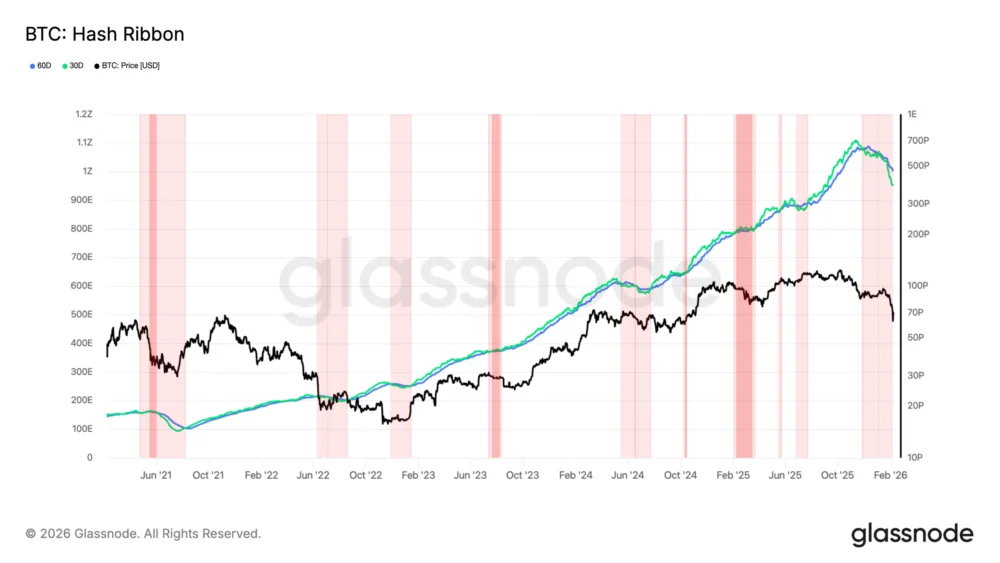
The Hash Ribbons indicator flashed a warning, signaling acute miner income stress, while long-term holders also showed signs of caution by reducing their BTC supply share.
BTC/USD daily price chart. Source: TradingView
The broader crypto market often takes cues from Bitcoin’s performance, and this latest slump has undoubtedly created a "stress test" for many balance sheets across the industry, as highlighted by related reports on the collapse of Bitcoin and Ether. The sudden shift from optimistic price targets and institutional inflows to a significant correction underscores the complex interplay of global macroeconomics, institutional trading strategies, and the evolving landscape of the cryptocurrency mining industry.
Hong Kong Hedge Funds Behind BTC Dump? The Leveraged Carry Trade Unwind
One of the most compelling theories posits that the recent Bitcoin crash may have originated from a substantial unwind of leveraged positions predominantly held by Hong Kong-based hedge funds. This narrative suggests that these funds engaged in a sophisticated "carry trade" strategy, capitalizing on the ultra-low interest rates in Japan. According to Parker White, COO and CIO of Nasdaq-listed DeFi Development Corp. (DFDV), these funds were placing substantial, leveraged bets on Bitcoin’s continued ascent.
The mechanism involved borrowing vast amounts of cheap Japanese yen, a common practice in global finance due to the Bank of Japan’s protracted ultra-loose monetary policy and yield curve control. This borrowed yen was then swapped into other major currencies, such as USD, and subsequently invested into riskier, high-yield assets, primarily cryptocurrencies like Bitcoin. Their exposure to Bitcoin was often through options linked to spot Bitcoin Exchange Traded Funds (ETFs), such as BlackRock’s IBIT, which provided a regulated and accessible avenue for institutional exposure. The expectation was that Bitcoin’s price would continue its upward trajectory, making the relatively small interest payments on the yen loans negligible compared to their potential crypto gains.
However, this highly leveraged strategy faced a dual blow. Firstly, Bitcoin’s upward momentum stalled, failing to meet the aggressive price appreciation anticipated by these funds. Secondly, and critically, the cost of borrowing Japanese yen began to increase. This shift in borrowing costs, coupled with a stagnant or declining Bitcoin price, meant that the carry trade became unprofitable and, worse, exposed these funds to significant losses.
Parker White highlighted the intensity of the selling pressure, noting on February 6, 2026:
This was the highest volume day on $IBIT, ever, by a factor of nearly 2x, trading $10.7B today. Additionally, roughly $900M in options premiums were traded today, also the highest ever for IBIT. Given these facts and the way $BTC and $SOL traded down in lockstep today (normally…
— Parker (@TheOtherParker_) February 6, 2026
When their leveraged bets started to sour, lenders, recognizing the increased risk, began to issue margin calls. This forced the Hong Kong hedge funds to sell off their Bitcoin holdings and other crypto assets rapidly to meet their obligations, creating a cascading effect. The sheer volume of these forced liquidations injected a massive amount of selling pressure into the market, exacerbating Bitcoin’s price drop and contributing significantly to the over $800 million in crypto liquidations seen across the market in a short period. This theory underscores how interconnected global financial markets are and how even seemingly isolated monetary policies can have profound impacts on the nascent crypto landscape.
Morgan Stanley Caused Bitcoin Selloff: Arthur Hayes’ Delta Hedging Theory
A second compelling theory, championed by former BitMEX CEO Arthur Hayes, points the finger at traditional financial institutions, specifically banks like Morgan Stanley. Hayes suggested that these financial giants might have been forced to sell Bitcoin (or related derivatives) to manage their exposure in complex financial products known as structured notes, which are tied to the performance of spot Bitcoin ETFs.
Source: X
Structured notes are bespoke financial instruments designed by banks for clients, offering exposure to underlying assets (like Bitcoin ETFs) often with specific features such as principal protection or barrier levels. For instance, a note might promise principal return if Bitcoin doesn’t drop below a certain threshold. To manage the risk associated with these notes, banks (acting as dealers) employ a strategy called "delta hedging." Delta hedging involves continuously adjusting their exposure to the underlying asset to offset the risk from the notes they’ve issued.
The problem arises when the underlying asset, in this case, Bitcoin, experiences a sharp and rapid decline. As Bitcoin’s price falls and breaches critical barrier levels – such as around $78,700, a significant threshold in one noted Morgan Stanley product – the delta hedging strategy reverses its typical behavior. Instead of buying to hedge, dealers are forced to sell the underlying BTC or Bitcoin futures to maintain a neutral position. This phenomenon is known as "negative gamma."
In a "negative gamma" environment, the more the price drops, the more the dealers are compelled to sell, creating a powerful feedback loop. What typically sees banks act as liquidity providers in the market transforms them into forced sellers, pushing prices down even further. Hayes’ theory highlights how the integration of Bitcoin into traditional finance through structured products and ETFs, while offering new avenues for investment, also introduces complex hedging dynamics that can amplify market downturns. The sheer size of these institutional positions means their hedging activities can significantly impact market liquidity and price action during periods of high volatility.
Miners Shifting from Bitcoin to AI: The "Mining Exodus" Theory
A less prominent but increasingly circulating theory suggests that a "mining exodus" may have contributed to Bitcoin’s recent downtrend. This theory posits that a significant number of Bitcoin miners are beginning to pivot their operations away from cryptocurrency mining towards the rapidly growing and often more profitable sector of artificial intelligence (AI) data centers.
The economics of Bitcoin mining are constantly evolving. Post-halving events and increasing network difficulty put immense pressure on miners’ profitability. When Bitcoin’s price stagnates or declines, coupled with high operational costs (primarily electricity), the margins for miners shrink dramatically. Simultaneously, the burgeoning demand for AI computational power has created a new, lucrative opportunity for data center infrastructure. These facilities require massive amounts of electricity and specialized hardware, resources that Bitcoin mining operations already possess.
On Saturday, analyst Judge Gibson, in a post on X, articulated this shift, stating that the growing AI data center demand is already forcing Bitcoin miners to pivot, leading to an estimated 10-40% drop in Bitcoin’s hash rate. The hash rate is a measure of the total computational power being used to process transactions and mine on the Bitcoin network. A decline in hash rate can signal that miners are shutting down operations or reallocating resources, potentially leading to increased selling pressure as they offload mined BTC to cover costs or fund new ventures.
Source: X
Concrete examples support this trend. In December 2025, Bitcoin mining giant Riot Platforms announced a strategic shift towards a broader data center strategy, concurrently selling a substantial $161 million worth of BTC. More recently, another significant miner, IREN, also publicly declared its pivot towards AI data centers. These moves by major players indicate a broader industry trend where miners are evaluating the long-term profitability of Bitcoin mining versus the immediate and potentially higher returns from servicing the AI industry.
Further validating concerns about miner stress, the Hash Ribbons indicator recently flashed a critical warning. This indicator, which tracks the 30-day and 60-day moving averages of the Bitcoin hash rate, showed a negative inversion – the 30-day average slipped below the 60-day. Historically, such an inversion signals acute financial stress among miners and often precedes periods of "miner capitulation," where miners are forced to sell their BTC holdings to cover operational costs or debt, thereby adding significant selling pressure to the market.
BTC Hash Riboon vs. price. Source: Glassnode
The financial viability of mining is a critical factor. As of Saturday, the estimated average electricity cost to mine a single Bitcoin was around $58,160, with the net production expenditure hovering at approximately $72,700.
BTC/USD daily chart vs. production and electrical cost. Source: Capriole Investments
These figures indicate that if Bitcoin’s price were to drop back below the $60,000 mark for an extended period, many miners would operate at a loss, pushing them towards severe financial stress and increasing the likelihood of further capitulation. The "mining exodus" theory suggests that this fundamental shift in miner incentives and economics is a significant underlying factor contributing to the current market weakness.
Broader Market Implications and Investor Sentiment
Beyond these specific theories, the sharp decline has also impacted broader market sentiment and the behavior of long-term holders. Data reveals that wallets holding between 10 and 10,000 BTC now control their smallest share of the total Bitcoin supply in nine months. This suggests that this cohort of significant holders has been actively trimming their exposure rather than accumulating, indicating a cautious stance or even a strategic de-risking in the face of uncertainty. Such behavior from traditionally strong hands can further dampen market confidence.
The combined effect of leveraged unwinds, institutional hedging strategies, and a potential shift in mining economics creates a complex and challenging environment for Bitcoin. While each theory offers a plausible explanation for the recent price action, it’s likely that a confluence of these factors, rather than a single catalyst, contributed to the magnitude of Bitcoin’s 40% monthly dip. The market remains on edge, with investors closely watching for signs of stabilization or further capitulation as these forces continue to play out. The path forward for Bitcoin will depend on how quickly these systemic pressures alleviate and whether new catalysts emerge to restore bullish momentum.
This article does not contain investment advice or recommendations. Every investment and trading move involves risk, and readers should conduct their own research when making a decision. While we strive to provide accurate and timely information, Cointelegraph does not guarantee the accuracy, completeness, or reliability of any information in this article. This article may contain forward-looking statements that are subject to risks and uncertainties. Cointelegraph will not be liable for any loss or damage arising from your reliance on this information.
Bybit Launches Yield Product For Tokenized Gold (XAUT)
Cryptocurrency exchange Bybit has launched a yield-bearing tokenized gold product that lets users earn interest on Tether Gold (XAUT), the latest entrant into a broader push to turn traditionally non-yielding…
Opera Proposes CELO Token Deal, Replacing Cash Payments With Crypto Stake
Opera, the venerable Nasdaq-listed web browser company known for its innovative features and early embrace of the internet, has unveiled a groundbreaking proposal to fundamentally alter its commercial relationship with…


 anjir abdul