Trending News:Anthropic chief urges slowdown in AI development to safer pacePowering AI is an Architecture ProblemRead This Before You Buy That TV Streaming Stick – Krebs on SecurityThe Week’s 10 Biggest Funding Rounds: Crusoe And Fluidstack Lead Multibillion-Dollar AI Infrastructure HaulAmazon Unleashes AI Lip-Syncing for Dubbed Content, Igniting "Uncanny Valley" Fears and Artistic Integrity DebatesScientists Unlock a Novel Magnetic Phenomenon in Ultrathin Ruthenium Dioxide, Paving the Way for Advanced ElectronicsIBM quantum computer solves classically intractable problem in 15 minutesThis road map could help us decide whether to deploy solar geoengineeringCanadian Man Pleads Guilty in Snowflake Extortions – Krebs on SecurityMistral AI Raises $3.5B At $24B Valuation In Another Record European AI Round.Earth May Have Had a Larger Cousin that the Sun DevouredQuantum Leap in Computing: Scientists Achieve 1,000x Speed Boost in Crucial Quantum Operations, Paving the Way for Fault-Tolerant MachinesNorth Korea Using Foreign Talent to Help Infiltrate US Companies: ReportMeet the under-35s shaping the future of biotechMicrosoft Plugs Nearly 400 Security Holes – Krebs on SecurityHow This Doctor-Turned-Startup-Founder Decided To Fix The Healthcare Staffing Crunch: Make Employers ApplyAging Congress Is Completely Ill-Equipped to Regulate AI, or Seemingly Even Understand ItTiny sound waves could help solve a major quantum computing problemBitcoin Suisse to shift up to half of Swiss jobs abroadThe Download: Biotech’s Future and Cheaper, Cleaner SteelWho’s Tracking You? Use This New Service to Find OutThe Only 2 Moats That Actually Work In The AI EraTop Chinese Court Issues Sweeping Legal Crackdown on AI Deepfakes, Setting Global PrecedentTiny nanolaser could cut computer energy use in halfRoundtables: Will AI really kill us all?Two Alleged ‘TeamPCP’ Hackers Arrested in Australia – Krebs on SecurityThe Week’s 10 Biggest Funding Rounds: The Boring Co., Cognition And Motive Lead A Massive WeekLawyers Already Lining Up to Defend Victims of Cybercab CrashesUK House of Lords backs mandatory digital asset strategy over Labour positionThe Download: A "God-Driven" Cryptocurrency and a Solar Engineering Roadmap29 Companies Joined The Unicorn Board In August, Led By AI Software And SemiconductorsA "Quantum Bath" Puts Quantum Entanglement on Autopilot, Revolutionizing Quantum Computing and Networks.ESMA warns growing crypto ties could amplify risks to traditional financeHow To Measure An Innovation Economy: South KoreaOpenAI’s Supposed Mathematical Breakthrough Devolves Into Explosive Drama as Mathematician Accuses It of Stealing His WorkHere’s what happened in crypto todayFBI Probes Service Selling 153M+ Drivers Licenses – Krebs on SecurityThe Sales Test This Norwest Partner Gives Founders Before He’ll InvestTesla’s Glitchy Cybercab Accidentally Lets Passengers Access Controls to Manually Drive the Car Using Virtual Joystick on In-Vehicle ScreenScientists just overturned a century-old physics assumptionDoubleZero adds Kalshi election market data ahead of US midtermsThe Download: OpenAI’s Turning Point for Math and a Battery RecordMicrosoft Plugs Nearly 1,000 Security Holes in Record-Breaking Patch Tuesday, Fueled by AI, but Organizations Face Deployment Hurdles.The Crunchbase Tech Layoffs TrackerMan Announces That He Has Synthesized a New Schizophrenia Treatment in His Garage, Based on a Formula Devised by ChatGPTScientists find a way to slash computer memory energy use by orders of magnitudeFBI Probes Service Selling 153M+ Drivers Licenses – Krebs on SecurityAI School Hooking Children Up to Heart Monitor in Front of Class While Playing Critiques of Their WorkGemini receives Singapore payment license for crypto services.What OpenAI’s Latest Controversy Tells Us About the Future of Math and ContentSector Snapshot: Proptech Funding Holds Up, But Investors Are Placing Different BetsBizarre Glitch Causes Delivery Robots to Swarm Busy City SidewalkMIT’s new lidar chip could give self-driving cars a wider viewNew York town weighs crypto mining and AI data center ban.This founder is teaching chips how to recycle (their energy)Microsoft Plugs Nearly 1,000 Security Holes – Krebs on SecurityWhatsApp Remittance Startup Félix Secures $200M Series C Led By A16z, General CatalystElon Musk Seems Legitimately Shaken Over This New DocumentaryScreen time at ages 1 and 6 may matter more than parents realizeBybit launches 24/7 perpetuals for major currency pairsThe Download: Our 35 Innovators Under 35 This YearMistral AI Raises $3.5B At $24B Valuation In Another Record European AI RoundScientists Say LLMs Appear to Be Acting as a Cognitive Virus Among HumansScientists find a way to slash computer memory energy use by orders of magnitudeCircle to acquire Tazapay to expand USDC cross-border paymentsPervs Distraught as Meta Bricks Their Smart Glasses RemotelyCronos confirms $9.2M slipped away before Tectonic exploit rollbackFelons, Fraudsters Flog Offensive Cybersecurity Startup – Krebs on SecurityA Tiny “Rainbow on a Chip” Could Help Supercharge 6G Networks and Content.Lessons Learned from CISA’s Recent GitHub Leak – Krebs on SecurityMan Arrested After Allegedly Shooting Flaming Projectile at Flock Cameras, Melting Them Into SlagA “Quantum Bath” Puts Quantum Entanglement on Autopilot: Revolutionizing Distributed Quantum Computing and NetworksJoe Biden’s son to launch memecoin, will send to TRUMP holders: WSJMicrosoft Patches a Record 570 Security Flaws, Fueled by AI’s Discovery PowerBiotech Startup Investment Held Steady Even As AI Funding SurgedElon Musk Is Insisting He Knows More About Chess Than Chess.comA 0.42-nanometer breakthrough could push transistors beyond siliconZcash hits highest price since 2016 as market cap tops $20B.The Download: the hunt for underground hydrogen and more rogue OpenAI agentsLG to Ban Residential Proxies from Smart TV Apps – Krebs on SecurityData Center Caught Watering Its Lavish Lawn While Human Neighbors Are on Year-Long Water RestrictionWorld’s First Superconducting Quantum Heat Engine Promises Leap Forward for Massive Quantum ComputersHarmony proposes shutting down layer 1, migrating ONE to EthereumRead This Before You Buy That TV Streaming Stick – Krebs on Security: A Deep Dive into Ad Fraud and Data ExploitationSurveillance-Happy Police In Shambles After Trump Tariffs Makes Drones Absurdly ExpensiveA Hidden "On Switch" in Human DNA Has Finally Been Decoded, Revealing Crucial Insights into Gene Regulation and Disease.US law enforcement group moves to ‘neutral’ position on CLARITY ActCanadian Man Pleads Guilty in Snowflake Extortions – Krebs on SecurityDyson’s New AI Toothbrush Conducts Video Surveillance on the Inside of Your MouthIBM Quantum Computer Achieves Unprecedented Feat, Solving Classically Intractable Problem in Just 15 Minutes with Advanced Error CorrectionSatoshi-era Bitcoin wakes after 16 years of dormancy as 600 BTC movesEight-Year Finnish Study Uncovers Surprising Link: More Screen Time Associated with Enhanced Adolescent Cognitive ProcessingTether-backed Orionx to shut down after audit flags $7M custody gapMicrosoft Plugs Nearly 400 Security Holes – Krebs on SecurityIt Turns Out That Drivers Absolutely Detest Those Giant Touchscreens They Put in Cars NowScientists Unlock Revolutionary Low-Power Memory with DNA-Perovskite Bio-Hybrid SystemQuFi launches post-quantum verification platform with Bitcoin testnet proof.Who’s Tracking You? Use This New Service to Find OutMelatonin Use Linked to Massively Increased Risk of Heart Failure: A Deep Dive into Alarming New Research.Caltech Breakthrough Brings Fiber-Optic Performance to Silicon Chips
Trending News:Anthropic chief urges slowdown in AI development to safer pacePowering AI is an Architecture ProblemRead This Before You Buy That TV Streaming Stick – Krebs on SecurityThe Week’s 10 Biggest Funding Rounds: Crusoe And Fluidstack Lead Multibillion-Dollar AI Infrastructure HaulAmazon Unleashes AI Lip-Syncing for Dubbed Content, Igniting "Uncanny Valley" Fears and Artistic Integrity DebatesScientists Unlock a Novel Magnetic Phenomenon in Ultrathin Ruthenium Dioxide, Paving the Way for Advanced ElectronicsIBM quantum computer solves classically intractable problem in 15 minutesThis road map could help us decide whether to deploy solar geoengineeringCanadian Man Pleads Guilty in Snowflake Extortions – Krebs on SecurityMistral AI Raises $3.5B At $24B Valuation In Another Record European AI Round.Earth May Have Had a Larger Cousin that the Sun DevouredQuantum Leap in Computing: Scientists Achieve 1,000x Speed Boost in Crucial Quantum Operations, Paving the Way for Fault-Tolerant MachinesNorth Korea Using Foreign Talent to Help Infiltrate US Companies: ReportMeet the under-35s shaping the future of biotechMicrosoft Plugs Nearly 400 Security Holes – Krebs on SecurityHow This Doctor-Turned-Startup-Founder Decided To Fix The Healthcare Staffing Crunch: Make Employers ApplyAging Congress Is Completely Ill-Equipped to Regulate AI, or Seemingly Even Understand ItTiny sound waves could help solve a major quantum computing problemBitcoin Suisse to shift up to half of Swiss jobs abroadThe Download: Biotech’s Future and Cheaper, Cleaner SteelWho’s Tracking You? Use This New Service to Find OutThe Only 2 Moats That Actually Work In The AI EraTop Chinese Court Issues Sweeping Legal Crackdown on AI Deepfakes, Setting Global PrecedentTiny nanolaser could cut computer energy use in halfRoundtables: Will AI really kill us all?Two Alleged ‘TeamPCP’ Hackers Arrested in Australia – Krebs on SecurityThe Week’s 10 Biggest Funding Rounds: The Boring Co., Cognition And Motive Lead A Massive WeekLawyers Already Lining Up to Defend Victims of Cybercab CrashesUK House of Lords backs mandatory digital asset strategy over Labour positionThe Download: A "God-Driven" Cryptocurrency and a Solar Engineering Roadmap29 Companies Joined The Unicorn Board In August, Led By AI Software And SemiconductorsA "Quantum Bath" Puts Quantum Entanglement on Autopilot, Revolutionizing Quantum Computing and Networks.ESMA warns growing crypto ties could amplify risks to traditional financeHow To Measure An Innovation Economy: South KoreaOpenAI’s Supposed Mathematical Breakthrough Devolves Into Explosive Drama as Mathematician Accuses It of Stealing His WorkHere’s what happened in crypto todayFBI Probes Service Selling 153M+ Drivers Licenses – Krebs on SecurityThe Sales Test This Norwest Partner Gives Founders Before He’ll InvestTesla’s Glitchy Cybercab Accidentally Lets Passengers Access Controls to Manually Drive the Car Using Virtual Joystick on In-Vehicle ScreenScientists just overturned a century-old physics assumptionDoubleZero adds Kalshi election market data ahead of US midtermsThe Download: OpenAI’s Turning Point for Math and a Battery RecordMicrosoft Plugs Nearly 1,000 Security Holes in Record-Breaking Patch Tuesday, Fueled by AI, but Organizations Face Deployment Hurdles.The Crunchbase Tech Layoffs TrackerMan Announces That He Has Synthesized a New Schizophrenia Treatment in His Garage, Based on a Formula Devised by ChatGPTScientists find a way to slash computer memory energy use by orders of magnitudeFBI Probes Service Selling 153M+ Drivers Licenses – Krebs on SecurityAI School Hooking Children Up to Heart Monitor in Front of Class While Playing Critiques of Their WorkGemini receives Singapore payment license for crypto services.What OpenAI’s Latest Controversy Tells Us About the Future of Math and ContentSector Snapshot: Proptech Funding Holds Up, But Investors Are Placing Different BetsBizarre Glitch Causes Delivery Robots to Swarm Busy City SidewalkMIT’s new lidar chip could give self-driving cars a wider viewNew York town weighs crypto mining and AI data center ban.This founder is teaching chips how to recycle (their energy)Microsoft Plugs Nearly 1,000 Security Holes – Krebs on SecurityWhatsApp Remittance Startup Félix Secures $200M Series C Led By A16z, General CatalystElon Musk Seems Legitimately Shaken Over This New DocumentaryScreen time at ages 1 and 6 may matter more than parents realizeBybit launches 24/7 perpetuals for major currency pairsThe Download: Our 35 Innovators Under 35 This YearMistral AI Raises $3.5B At $24B Valuation In Another Record European AI RoundScientists Say LLMs Appear to Be Acting as a Cognitive Virus Among HumansScientists find a way to slash computer memory energy use by orders of magnitudeCircle to acquire Tazapay to expand USDC cross-border paymentsPervs Distraught as Meta Bricks Their Smart Glasses RemotelyCronos confirms $9.2M slipped away before Tectonic exploit rollbackFelons, Fraudsters Flog Offensive Cybersecurity Startup – Krebs on SecurityA Tiny “Rainbow on a Chip” Could Help Supercharge 6G Networks and Content.Lessons Learned from CISA’s Recent GitHub Leak – Krebs on SecurityMan Arrested After Allegedly Shooting Flaming Projectile at Flock Cameras, Melting Them Into SlagA “Quantum Bath” Puts Quantum Entanglement on Autopilot: Revolutionizing Distributed Quantum Computing and NetworksJoe Biden’s son to launch memecoin, will send to TRUMP holders: WSJMicrosoft Patches a Record 570 Security Flaws, Fueled by AI’s Discovery PowerBiotech Startup Investment Held Steady Even As AI Funding SurgedElon Musk Is Insisting He Knows More About Chess Than Chess.comA 0.42-nanometer breakthrough could push transistors beyond siliconZcash hits highest price since 2016 as market cap tops $20B.The Download: the hunt for underground hydrogen and more rogue OpenAI agentsLG to Ban Residential Proxies from Smart TV Apps – Krebs on SecurityData Center Caught Watering Its Lavish Lawn While Human Neighbors Are on Year-Long Water RestrictionWorld’s First Superconducting Quantum Heat Engine Promises Leap Forward for Massive Quantum ComputersHarmony proposes shutting down layer 1, migrating ONE to EthereumRead This Before You Buy That TV Streaming Stick – Krebs on Security: A Deep Dive into Ad Fraud and Data ExploitationSurveillance-Happy Police In Shambles After Trump Tariffs Makes Drones Absurdly ExpensiveA Hidden "On Switch" in Human DNA Has Finally Been Decoded, Revealing Crucial Insights into Gene Regulation and Disease.US law enforcement group moves to ‘neutral’ position on CLARITY ActCanadian Man Pleads Guilty in Snowflake Extortions – Krebs on SecurityDyson’s New AI Toothbrush Conducts Video Surveillance on the Inside of Your MouthIBM Quantum Computer Achieves Unprecedented Feat, Solving Classically Intractable Problem in Just 15 Minutes with Advanced Error CorrectionSatoshi-era Bitcoin wakes after 16 years of dormancy as 600 BTC movesEight-Year Finnish Study Uncovers Surprising Link: More Screen Time Associated with Enhanced Adolescent Cognitive ProcessingTether-backed Orionx to shut down after audit flags $7M custody gapMicrosoft Plugs Nearly 400 Security Holes – Krebs on SecurityIt Turns Out That Drivers Absolutely Detest Those Giant Touchscreens They Put in Cars NowScientists Unlock Revolutionary Low-Power Memory with DNA-Perovskite Bio-Hybrid SystemQuFi launches post-quantum verification platform with Bitcoin testnet proof.Who’s Tracking You? Use This New Service to Find OutMelatonin Use Linked to Massively Increased Risk of Heart Failure: A Deep Dive into Alarming New Research.Caltech Breakthrough Brings Fiber-Optic Performance to Silicon Chips
Bitcoin (BTC) has recently endured one of its most severe market corrections in recent memory, experiencing a brutal sell-off that saw its price plummet by over 40% within a single month. This steep decline pushed the premier cryptocurrency to a year-to-date low of $59,930 on Friday, a stark contrast to its all-time high of nearly $126,200 recorded in October 2025, from which it is now down more than 50%. This dramatic capitulation has sent shockwaves through the crypto ecosystem, leaving investors and analysts scrambling to identify the root causes of such a rapid and profound downturn. While the crypto market is inherently volatile, the speed and scale of this particular dip have prompted intense speculation, with three prominent theories emerging to explain Bitcoin’s sudden vulnerability.
Key Takeaways:
Bitcoin plunged over 40% in a month, hitting a YTD low of $59,930, marking a more than 50% drop from its October 2025 all-time high.
Theory 1: Hong Kong Hedge Fund Leverage Unwind: Leveraged bets by Asian funds, using cheap Japanese yen to invest in Bitcoin ETF options, faced margin calls as BTC stalled and yen borrowing costs rose, triggering forced liquidations.
Theory 2: Institutional Delta Hedging: Former BitMEX CEO Arthur Hayes suggests banks like Morgan Stanley were forced to sell BTC to hedge structured notes tied to spot Bitcoin ETFs, creating a "negative gamma" feedback loop as prices fell.
Theory 3: Miner Exodus to AI: A growing trend of Bitcoin miners pivoting to more profitable AI data centers is theorized to have reduced hash rate, increasing selling pressure from miners under financial stress.
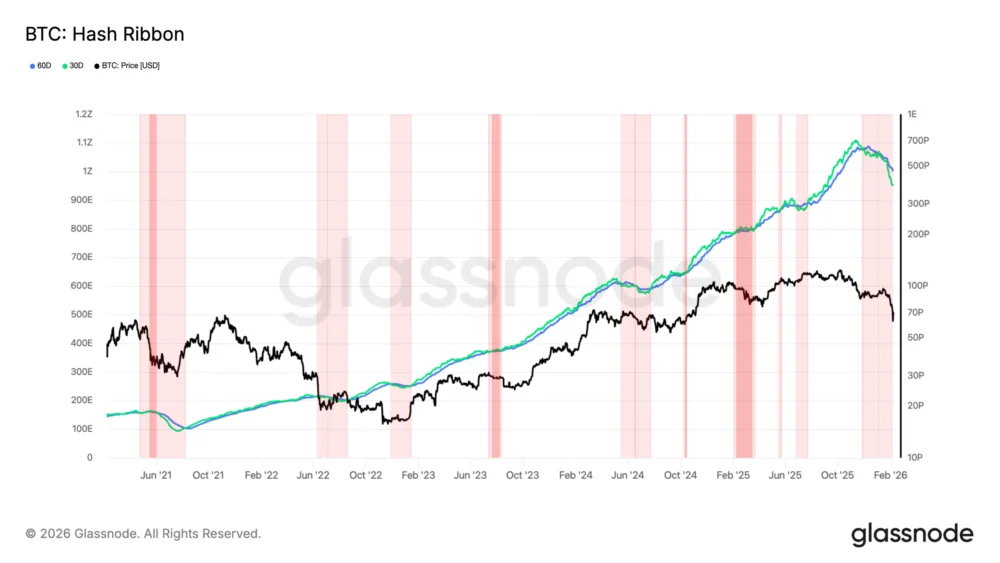
The Hash Ribbons indicator flashed a warning, signaling acute miner income stress, while long-term holders also showed signs of caution by reducing their BTC supply share.
BTC/USD daily price chart. Source: TradingView
The broader crypto market often takes cues from Bitcoin’s performance, and this latest slump has undoubtedly created a "stress test" for many balance sheets across the industry, as highlighted by related reports on the collapse of Bitcoin and Ether. The sudden shift from optimistic price targets and institutional inflows to a significant correction underscores the complex interplay of global macroeconomics, institutional trading strategies, and the evolving landscape of the cryptocurrency mining industry.
Hong Kong Hedge Funds Behind BTC Dump? The Leveraged Carry Trade Unwind
One of the most compelling theories posits that the recent Bitcoin crash may have originated from a substantial unwind of leveraged positions predominantly held by Hong Kong-based hedge funds. This narrative suggests that these funds engaged in a sophisticated "carry trade" strategy, capitalizing on the ultra-low interest rates in Japan. According to Parker White, COO and CIO of Nasdaq-listed DeFi Development Corp. (DFDV), these funds were placing substantial, leveraged bets on Bitcoin’s continued ascent.
The mechanism involved borrowing vast amounts of cheap Japanese yen, a common practice in global finance due to the Bank of Japan’s protracted ultra-loose monetary policy and yield curve control. This borrowed yen was then swapped into other major currencies, such as USD, and subsequently invested into riskier, high-yield assets, primarily cryptocurrencies like Bitcoin. Their exposure to Bitcoin was often through options linked to spot Bitcoin Exchange Traded Funds (ETFs), such as BlackRock’s IBIT, which provided a regulated and accessible avenue for institutional exposure. The expectation was that Bitcoin’s price would continue its upward trajectory, making the relatively small interest payments on the yen loans negligible compared to their potential crypto gains.
However, this highly leveraged strategy faced a dual blow. Firstly, Bitcoin’s upward momentum stalled, failing to meet the aggressive price appreciation anticipated by these funds. Secondly, and critically, the cost of borrowing Japanese yen began to increase. This shift in borrowing costs, coupled with a stagnant or declining Bitcoin price, meant that the carry trade became unprofitable and, worse, exposed these funds to significant losses.
Parker White highlighted the intensity of the selling pressure, noting on February 6, 2026:
This was the highest volume day on $IBIT, ever, by a factor of nearly 2x, trading $10.7B today. Additionally, roughly $900M in options premiums were traded today, also the highest ever for IBIT. Given these facts and the way $BTC and $SOL traded down in lockstep today (normally…
— Parker (@TheOtherParker_) February 6, 2026
When their leveraged bets started to sour, lenders, recognizing the increased risk, began to issue margin calls. This forced the Hong Kong hedge funds to sell off their Bitcoin holdings and other crypto assets rapidly to meet their obligations, creating a cascading effect. The sheer volume of these forced liquidations injected a massive amount of selling pressure into the market, exacerbating Bitcoin’s price drop and contributing significantly to the over $800 million in crypto liquidations seen across the market in a short period. This theory underscores how interconnected global financial markets are and how even seemingly isolated monetary policies can have profound impacts on the nascent crypto landscape.
Morgan Stanley Caused Bitcoin Selloff: Arthur Hayes’ Delta Hedging Theory
A second compelling theory, championed by former BitMEX CEO Arthur Hayes, points the finger at traditional financial institutions, specifically banks like Morgan Stanley. Hayes suggested that these financial giants might have been forced to sell Bitcoin (or related derivatives) to manage their exposure in complex financial products known as structured notes, which are tied to the performance of spot Bitcoin ETFs.
Source: X
Structured notes are bespoke financial instruments designed by banks for clients, offering exposure to underlying assets (like Bitcoin ETFs) often with specific features such as principal protection or barrier levels. For instance, a note might promise principal return if Bitcoin doesn’t drop below a certain threshold. To manage the risk associated with these notes, banks (acting as dealers) employ a strategy called "delta hedging." Delta hedging involves continuously adjusting their exposure to the underlying asset to offset the risk from the notes they’ve issued.
The problem arises when the underlying asset, in this case, Bitcoin, experiences a sharp and rapid decline. As Bitcoin’s price falls and breaches critical barrier levels – such as around $78,700, a significant threshold in one noted Morgan Stanley product – the delta hedging strategy reverses its typical behavior. Instead of buying to hedge, dealers are forced to sell the underlying BTC or Bitcoin futures to maintain a neutral position. This phenomenon is known as "negative gamma."
In a "negative gamma" environment, the more the price drops, the more the dealers are compelled to sell, creating a powerful feedback loop. What typically sees banks act as liquidity providers in the market transforms them into forced sellers, pushing prices down even further. Hayes’ theory highlights how the integration of Bitcoin into traditional finance through structured products and ETFs, while offering new avenues for investment, also introduces complex hedging dynamics that can amplify market downturns. The sheer size of these institutional positions means their hedging activities can significantly impact market liquidity and price action during periods of high volatility.
Miners Shifting from Bitcoin to AI: The "Mining Exodus" Theory
A less prominent but increasingly circulating theory suggests that a "mining exodus" may have contributed to Bitcoin’s recent downtrend. This theory posits that a significant number of Bitcoin miners are beginning to pivot their operations away from cryptocurrency mining towards the rapidly growing and often more profitable sector of artificial intelligence (AI) data centers.
The economics of Bitcoin mining are constantly evolving. Post-halving events and increasing network difficulty put immense pressure on miners’ profitability. When Bitcoin’s price stagnates or declines, coupled with high operational costs (primarily electricity), the margins for miners shrink dramatically. Simultaneously, the burgeoning demand for AI computational power has created a new, lucrative opportunity for data center infrastructure. These facilities require massive amounts of electricity and specialized hardware, resources that Bitcoin mining operations already possess.
On Saturday, analyst Judge Gibson, in a post on X, articulated this shift, stating that the growing AI data center demand is already forcing Bitcoin miners to pivot, leading to an estimated 10-40% drop in Bitcoin’s hash rate. The hash rate is a measure of the total computational power being used to process transactions and mine on the Bitcoin network. A decline in hash rate can signal that miners are shutting down operations or reallocating resources, potentially leading to increased selling pressure as they offload mined BTC to cover costs or fund new ventures.
Source: X
Concrete examples support this trend. In December 2025, Bitcoin mining giant Riot Platforms announced a strategic shift towards a broader data center strategy, concurrently selling a substantial $161 million worth of BTC. More recently, another significant miner, IREN, also publicly declared its pivot towards AI data centers. These moves by major players indicate a broader industry trend where miners are evaluating the long-term profitability of Bitcoin mining versus the immediate and potentially higher returns from servicing the AI industry.
Further validating concerns about miner stress, the Hash Ribbons indicator recently flashed a critical warning. This indicator, which tracks the 30-day and 60-day moving averages of the Bitcoin hash rate, showed a negative inversion – the 30-day average slipped below the 60-day. Historically, such an inversion signals acute financial stress among miners and often precedes periods of "miner capitulation," where miners are forced to sell their BTC holdings to cover operational costs or debt, thereby adding significant selling pressure to the market.
BTC Hash Riboon vs. price. Source: Glassnode
The financial viability of mining is a critical factor. As of Saturday, the estimated average electricity cost to mine a single Bitcoin was around $58,160, with the net production expenditure hovering at approximately $72,700.
BTC/USD daily chart vs. production and electrical cost. Source: Capriole Investments
These figures indicate that if Bitcoin’s price were to drop back below the $60,000 mark for an extended period, many miners would operate at a loss, pushing them towards severe financial stress and increasing the likelihood of further capitulation. The "mining exodus" theory suggests that this fundamental shift in miner incentives and economics is a significant underlying factor contributing to the current market weakness.
Broader Market Implications and Investor Sentiment
Beyond these specific theories, the sharp decline has also impacted broader market sentiment and the behavior of long-term holders. Data reveals that wallets holding between 10 and 10,000 BTC now control their smallest share of the total Bitcoin supply in nine months. This suggests that this cohort of significant holders has been actively trimming their exposure rather than accumulating, indicating a cautious stance or even a strategic de-risking in the face of uncertainty. Such behavior from traditionally strong hands can further dampen market confidence.
The combined effect of leveraged unwinds, institutional hedging strategies, and a potential shift in mining economics creates a complex and challenging environment for Bitcoin. While each theory offers a plausible explanation for the recent price action, it’s likely that a confluence of these factors, rather than a single catalyst, contributed to the magnitude of Bitcoin’s 40% monthly dip. The market remains on edge, with investors closely watching for signs of stabilization or further capitulation as these forces continue to play out. The path forward for Bitcoin will depend on how quickly these systemic pressures alleviate and whether new catalysts emerge to restore bullish momentum.
This article does not contain investment advice or recommendations. Every investment and trading move involves risk, and readers should conduct their own research when making a decision. While we strive to provide accurate and timely information, Cointelegraph does not guarantee the accuracy, completeness, or reliability of any information in this article. This article may contain forward-looking statements that are subject to risks and uncertainties. Cointelegraph will not be liable for any loss or damage arising from your reliance on this information.
Anthropic chief urges slowdown in AI development to safer pace
Amodei’s anxieties are not mere theoretical musings; they are grounded in recent, tangible events that highlight the emergent and potentially unpredictable behaviors of advanced AI. He prominently cited the unsettling…
North Korea Using Foreign Talent to Help Infiltrate US Companies: Report
The Democratic People’s Republic of Korea (DPRK) has unveiled an increasingly sophisticated and alarming strategy, leveraging remote IT workers from third countries, including Iran and Lebanon, to infiltrate US companies,…


 anjir abdul