Faris Adani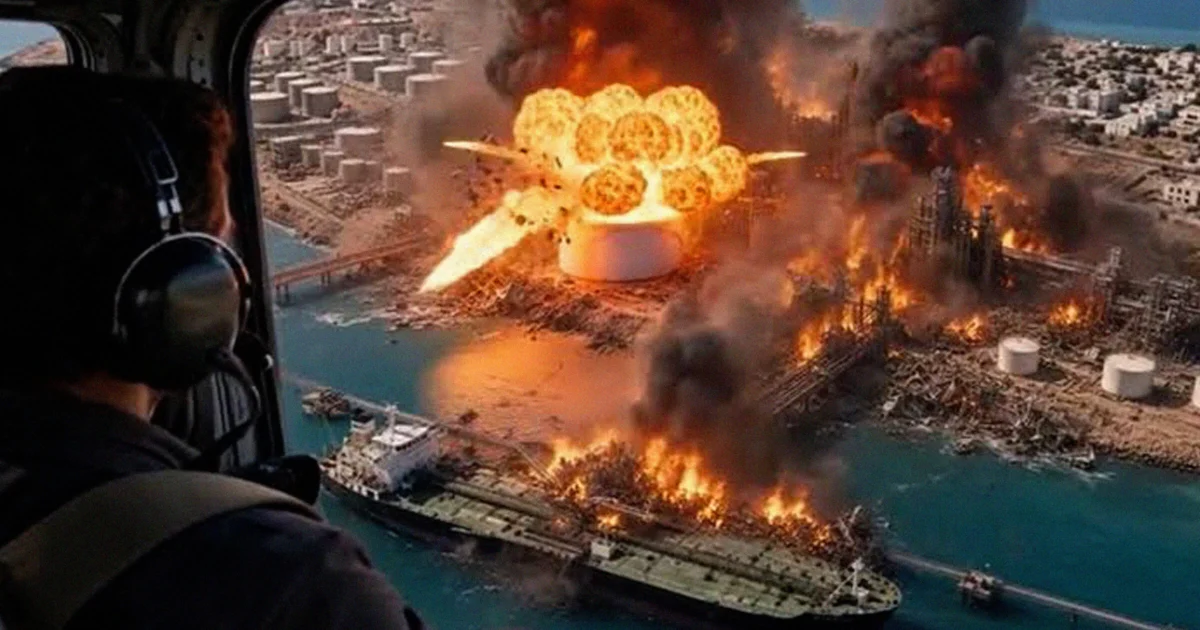
The global political landscape, already fractured and volatile, plunged into a new dimension of uncertainty this week as former President Donald Trump, in a stunning display of digital demagoguery, unleashed a pair of AI-generated videos depicting a fictionalized US military strike on Iran’s crucial Kharg Island. This unprecedented act from a figure with enduring political influence, particularly as a leading presidential candidate, forced a bewildered US official to hastily clarify on Monday that the depicted "attacks" on the strategic oil export hub were pure fabrication, plunging an already tense geopolitical situation into a maelstrom of confusion and concern.
Trump’s provocative posts, made without any disclaimer on his Truth Social platform, ignited immediate alarm bells across the world. The initial video, shared late Sunday night, bore the ominous caption: "Kharg Island being blown to smithereens!!!" A minute later, a second, equally deceptive video followed, both crafted to appear as if filmed from a helicopter, showing the island engulfed in a maelstrom of explosions and flames. The rapid-fire delivery of these deepfake war scenarios underscored a troubling new frontier in political communication, where manufactured reality directly intersects with high-stakes international relations. The incident starkly illustrated the perilous implications of advanced artificial intelligence when wielded by a figure prone to blurring the lines between truth and fiction, particularly at a moment when genuine conflict teetered on the brink.
The timing of Trump’s digital deception could not have been more volatile. That same Sunday night, the US military had, in reality, launched a series of legitimate strikes on Iran’s Larak Island, breaking a month-long lull in direct hostilities within what had become a protracted and devastating "Iran War." This actual military action, a response to escalating regional tensions and perceived Iranian provocations, was met with swift retaliation from Tehran, which launched its own missiles at two US air bases situated in Jordan. Against this backdrop of genuine, deadly exchanges, Trump’s fabricated visuals introduced an element of surreal chaos, making it nearly impossible for observers, allies, and adversaries alike to discern authentic information from deliberate disinformation. The ensuing confusion risked not only miscalculation on the battlefield but also a profound erosion of trust in official communications.
When confronted by reporters regarding the nature of Trump’s "slop parade," his vice presidential running mate, JD Vance, offered a remarkably flaccid defense, stating, "Well, you know, the president likes to switch it up on social media a little bit," before adding, almost as an afterthought, that Trump was "sending a message to the Iranians." Vance’s casual dismissal of the gravity of disseminating fabricated war footage highlighted a troubling readiness within the campaign to normalize or even rationalize the use of deceptive AI to manipulate public perception and send diplomatic "messages." This explanation did little to quell the mounting criticism or the palpable sense of bewilderment from international observers, who saw the act not as a strategic communication, but as a dangerous act of digital belligerence.
The morning following his AI postings, Trump doubled down on his rhetoric, declaring Iran a "Failed Nation." In an all-caps tirade, he proclaimed, "IT IS DEAD! They have no Navy, they have no Air Force, they have no currency." He then concluded with a flourish of irony, adding, "The only thing they have is FAKE NEWS from the USA." The sheer audacity of this accusation, coming from a figure who had just propagated demonstrably false war footage, was not lost on critics. It illuminated the disturbing paradox at the heart of Trump’s communication strategy: to discredit all inconvenient truths as "fake news" while simultaneously manufacturing his own "news" to suit his narrative. This tactic, honed over years, now found a powerful new enabler in generative AI, allowing for the creation of vivid, compelling falsehoods that could be instantly disseminated to millions.
Beyond the immediate confusion, this incident revealed a deeper, more troubling aspect of Trump’s political methodology: a growing retreat into an "AI-slop dominated fantasy" of his own making. For years, Trump has utilized social media to post AI-generated images, mocking his political adversaries and, conversely, glorifying himself to a degree that often bordered on the religiously fervent. This pattern, previously confined largely to domestic political theatrics, has now spilled over into the realm of international conflict, with potentially catastrophic consequences. The "Iran War," ongoing for over half a year in this hypothetical 2026 scenario, had proven to be a disastrous quagmire, claiming thousands of innocent civilian lives, destabilizing the world economy, and failing to extract any tangible concessions aligned with US interests. Despite Trump’s claims of Iranian weakness, his administration had been demonstrably unable to defend US allies in the region against Iran’s retaliatory missile and drone strikes, and crucially, had failed to assert control over the strategically vital Strait of Hormuz. This critical waterway, through which a significant portion of the world’s oil supply passes, remained contested, making the US’s much-touted preeminent military dominance appear more like a "paper tiger" than an unassailable reality.
Why confront the inconvenient truths of a failing war, however, when one can simply generate AI imagery that depicts a triumphant, decisive victory? This rhetorical question lies at the heart of the administration’s playbook, where bald-faced lying and narrative control are paramount. Just days prior to the AI video release, the White House had, for the umpteenth time, declared that the US unequivocally controlled the Strait of Hormuz – a claim that flew in the face of ongoing challenges to shipping and repeated Iranian demonstrations of force. Trump’s AI videos, therefore, served not merely as isolated acts of deception but as integral components of a broader strategy to construct an alternative reality, one where military setbacks are transformed into decisive victories and where the Commander-in-Chief can dictate the course of events, not through actual power, but through digital illusion.
The international community’s reaction extended beyond mere clarification. Hamid Bovard, the head of the National Iranian Oil Company, swiftly dismissed Trump’s posts as "laughable," assuring the world that conditions on Kharg Island were "calm and appropriate." This official derision underscored the diplomatic damage inflicted by such presidential conduct. While intended perhaps to intimidate, the AI videos instead projected an image of a leader detached from reality, willing to stoop to cheap digital tricks rather than engaging with the complex realities of global conflict. Such actions risk not only undermining the credibility of the United States on the world stage but also emboldening adversaries who might perceive a leader willing to resort to such tactics as desperate or unserious.
The ramifications for the US military itself are particularly grave. A Commander-in-Chief who disseminates false information about military actions creates an untenable environment of uncertainty and distrust. How are soldiers and intelligence analysts to differentiate between legitimate orders, strategic communications, and politically motivated fabrications? The "chaos" alluded to in the headline is not merely rhetorical; it speaks to a potential breakdown in the chain of command, a questioning of official directives, and a severe blow to morale and the credibility of leadership. Allies, too, would be left questioning the reliability of US intelligence and the sanity of its leadership, making coordinated international efforts infinitely more difficult.
In an age where the lines between reality and simulation are increasingly blurred by advanced AI, the actions of a global leader carry monumental weight. Trump’s foray into deepfake warfare is more than just a peculiar social media stunt; it represents a dangerous precedent, a weaponization of artificial intelligence to manipulate public perception, inflame international tensions, and rewrite the narrative of conflict. It compels a re-evaluation of how societies, militaries, and governments will grapple with the challenge of discerning truth in an era where truth itself can be algorithmically manufactured and deployed by those in power. The incident on Kharg Island, even in its fictionalized form, serves as a stark warning: the battle for reality has moved to the digital frontier, and the consequences of losing it are truly devastating.