anjir abdul
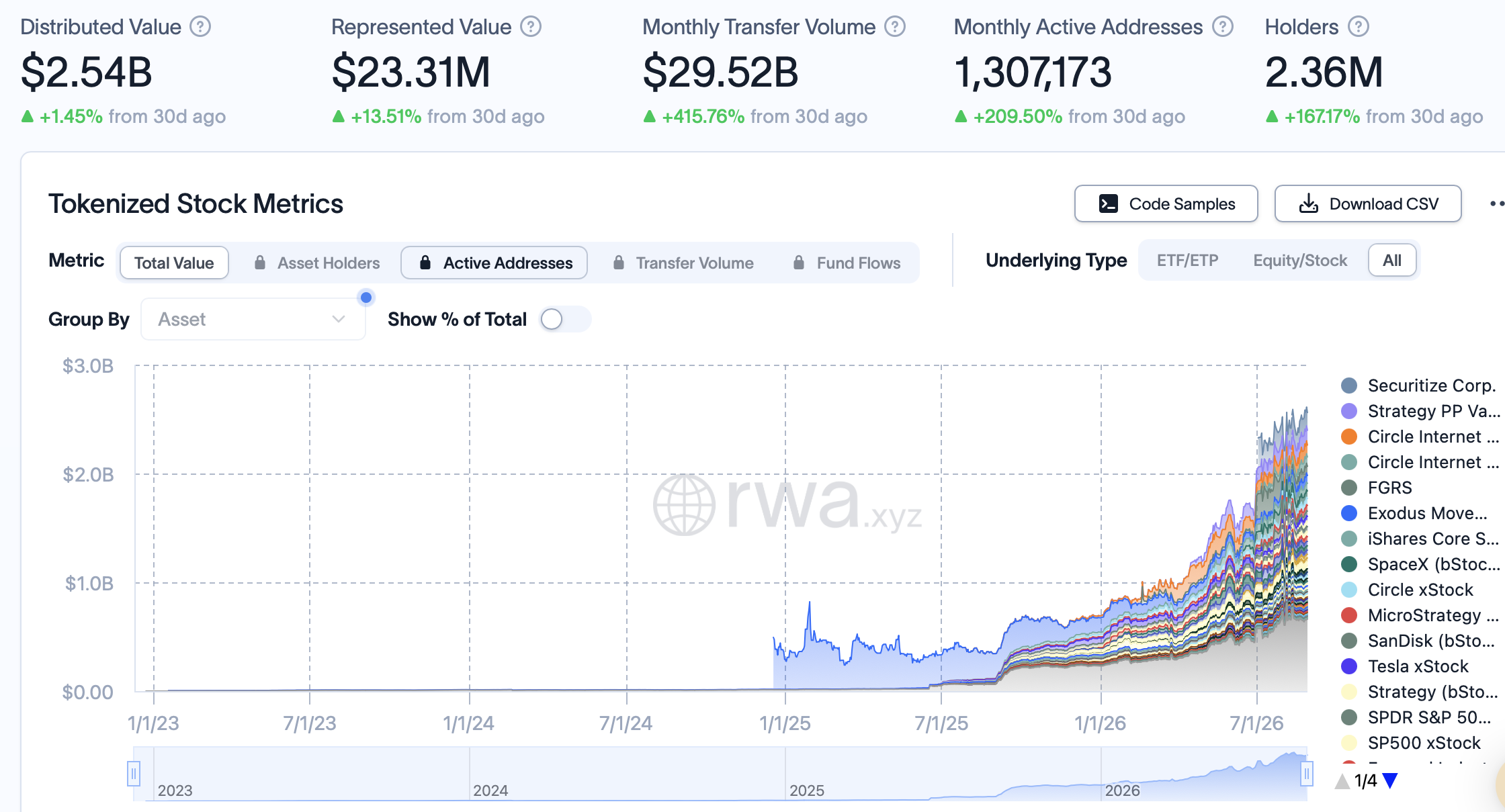
The landscape of financial markets is undergoing a profound transformation, spearheaded by the burgeoning sector of tokenized securities. Over the past 30 days, tokenized stock activity has witnessed an unprecedented acceleration, with monthly transfer volume soaring by more than 415% to an impressive $29.5 billion, according to comprehensive data compiled by RWA.xyz. This explosive growth is not merely a fleeting trend but a clear indicator of increasing investor confidence, technological maturity, and the expanding utility of blockchain-based financial instruments.
This remarkable surge in transfer volume is complemented by equally compelling growth across other key metrics. The number of monthly active addresses engaging with tokenized stocks more than doubled, rising by over 209% to approximately 1.3 million. This substantial increase in active participants highlights a broadening user base and heightened engagement within the ecosystem. Concurrently, the total number of tokenized stock holders climbed by a robust 167%, reaching 2.36 million over the same period. These figures collectively paint a picture of a rapidly expanding market, attracting a diverse range of investors from seasoned institutions to individual retail participants. The democratization of access to global equities, facilitated by tokenization, is clearly a major driving force behind this expansion.
Beyond mere trading activity, the underlying value of these digital assets has also seen significant appreciation. The total value of tokenized stocks distributed on-chain edged up by 1.45% over the last month to $2.54 billion. While the monthly percentage increase might seem modest compared to the transfer volume, a broader perspective reveals a truly astounding annual growth rate: this figure represents a colossal 637% increase from just $344 million a year ago. This year-over-year growth underscores the long-term viability and increasing capital commitment to tokenized equities, positioning them as a significant segment within the broader digital asset space. This "total value distributed" can be understood as the aggregate market capitalization of all tokenized stocks currently live on various blockchains, demonstrating a solid foundation of underlying assets supporting the vibrant trading activity.
Leading the charge among individual tokenized stocks tracked by RWA.xyz is Securitize Corp., boasting approximately $163 million in distributed value. This is closely followed by Strategy PP Variable xStock at $136 million and an Ondo-tokenized version of Circle Internet Group, valued at $109 million. These prominent examples illustrate the diverse range of entities and assets being brought on-chain, from corporate equity to shares in innovative financial service providers. Their success reflects a growing appetite for fractional ownership and diversified investment opportunities that traditional markets often struggle to provide with the same level of accessibility.
From a platform perspective, key players in the crypto ecosystem are solidifying their dominance. Ondo leads with an impressive $842.8 million in distributed value, showcasing its robust infrastructure and appeal to issuers and investors alike. Kraken’s xStocks follows with $609.3 million, leveraging the exchange’s established user base and regulatory compliance efforts. Binance’s bStocks contributes $599.9 million, demonstrating the global exchange’s reach and commitment to expanding its tokenized offerings. Together, these three platforms account for roughly 81% of the total market share, underscoring the concentration of liquidity and activity around these major industry participants. Their strategic focus on compliant and accessible tokenized stock offerings has been instrumental in driving the recent market expansion.
This unprecedented surge in activity is not accidental; it coincides with and is significantly fueled by crypto platforms introducing innovative new ways for investors to trade, hold, and integrate tokenized equities into decentralized finance (DeFi) applications. These advancements are democratizing access to global financial markets and unlocking new use cases for traditional assets.
A prime example of this innovation occurred on August 24, when Coinbase’s tokenized US stocks went live on Base, its Ethereum Layer 2 network. This pivotal development allows eligible non-US users to trade major blue-chip companies such as Nvidia, Apple, Meta, and Alphabet around the clock, transcending traditional market hours. Crucially, these B20 tokens can be held in self-custody wallets, empowering investors with direct control over their assets, a core tenet of the blockchain ethos. Furthermore, their integration into the Base ecosystem opens doors for these tokenized stocks to be utilized across a myriad of decentralized finance applications, from lending protocols to liquidity pools, thereby expanding their utility far beyond simple spot trading. The move by Coinbase, a regulated and widely trusted entity, lends significant credibility and accessibility to the tokenized stock market.
Building on this momentum, just a day later, Bitwise, a prominent crypto asset manager, launched automated portfolios built from Coinbase’s tokenized stocks. These innovative offerings allow eligible non-US investors to follow preset investment strategies while maintaining full self-custody of the underlying assets. The initial portfolios are strategically designed to target high-growth sectors, including the "Magnificent Seven" – a group of highly influential tech stocks – as well as robotics and artificial intelligence sectors. This development signifies a maturation of the tokenized stock market, moving beyond individual asset trading to offering structured, diversified investment products that cater to more sophisticated investment strategies and risk profiles. Such automated solutions lower the barrier for entry for investors looking to gain exposure to specific market segments through a tokenized framework.
Other platforms have also been instrumental in expanding the utility and reach of tokenized stocks. In July, Bybit, a leading cryptocurrency exchange, integrated tokenized shares of major US companies like Nvidia, Apple, and Tesla as collateral for margin loans. This move significantly enhances the financial leverage and capital efficiency available to tokenized stock holders, allowing them to unlock liquidity from their holdings without selling them. This expands the use cases for tokenized equities beyond simple investment, transforming them into dynamic financial instruments within the broader crypto economy.
Moreover, Robinhood-backed DEX Arcus launched more than 95 stock tokens and perpetual markets on Robinhood Chain, further diversifying the trading options available. The introduction of perpetual markets for tokenized stocks allows for more complex derivatives trading, enabling investors to speculate on price movements with leverage and without an expiry date. The association with Robinhood, a platform known for democratizing stock trading for retail investors, signals a potential bridge between traditional retail trading and the burgeoning world of decentralized finance, further accelerating adoption.
The rapid advancement in tokenized stock activity points towards several broader implications for the future of finance. Firstly, it embodies the true spirit of financial democratization, breaking down geographical and financial barriers that have historically limited access to global equity markets. Investors from anywhere in the world, with sufficient regulatory compliance, can now gain fractional ownership of blue-chip companies, fostering a more inclusive global financial system. Secondly, blockchain technology offers unparalleled efficiency and transparency. The immutability of blockchain records ensures clear ownership, while automated smart contracts can streamline settlement processes, reducing costs and transaction times traditionally associated with securities trading. This inherent transparency also enhances auditability and reduces the potential for fraud.
Furthermore, the seamless interoperability of tokenized stocks with decentralized finance (DeFi) protocols is creating entirely new financial primitives. The ability to use tokenized equities as collateral for loans, participate in liquidity pools, or integrate them into complex derivatives instruments unlocks unprecedented capital efficiency and innovative financial engineering. This synergy between traditional assets and decentralized finance is forging a robust new financial ecosystem where assets are liquid, composable, and accessible 24/7.
While the growth is undeniable, the long-term success and widespread institutional adoption of tokenized stocks will also depend heavily on the evolving regulatory landscape. Clarity from financial regulators across major jurisdictions is crucial for attracting larger institutional players who require legal certainty and robust consumer protection frameworks. As the market matures, we can anticipate more standardized regulatory approaches that will further legitimize and stabilize this innovative asset class. Challenges such as ensuring sufficient liquidity, managing scalability of underlying blockchain networks, mitigating smart contract security risks, and refining user experience to bridge the gap between traditional finance and crypto remain important considerations for sustained growth.
In conclusion, the astounding jump in tokenized stock transfer volume, coupled with significant increases in active addresses and holders, unequivocally signals a transformative shift in global finance. The integration of traditional equities onto blockchain platforms offers unparalleled opportunities for accessibility, efficiency, and innovation. With major platforms like Coinbase, Bitwise, Bybit, and Arcus actively expanding their offerings and utility, tokenized stocks are poised to reshape how we perceive, trade, and interact with financial assets. This is more than just a passing trend; it is a testament to the enduring power of blockchain technology to democratize finance and create a more interconnected and efficient global market for real-world assets. The future of equity markets is increasingly looking digital, decentralized, and tokenized.