anjir abdul
British multinational banking giant Standard Chartered has issued a highly optimistic forecast for Ethena, predicting an eightfold expansion of its USDe stablecoin supply to an astounding $40 billion by the close of 2028, alongside a projected sevenfold surge in the value of its native ENA token to $2 by the same year-end. This bold outlook, detailed in a comprehensive research report shared recently with Cointelegraph, signals a significant vote of confidence from a major traditional finance institution in the burgeoning decentralized finance (DeFi) sector, specifically highlighting Ethena’s innovative approach to generating yield and its strategic diversification beyond conventional crypto markets.
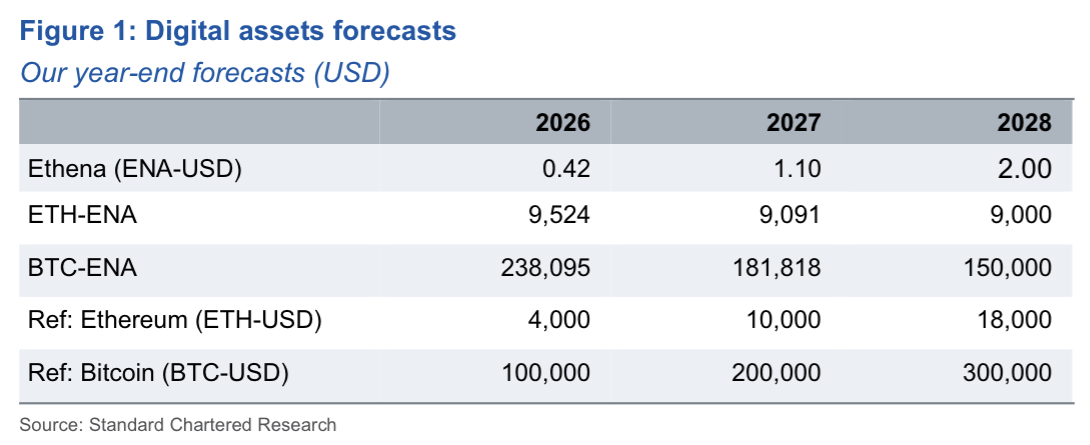
Standard Chartered’s analysis, which marked its initiation of coverage for Ethena’s ENA token, posited a 2028 year-end price target of $2 for ENA. This figure represents a substantial increase from the approximately $0.28 price point cited in the report at the time of its publication, indicating a potential return of nearly 614% for investors over the forecast period. The bank’s conviction extends to USDe, which it expects to not only grow exponentially but also to slightly outpace the overall growth rate of the broader stablecoin market during this timeframe, solidifying its position as a dominant player.
Intriguingly, Standard Chartered’s projections imply that ENA is poised to outperform even the most established cryptocurrencies, Bitcoin (BTC) and Ether (ETH), through 2028. The bank, known for its forward-looking insights into digital assets, simultaneously forecasted Bitcoin to reach an impressive $300,000 and Ether to hit $18,000 by the end of 2028. This comparative analysis underscores the profound belief held by Standard Chartered in Ethena’s unique value proposition and its potential for accelerated growth within the crypto ecosystem.
The foundation of Standard Chartered’s bullish thesis lies in Ethena’s proactive strategy to evolve its yield-generation mechanisms. Historically, USDe’s yield has been primarily derived from the "crypto basis trade," a sophisticated arbitrage strategy involving holding spot crypto assets while simultaneously shorting their perpetual futures contracts on various exchanges. While effective, this strategy is susceptible to market conditions, and Standard Chartered observed declining returns from this traditional crypto basis trade. In response, Ethena has strategically diversified its sources of yield, venturing into a broader spectrum of financial avenues.

These expanded sources of yield are critical to USDe’s scalability and long-term sustainability. Ethena is now actively exploring and integrating DeFi (Decentralized Finance) protocols and institutional lending opportunities, tapping into the vast liquidity and yield potential offered by these innovative financial ecosystems. Furthermore, the protocol is expanding into real-world assets (RWAs), a rapidly growing segment of the crypto market where tangible assets like bonds, real estate, or commodities are tokenized on a blockchain. This move allows Ethena to access more stable and predictable yields that are traditionally less correlated with the volatile crypto markets. The protocol is also extending its basis trades to include equities and commodities, further broadening its exposure beyond crypto-native strategies and connecting it to the multi-trillion-dollar traditional finance markets. This multi-pronged approach currently generates a blended yield of 5.2%, a crucial factor that provides USDe with ample room to scale its operations and attract a wider base of users.
A significant tailwind for Ethena’s expansion, as highlighted by Standard Chartered, is the projected monumental growth of the tokenized assets market. The bank forecasts this market to explode from approximately $350 billion today to an astonishing $4 trillion by the end of 2028. This elevenfold increase in the market for tokenized assets represents a massive expansion of the underlying pool of assets that Ethena could potentially leverage to generate yield. By embracing RWAs and diversifying its yield sources, Ethena is strategically positioning itself to capitalize on this megatrend, enabling it to access deeper liquidity and more robust yield opportunities, thereby enhancing USDe’s stability and attractiveness.
Central to Standard Chartered’s valuation case for the ENA token is the direct link between USDe’s supply growth and the implementation of ENA buybacks. In early September, Ethena’s governance community approved a crucial "fee switch." This mechanism dictates that 95% of the net revenue generated from Ethena’s diverse business lines will be directed towards buying back ENA tokens from the open market, but only once USDe reaches predefined supply milestones. This creates a powerful demand-side pressure for ENA, directly tying the token’s value to the protocol’s success and revenue generation.
To illustrate the potential impact of this mechanism, Ethena’s own estimates suggest that at a USDe supply of $25 billion, with a conservative assumption of a 6% gross protocol yield and a 25% net revenue take rate, the fee switch could generate an impressive $375 million in annual ENA buybacks. Extrapolating this to Standard Chartered’s $40 billion USDe forecast, and assuming similar yield and take rates, the potential for annual ENA buybacks would significantly increase, creating substantial upward price pressure on the token.
Standard Chartered elaborated on the sustainability of these buybacks, arguing that if USDe were to reach its $40 billion forecast and ENA’s price remained unchanged at its current levels, annual buybacks could amount to roughly 23% of ENA’s circulating market capitalization. The bank deems such a high annual buyback rate as "unsustainable" in the long term. This unsustainability, paradoxically, forms a core part of their bullish argument for ENA. Standard Chartered expects that ENA’s price will naturally rise until the annualized buyback rate stabilizes at a lower, more sustainable percentage of its market value. They drew a parallel to Uniswap (UNI), noting that UNI’s annualized buyback rate has typically stabilized around 3% to 4% as its token price appreciated over time. This implies that ENA’s current market capitalization would need to grow substantially to bring its buyback rate into a sustainable range, thereby justifying the $2 price target.
At the time of the report’s publication, ENA was trading around $0.27, reflecting a robust performance with an approximate 28% increase over the preceding week and a significant 77% surge over the past month, according to CoinGecko data. With a market capitalization of approximately $2.65 billion, ENA still has considerable room for growth if Standard Chartered’s ambitious forecasts materialize. The bank’s analysis positions ENA not just as another altcoin, but as a high-growth asset intrinsically linked to the expanding utility and adoption of USDe and the broader tokenized asset market.
However, a comprehensive outlook necessitates acknowledging potential risks and challenges that Ethena may face. The sustainability of yield generation, while diversified, remains a critical factor. Significant downturns in crypto markets or a broader economic recession could impact the profitability of Ethena’s various yield strategies, potentially affecting the blended yield and, consequently, the revenue available for ENA buybacks. Regulatory scrutiny around stablecoins and DeFi protocols is intensifying globally, and any adverse regulatory actions could pose significant operational or legal hurdles for Ethena. Smart contract risks, inherent to any DeFi project, also present a vulnerability, though Ethena employs robust security measures. Furthermore, the competitive landscape for stablecoins and yield-generating protocols is fierce, and Ethena will need to continuously innovate to maintain its edge.
In conclusion, Standard Chartered’s deep dive into Ethena represents a landmark moment for the protocol, signaling validation from a major player in traditional finance. The bank’s bold predictions for USDe’s supply reaching $40 billion and ENA’s price hitting $2 by 2028 are underpinned by Ethena’s strategic expansion of yield sources beyond crypto-native strategies, its embrace of real-world assets, and the powerful, governance-approved ENA buyback mechanism. While risks are inherent in the volatile crypto market, Standard Chartered’s analysis paints a compelling picture of Ethena’s potential to not only thrive but also to significantly outperform leading cryptocurrencies, establishing itself as a pivotal force in the future of decentralized finance and tokenized assets.