anjir abdul
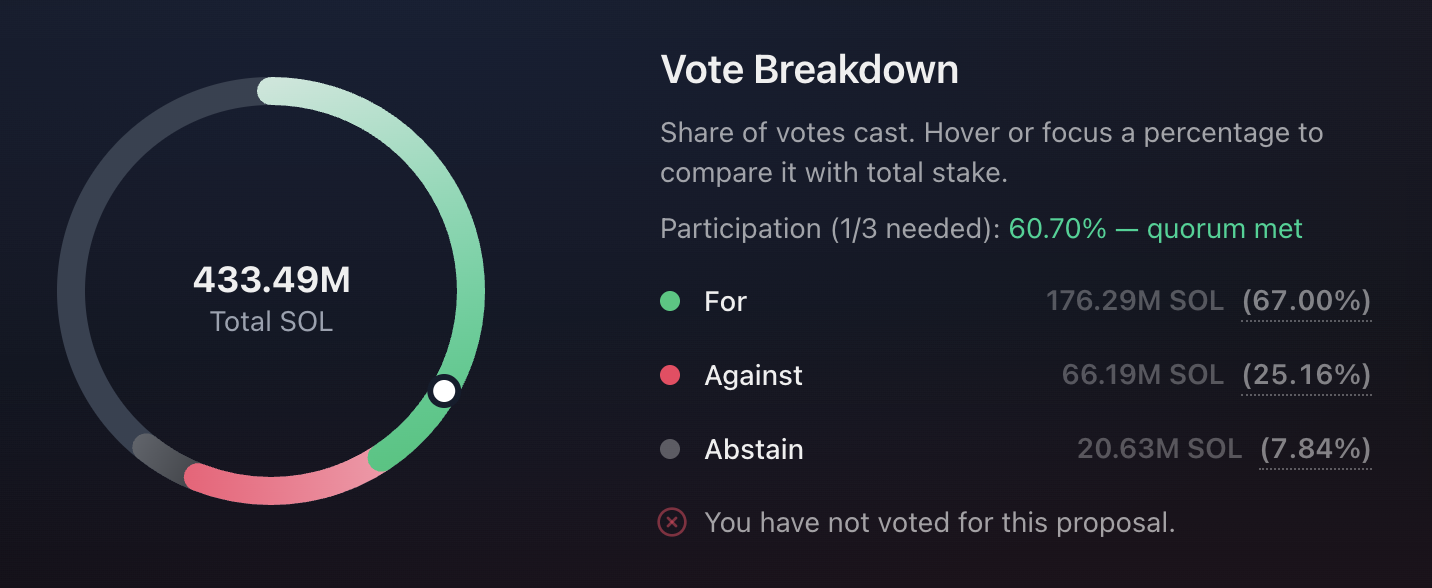
The proposal, officially designated as SGP-0002 and colloquially known as "Double Disinflation," saw robust community engagement and a clear mandate for change. Finalized voting results reveal that the measure garnered substantial support, with 67% of the participating stake voting in favor. Opposition was noted at 25.16%, while 7.84% chose to abstain. Crucially, overall participation reached an impressive 60.7% of eligible staked SOL, underscoring the community’s commitment to the network’s future direction and the significance of this particular vote. Such a high participation rate for a foundational economic adjustment demonstrates a healthy and engaged validator ecosystem.
At its core, SGP-0002 elevates Solana’s annual disinflation rate from 15% to 30%. Disinflation, in this context, refers to a decrease in the rate at which the supply of SOL expands, rather than an absolute reduction in supply (which would be deflation). The proposal, however, meticulously maintains the network’s long-term terminal inflation target of 1.5%. This target is critical for ensuring continued security and decentralization by providing a sustainable, albeit lower, incentive for validators and delegators to stake their SOL and contribute to network integrity in perpetuity. The distinction between disinflation and the terminal inflation rate is crucial for understanding Solana’s nuanced approach to tokenomics.

Under the newly adopted schedule, Solana is projected to achieve its 1.5% terminal inflation rate in approximately 2.8 years. This represents a substantial acceleration compared to the previous schedule, which would have seen the network reach this target in roughly 5.7 years, as reported by Solana Compass. The direct consequence of this accelerated disinflation is a notable reduction in the total amount of SOL entering circulation. Estimates suggest that approximately 18.9 million fewer SOL will be issued over the next six years. For existing SOL holders, this translates directly into reduced dilution, meaning their proportional ownership of the network will be preserved more effectively over time. However, this positive outcome for holders comes with a trade-off: lower staking rewards for both validators and delegators, as the pool of newly issued SOL distributed as rewards will shrink.
The vote on SGP-0002 was a cornerstone of Solana’s first-ever binding governance process, a pivotal moment marking the network’s increasing decentralization and community-driven evolution. Alongside the disinflation proposal, validators also approved a proposed Solana Constitution, laying down foundational principles for the network’s future development and governance. Conversely, a separate proposal concerning resource and inclusion fees was rejected, indicating that while there is a strong appetite for economic adjustments, the community remains discerning about specific implementations. This demonstrates a balanced and critical approach to governance, where not all proposals are rubber-stamped.
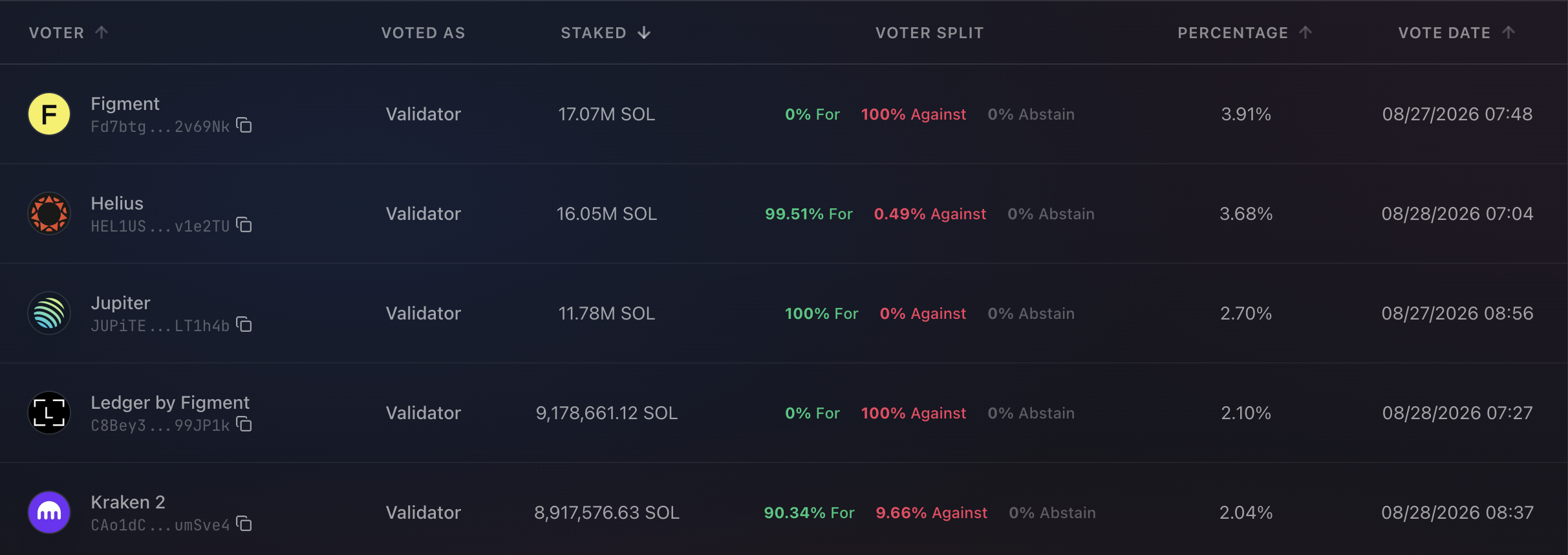
The voting dynamics for SGP-0002 revealed a fascinating divergence among some of the largest network participants. Figment, which emerged as the largest voter in the finalized governance data with an impressive 17.1 million SOL staked, notably cast all its votes against the measure. This opposition from a major staking provider likely stems from the direct impact on staking rewards, which are a core part of their business model. In stark contrast, other prominent entities like Helius and Jupiter overwhelmingly backed the proposal, signaling a belief that the long-term benefits of increased scarcity outweigh the immediate reduction in staking yield. This split highlights the complex considerations involved in balancing different stakeholder interests within a decentralized network.
Adding another layer of intrigue to the voting process was the shifting stance of Kraken, a major US-based crypto exchange. Initially, Kraken voted against SGP-0002 at 12:33 UTC, a move that temporarily pushed the proposal’s support below the required threshold. Such a significant shift from a major player can cause market jitters and intense scrutiny. However, by the close of the voting period, Kraken had significantly altered its position, with more than 90% of its substantial 8.9 million SOL voting stake ultimately backing the proposal. This reversal could be attributed to various factors, including internal deliberations, responsiveness to community feedback, a re-evaluation of the proposal’s long-term implications, or even a strategic alignment with the broader market sentiment that coalesced around the proposal. The fluidity of such votes underscores the dynamic nature of decentralized governance.
This crucial governance decision arrives amidst a period of burgeoning interest and investment in Solana, particularly from institutional players. US-listed Solana investment products have been consistently attracting significant capital, even in periods when SOL’s price performance might have been less robust earlier in the year. A testament to this growing institutional appetite is Bitwise’s Solana ETF, which recently crossed the $1 billion mark in assets under management (AUM). This achievement makes it the first Solana-focused exchange-traded fund to reach such a significant milestone, as highlighted by Bloomberg ETF analyst Eric Balchunas.
Balchunas further noted that US Solana ETFs have collectively amassed approximately $1.7 billion in cumulative net inflows, demonstrating sustained investor confidence with little evidence of consistent outflows since their respective launches. This strong inflow trend suggests that institutional investors are increasingly viewing Solana as a viable and attractive asset class, potentially drawn by its high throughput, low transaction fees, and rapidly expanding ecosystem across DeFi, NFTs, and gaming. The approval of accelerated disinflation could further bolster this institutional interest, as a more controlled and predictable supply schedule often appeals to traditional financial institutions looking for assets with clear tokenomic frameworks.
The move towards a faster disinflation schedule can be interpreted as Solana’s commitment to strengthening its tokenomics, making SOL potentially more appealing as a store of value in the long run. By reducing the rate of new SOL issuance, the network aims to create a more deflationary-like pressure on the token’s supply, which, combined with growing demand, could positively impact its market valuation. This strategic decision aligns Solana with a broader trend seen across major blockchain networks, such as Ethereum’s EIP-1559 and its transition to Proof-of-Stake, both of which introduced mechanisms to reduce ETH supply growth or even make it deflationary under certain conditions. For Solana, a network often lauded for its technical prowess and scalability, enhancing its economic scarcity model adds another layer to its competitiveness in the rapidly evolving blockchain landscape.
While the reduction in staking rewards presents a challenge for validators and delegators, the long-term vision is that a more valuable SOL token, driven by scarcity and sustained demand, will ultimately benefit all network participants. The reduced dilution for holders means that the overall value of their staked assets might appreciate more significantly, potentially offsetting the lower nominal reward rates. This delicate balance between incentivizing network security through staking rewards and creating scarcity for the token’s holders is a continuous optimization challenge for any Proof-of-Stake blockchain. Solana’s community, through this vote, has clearly signaled its preference for accelerating the path to a more constrained supply, betting on the long-term appreciation of SOL as a primary driver of network value and participant benefit. This bold step marks a new chapter in Solana’s economic evolution, positioning it for what its community hopes will be a trajectory of enhanced stability and value.