Imroatul Nasiyah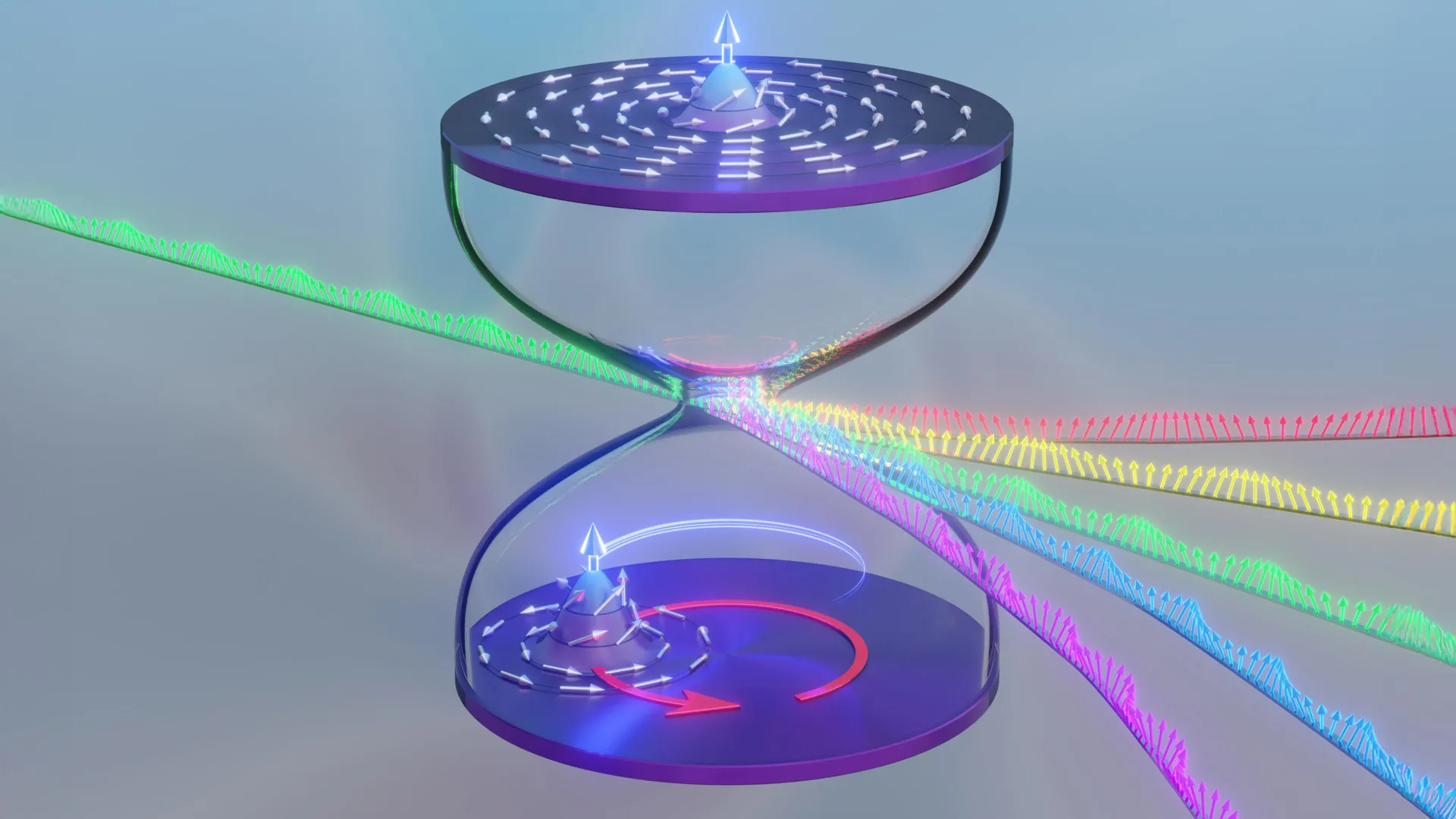
Magnetic vortices, enigmatic structures residing within the heart of matter, have long captivated the attention of physicists. These miniature whirlpools, formed in ultrathin disks crafted from materials like nickel-iron, can be astonishingly small, measuring mere micrometers or even nanometers in diameter. Within these confined realms, the fundamental building blocks of magnetism – tiny magnetic moments, akin to infinitesimally small compass needles – arrange themselves in intricate, swirling patterns. When these delicate arrangements are disturbed, they respond with a ripple effect, propagating waves through the system in a manner reminiscent of a coordinated "wave" rippling through a cheering stadium crowd. Each magnetic moment, nudged from its equilibrium, tilts slightly and then imparts its motion to its neighbor, initiating a cascading chain reaction. These collective, wave-like excitations, the very essence of these propagating disturbances, are scientifically known as magnons.
Dr. Helmut Schultheiß, the visionary project leader from the Institute of Ion Beam Physics and Materials Research at HZDR, eloquently explains the significance of these magnons: "These magnons can transmit information through a magnet without the need for charge transport." This remarkable ability, the capacity to carry information without the conventional flow of electrical current, renders magnons exceptionally attractive for the ongoing research and development of next-generation computing technologies. The promise of more energy-efficient and potentially faster computational devices hinges on harnessing these subtle magnetic phenomena.
Unexpected Frequency Combs Emerge in the Realm of Tiny Magnetic Disks
The scientific quest that led to this groundbreaking discovery began with an exploration into the influence of scale. The researchers at HZDR were meticulously experimenting with magnetic disks, systematically shrinking their dimensions from several micrometers down to an astonishingly small few hundred nanometers. Their primary objective was to unravel how variations in disk size might impact the functionality and efficiency of neuromorphic computing, a cutting-edge, brain-inspired approach to information processing that aims to mimic the intricate workings of the human brain. However, as the vast datasets from their experiments underwent rigorous analysis, an anomaly began to surface. Instead of the expected singular resonance signal, a hallmark of predictable magnetic behavior, some of the minuscule disks began to exhibit a peculiar phenomenon: a series of closely spaced lines, an optical illusion of sorts within the magnetic spectrum, forming what physicists refer to as a frequency comb.
The initial reaction was one of cautious skepticism. "At first, we assumed it was a measurement artifact or some kind of interference," recalls Dr. Schultheiß, his voice tinged with the memory of that pivotal moment. The possibility of an error in the sophisticated instrumentation or an external perturbation that was skewing the results was a plausible explanation. However, as the experiments were meticulously repeated, the inexplicable effect reappeared, stubbornly refusing to dissipate. "That is when it became clear we were looking at something genuinely new," he emphasizes, underscoring the shift from doubt to dawning realization.
The Rotating Vortex Core: The Unseen Maestro of New Oscillation States
The scientific explanation for this bizarre behavior traces its roots back to the theoretical work of the esteemed 19th-century French mathematician, Gaston Floquet. Floquet’s seminal contributions demonstrated that physical systems subjected to periodic forces, forces that repeat themselves at regular intervals, can indeed develop entirely novel and previously unimagined oscillation states. Historically, the generation of these so-called Floquet states has been an energy-intensive endeavor, typically requiring substantial energy inputs, most commonly delivered through the application of powerful and intense laser pulses.
However, in a remarkable departure from established paradigms, the HZDR researchers discovered that magnetic vortices possess an inherent capability to naturally produce these elusive Floquet states. This remarkable phenomenon is triggered when the magnons, the energy carriers within the magnetic material, reach a sufficient level of excitation. As these magnons become more energetic, they transfer a portion of their energy to the vortex core, the very center of the magnetic whirlpool. This energy transfer causes the vortex core to embark on a minute, yet significant, circular path around its central axis. Astonishingly, even this minuscule motion, this ephemeral dance of the vortex core, is sufficient to rhythmically modulate and alter the magnetic state of the surrounding material.
In the experimental observations, this subtle yet profound modulation manifests as a frequency comb. Instead of a single, sharp peak in the magnetic spectrum, a multitude of evenly spaced lines emerge, akin to how a pure musical note can, under certain conditions, split into a series of harmonious overtones. "We were stunned that such a minute core motion was enough to transform the familiar magnon spectrum into a whole array of new states," exclaims Dr. Schultheiß, conveying the sheer astonishment and wonder of the discovery. The implication is profound: the intricate dance of a microscopic vortex core can sculpt the magnetic landscape, giving rise to complex and previously undetected oscillatory behaviors.
An Ultra-Low Energy Breakthrough with Far-Reaching Potential
One of the most compelling and revolutionary aspects of this discovery lies in its astonishingly low energy requirement. In stark contrast to the high-powered laser systems that were the standard for generating Floquet states in previous research, this newly identified effect can be reliably triggered with an almost negligible amount of power – a mere microwatt. To put this into perspective, this is significantly less energy than what a typical smartphone consumes even when it is in its standby mode, a state of minimal power usage.
This remarkable energy efficiency unlocks a cascade of exciting new possibilities and applications. Frequency combs generated through this ultra-low energy mechanism hold the potential to act as a sophisticated synchronization tool, capable of harmonizing vastly different physical systems. This could involve bridging the gap between ultrafast terahertz signals, which operate at extremely high frequencies, and the more conventional electronics that underpin much of our modern technology. Furthermore, it offers a pathway to integrate these magnetic phenomena with the nascent and highly sensitive world of quantum devices. Dr. Schultheiß aptly likens this capability to a "universal adapter," elaborating, "Just as a USB adapter allows devices with different connectors to work together, Floquet magnons could bridge frequencies that would otherwise remain incompatible." This analogy powerfully illustrates the potential of this discovery to foster unprecedented interoperability between disparate technological domains.
Paving the Way for Future Computing and Quantum Integration
The research team at HZDR is not resting on their laurels; they are already charting the course for future investigations. A key area of focus will be to explore the applicability of this discovered mechanism to other types of magnetic structures. The implications of this discovery are profound for the development of future computing systems. By enabling seamless communication and interaction between magnon-based signals, conventional electronic circuits, and the enigmatic realm of quantum components, it could represent a significant leap forward in creating more powerful, efficient, and versatile computing architectures.
"On the one hand, our discovery opens new avenues for addressing fundamental questions in magnetism," Dr. Schultheiß emphasizes, highlighting the intrinsic scientific value of the findings. "On the other hand, it could eventually serve as a valuable tool to interconnect the realms of electronics, spintronics, and quantum information technology." This dual impact – advancing fundamental understanding while simultaneously providing practical technological solutions – underscores the transformative potential of this research. The journey of these tiny magnetic whirlpools and their bizarre new states is far from over, promising to reshape our understanding of matter and to forge new pathways in the technological landscape of the future. The meticulous execution of all measurements of the magnetic vortices and the subsequent analysis of the complex data streams from multiple sophisticated instruments were facilitated by the advanced Labmule program, a testament to HZDR’s commitment to innovation in research tools, which is also readily available as a valuable lab automation solution for the broader scientific community.