Imroatul Nasiyah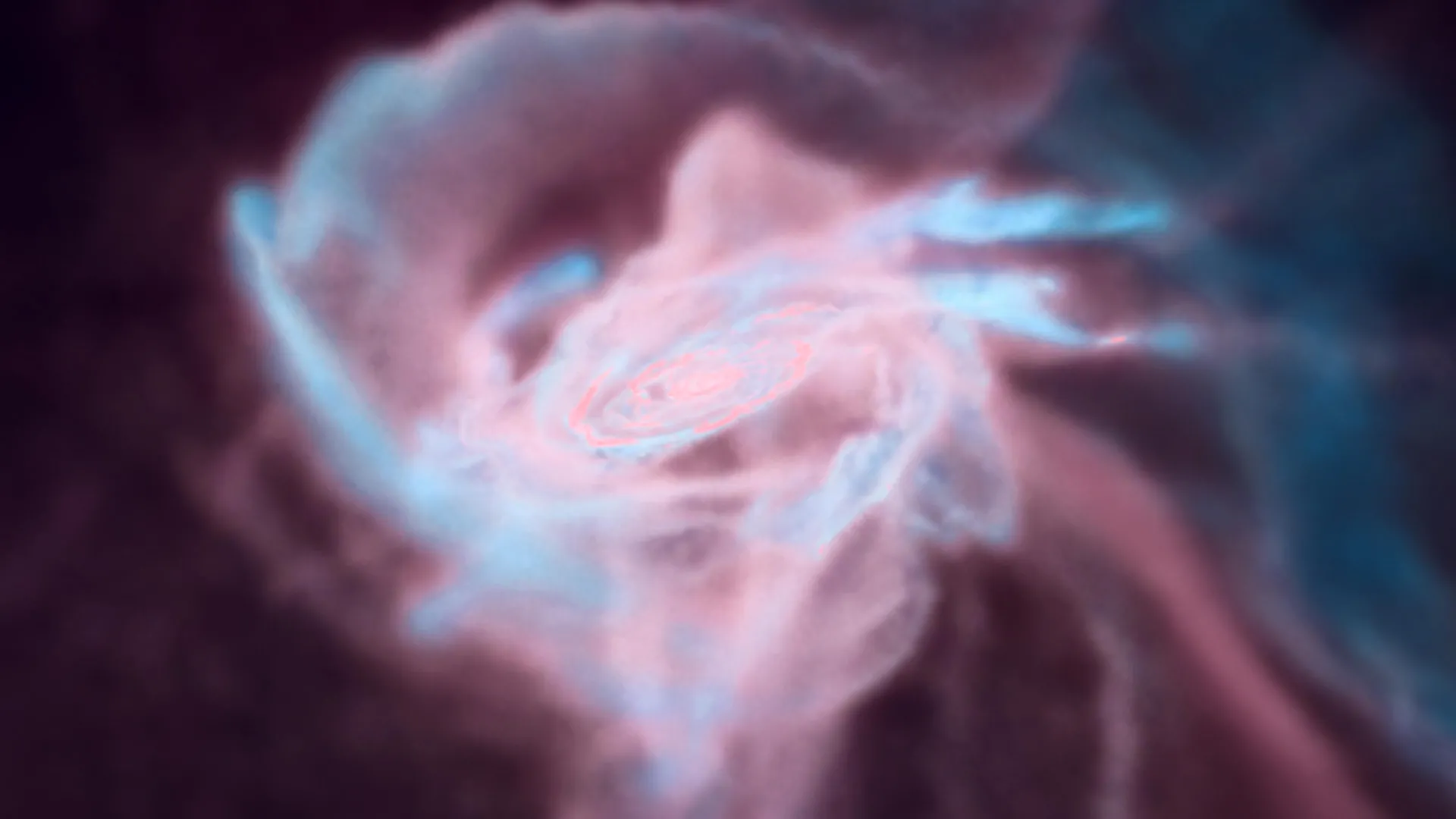
Among the myriad of astonishing revelations emerging from the James Webb Space Telescope (JWST), one of the most perplexing has been the discovery of a substantial population of diminutive, intensely red celestial objects, affectionately dubbed "Little Red Dots" (LRDs). For a considerable period, their true cosmic identity remained shrouded in mystery, sparking intense debate and speculation within the astronomical community. However, a groundbreaking new study, powered by sophisticated simulations executed on Japan’s formidable ATERUI III supercomputer, now proposes a compelling hypothesis: these enigmatic LRDs may represent nascent black holes, undergoing a period of astonishingly rapid accretion, a phenomenon facilitated by the unique and no longer extant conditions of the primordial Universe.
This compelling theoretical framework, as outlined in a recent publication, remarkably avoids the necessity of invoking exotic physics or invoking astronomically improbable events. Instead, the meticulously crafted simulations suggest that the LRDs could arise as a natural consequence of the environmental dynamics prevalent in the nascent cosmos. In this early epoch, black holes were not constrained by the same limitations that govern their growth in the present-day Universe, allowing them to accrete matter and expand their mass at extraordinary rates.
The pioneering research, spearheaded by Sunmyon Chon of the Max Planck Institute for Astrophysics, leveraged the unparalleled computational prowess of the ATERUI III supercomputer, situated at the National Astronomical Observatory of Japan. This powerful facility enabled the team to conduct some of the most detailed and high-resolution cosmological simulations ever attempted, specifically designed to replicate the intricate conditions of the early Universe. The simulation process began with a broad, galactic-scale perspective of the nascent Universe and progressively zoomed in on progressively smaller, more localized regions. This iterative refinement ultimately focused on the behavior of individual clouds of gas, a demanding computational task that necessitated the extraordinary processing capabilities of ATERUI III.
The results of these intricate simulations yielded a profound insight: the intense far-ultraviolet (FUV) radiation emanating from nearby galaxies played a crucial role in shaping the formation of stellar objects within certain gas clouds. This pervasive FUV radiation, rather than allowing the gas to fragment into numerous smaller stars, effectively suppressed such fragmentation. Consequently, the gas was able to undergo a more monolithic collapse, leading to the formation of a single, colossal supermassive star. It is the subsequent gravitational collapse of these gargantuan stellar entities that, according to the simulations, initiates the birth of a black hole seed.
Once these primordial black hole seeds are established, the simulations vividly illustrate their potential for rapid escalation. They become enveloped by thick, dense disks of gas, acting as veritable cosmic feeding grounds. These gas-rich environments possess a unique characteristic: they effectively trap radiation, a phenomenon that significantly enhances the efficiency with which the black holes can consume surrounding matter. This enhanced accretion rate is demonstrably far more potent than anything observed in black holes within the modern Universe. Under these exceptionally favorable conditions, the simulations predict that these nascent black holes can achieve growth rates dozens of times faster than is currently possible. Crucially, the simulated properties of these rapidly accreting black holes bear a striking resemblance to the observed characteristics of the Little Red Dots detected by the JWST. This remarkable congruence strongly suggests that the mysterious red objects observed by the telescope could indeed represent an early, formative stage in the evolution of black holes, characterized by exceptionally rapid mass accumulation.
The existence of supermassive black holes in the early Universe has long presented a profound enigma for astronomers. For decades, the scientific community has grappled with the perplexing question of how these colossal objects, some boasting masses millions or even billions of times that of our Sun, could have formed and matured so early in cosmic history, existing less than 600 million years after the Big Bang. The advent of the JWST, with its unprecedented sensitivity and reach, was anticipated to shed significant light on this enduring mystery. By virtue of its ability to detect fainter and more distant galaxies than its predecessors, the JWST provides astronomers with a direct window into the Universe’s infancy. The finite speed of light dictates that observing extremely distant objects is akin to looking back in time. For instance, a galaxy situated 11 billion light-years away is being observed as it appeared 11 billion years ago, its light having traversed that immense distance to reach our telescopes. Similarly, a galaxy 12 billion light-years away offers a glimpse into the Universe as it was 12 billion years ago. The JWST’s unparalleled capacity to peer further into the cosmic past than any previous observatory offers an unprecedented and invaluable perspective on the formative epochs of the Universe.
Paradoxically, rather than immediately resolving the long-standing mystery of early black hole formation, the JWST unveiled a new and equally puzzling phenomenon: the ubiquitous presence of a multitude of small, intensely red objects, which researchers soon christened Little Red Dots. The new simulations, however, offer a compelling resolution to this developing puzzle. They propose that these LRDs are not a separate, unrelated cosmic oddity, but rather the very missing pieces of the black hole puzzle. The theoretical model indicates that the specific environmental conditions necessary for both the creation and the extraordinarily rapid growth of these black holes naturally arose within the crucible of the early Universe. This implies that no extraordinary physical laws or improbable coincidences are required to explain their existence. This naturalistic explanation also offers a plausible reason for the apparent abundance of LRDs observed in JWST data. As the JWST continues its mission, uncovering more LRDs, and as future generations of telescopes push the boundaries of cosmic observation even deeper into the past, this sophisticated simulation model is poised to provide astronomers with an invaluable conceptual framework. This framework will be instrumental in understanding the intricate processes by which some of the Universe’s earliest and most massive black holes originated, achieved their prodigious growth, and ultimately played a pivotal role in shaping the grand tapestry of cosmic evolution.