anjir abdul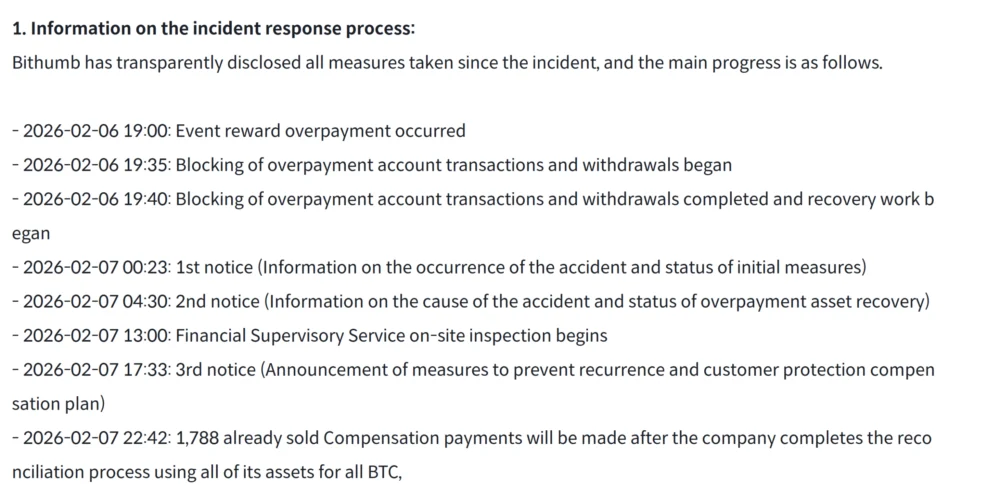
South Korean cryptocurrency exchange Bithumb has successfully navigated a significant operational challenge, confirming it has fully resolved an incident stemming from a promotional reward error that inadvertently credited certain user accounts with an excessive amount of Bitcoin (BTC). The exchange’s swift response and subsequent financial commitment underscore the critical importance of robust internal controls and proactive customer protection in the volatile digital asset landscape. The incident, which unfolded on a Friday, saw an unusual distribution of Bitcoin to a select group of users, leading to immediate market repercussions and raising concerns about system integrity and user trust.
In a comprehensive statement released on Sunday, Bithumb provided critical updates on its handling of the situation, affirming that it managed to recover a staggering 99.7% of the overpaid Bitcoin on the very day the error occurred. This rapid retrieval highlights the exchange’s capability to identify and act upon system anomalies with remarkable efficiency. The statement elaborated that the remaining 0.3% of the distributed BTC, which amounted to 1,788 Bitcoin and had already been liquidated by recipients in the open market, was fully covered using the company’s own substantial funds. This decisive action ensured that no customer balances were negatively impacted, and all user deposits remained perfectly matched or exceeded by Bithumb’s holdings. The exchange explicitly stated, "Bithumb’s holdings of all virtual assets, including Bitcoin (BTC), are 100% equivalent to or exceeding user deposits," a crucial assurance aimed at maintaining investor confidence in the wake of the unusual event.
The operational glitch originated from a promotional event, where a system error caused an unusually large amount of Bitcoin to be credited to some user accounts. The immediate consequence was a flurry of activity as recipients, perhaps in surprise or an attempt to capitalize, began selling these newly acquired funds. This sudden influx of sell orders briefly triggered sharp price swings on the exchange, creating a momentary period of market instability. Recognizing the anomaly almost instantly, Bithumb’s technical teams moved with alacrity to restrict the affected accounts, effectively isolating the problem and preventing a broader market cascade. Trading stability was restored within minutes, a testament to the exchange’s emergency protocols and system monitoring capabilities. Bithumb was quick to clarify that the incident was purely an operational error and not the result of a hacking attempt, alleviating fears of external breaches and reinforcing that no customer assets were lost or compromised. Deposits and withdrawals continued to function normally throughout and after the resolution process, signaling the underlying security of the platform remained intact. While Bithumb refrained from disclosing the exact total amount involved in the overpayment, some users who experienced the error claimed to have received roughly 2,000 BTC, providing a rough scale of the incident.
Beyond merely resolving the technical issue, Bithumb demonstrated a commitment to its user base by announcing a multi-faceted compensation plan. Recognizing the potential inconvenience and distress caused, the exchange outlined several measures designed to mitigate any negative impact and rebuild trust. Firstly, all users connected to the platform at the time of the incident, regardless of whether they were directly affected by the overpayment, were promised a compensatory payment of 20,000 Korean won, equivalent to approximately $15 USD. This gesture aimed to acknowledge the general disruption and maintain goodwill across its user community. More specifically, traders who found themselves in an unfavorable position, having sold Bitcoin at disadvantageous prices during the brief period of market disruption caused by the error, were promised full reimbursement of their sale value. To further sweeten the deal and compensate for any potential losses or stress, an additional 10% payment on top of the reimbursement was also pledged. Furthermore, in a move designed to encourage continued trading and demonstrate a commitment to its platform, Bithumb announced that it would waive trading fees for all markets for a period of seven days, commencing the following Monday. These comprehensive compensation measures illustrate an exchange’s willingness to absorb financial costs to protect its reputation and foster user loyalty, especially in a competitive market like South Korea.
The Bithumb incident, while quickly contained, serves as a poignant reminder of the inherent operational challenges faced by centralized cryptocurrency exchanges. These platforms, acting as custodians of vast sums of digital assets and facilitating millions of transactions daily, operate under immense technical and financial pressure. System glitches, human error, and the sheer complexity of managing high-volume, real-time trading environments can lead to unforeseen issues. This is not an isolated phenomenon in the crypto world. Other major exchanges have also grappled with their own sets of operational hurdles, highlighting a broader industry-wide struggle for flawless execution.

Coinbase, one of the largest cryptocurrency exchanges globally, openly acknowledged in June that account restrictions had been a significant point of contention for its users. For years, countless users had reported being locked out of their accounts for extended periods, sometimes months, without any apparent security breach or clear explanation. This led to widespread frustration and a perception of inadequate customer support. In response, Coinbase announced a substantial effort to address these concerns, reporting an impressive 82% reduction in "unnecessary freezes" after upgrading its machine-learning systems and overhauling its internal infrastructure. This proactive approach by Coinbase underscores the importance of continuous investment in technology and customer service to maintain user trust and operational efficiency. The nature of digital assets, often involving irreversible transactions and significant financial value, amplifies the impact of any account access issues.
Similarly, during a notable market sell-off on October 10, Binance, the world’s largest crypto exchange by trading volume, encountered its own set of technical difficulties. Users reported being unable to close their positions at moments of peak volatility, potentially leading to substantial financial losses. While Binance maintained that its core trading system remained operational and attributed most liquidations to broader market conditions rather than systemic failure, the user experience painted a different picture. In a subsequent move to mollify its affected user base and mitigate reputational damage, Binance distributed approximately $728 million in compensation to traders impacted by the disruption. Such large-scale compensation programs highlight the immense financial liabilities exchanges face when operational issues lead to user losses, pushing them to invest more in redundancy and resilience.
These recurring incidents across major exchanges—be it Bithumb’s promotional error, Coinbase’s account freezes, or Binance’s trading glitches—underscore several critical aspects of the centralized crypto exchange model. Firstly, the complexity of the underlying technology and the rapid pace of innovation mean that system vulnerabilities, however small, can have outsized impacts. Designing systems that are both highly performant and impeccably secure, especially under extreme load or during complex promotional campaigns, is an ongoing challenge. Secondly, the expectation for "always-on" service in the digital age places immense pressure on these platforms. Unlike traditional financial institutions that might have scheduled downtimes, crypto markets operate 24/7, demanding constant vigilance and immediate response capabilities. Thirdly, the incidents emphasize the paramount importance of robust risk management frameworks and clear communication strategies. Exchanges must not only be able to prevent and resolve issues but also to communicate transparently with their users throughout the process, providing assurances and outlining corrective actions.
The regulatory environment in South Korea also adds another layer of scrutiny to such incidents. South Korea has historically maintained a strict and evolving regulatory stance on cryptocurrency, aiming to protect investors and prevent illicit activities. Exchanges operating in the country are subject to stringent oversight and compliance requirements. An incident like Bithumb’s, even if quickly resolved and not involving a hack, would likely draw attention from financial regulators, reinforcing the need for exchanges to demonstrate impeccable operational integrity and financial stability. The country has previously seen its lawmakers face scrutiny over family ties to crypto exchanges, as alluded to in related news, which further underscores the sensitivity around the industry’s operations and governance.
In conclusion, Bithumb’s swift recovery of overpaid Bitcoin and its proactive approach to covering the 1,788 BTC shortfall using company funds exemplify a responsible response to an internal operational error. The comprehensive compensation package, including direct payments and fee waivers, further solidifies its commitment to user trust and experience. However, this incident, alongside those experienced by industry giants like Coinbase and Binance, serves as a stark reminder that even the most sophisticated centralized cryptocurrency exchanges remain susceptible to operational challenges. As the digital asset space continues its rapid expansion and integration into the global financial system, the imperative for exchanges to invest relentlessly in robust infrastructure, rigorous testing, transparent communication, and comprehensive customer protection measures will only grow. The ability to not only innovate but also to operate with unwavering reliability will ultimately define the long-term success and trustworthiness of these critical financial intermediaries.