anjir abdul
In a landmark move that bridges the burgeoning world of digital assets with the bedrock of traditional finance, Better Mortgage and Coinbase have officially made their Bitcoin-backed mortgage product generally available to U.S. homebuyers. This innovative offering allows individuals to leverage their Bitcoin holdings as collateral for a down payment, circumventing the need to sell their digital assets and incur potential capital gains taxes. The announcement, initially previewed in March through an early-access program, marks a significant step towards integrating cryptocurrency into mainstream financial services, particularly within the competitive and often challenging U.S. housing market.
The core mechanism of this pioneering product is designed to provide flexibility and unlock the liquidity of Bitcoin wealth for prospective homeowners. As detailed in Coinbase’s Help Center, the mortgage structure ingeniously combines a traditional Fannie Mae-backed home loan with a distinct down payment loan, the latter being secured by Bitcoin (BTC). This dual-loan approach ensures that while the primary mortgage adheres to established federal housing standards, the down payment component offers a novel, crypto-centric solution.
A crucial aspect of this arrangement is the collateral requirement: borrowers must pledge BTC equivalent to at least 250% of the down payment loan amount. This substantial overcollateralization is a deliberate strategy to mitigate the inherent volatility of Bitcoin, providing a significant buffer against price fluctuations. The pledged BTC is then transferred to Better’s dedicated custodial account, securely held on Coinbase Prime. Coinbase Prime, known for its institutional-grade custody solutions, offers a high level of security and compliance, a critical factor in building trust for such a novel financial instrument. This custodial arrangement ensures the safety of the digital assets while they serve as collateral for the down payment loan.
One of the most appealing features for potential borrowers is the unified financial structure. Both the primary Fannie Mae loan and the Bitcoin-backed down payment loan carry the same interest rate and amortization term, simplifying the repayment process. Borrowers make a single monthly payment, which covers both components, Streamlining what could otherwise be a complex financial arrangement. Upon the full repayment or refinancing of the mortgage, and subject to the specific terms of the loan agreement, the pledged Bitcoin is returned to the borrower. This clear exit strategy provides peace of mind for those utilizing their valuable digital assets.

Perhaps the most significant differentiator from typical crypto-backed loans is the explicit provision regarding Bitcoin price declines. Unlike many lending products that might trigger margin calls or require additional collateral during market downturns, Better’s Bitcoin-backed mortgage specifies that BTC price declines alone do not initiate margin calls or alter the mortgage terms. This feature is a game-changer for Bitcoin holders, insulating them from the immediate pressures of market volatility and allowing them to retain their long-term conviction in the asset without risking immediate liquidation due to temporary dips. However, there is a critical caveat: if a borrower becomes 60 days delinquent on their payments, Better retains the right to liquidate the pledged BTC. This provision underscores the importance of consistent payment and serves as a safeguard for the lender, emphasizing that while market volatility is accounted for, repayment obligations remain paramount.
Eligibility for this innovative product is straightforward yet specific. Borrowers must be U.S. residents and possess a verified Coinbase account. Beyond these crypto-specific requirements, they remain subject to Better’s standard, rigorous underwriting criteria, which include assessments of credit history, income stability, and other financial qualifications. This ensures that the product is offered responsibly to individuals who can genuinely afford the mortgage, regardless of their Bitcoin holdings. As an added incentive, Coinbase One members are eligible for a 1% rebate from Better, capped at $10,000, which can be applied towards closing costs and fees, further sweetening the deal for engaged Coinbase users.
The general availability of this product follows an initial rollout in March, where Better and Coinbase first unveiled the token-backed mortgage concept through an early-access program. This phased approach allowed for testing and refinement, ensuring the product was robust and ready for a broader audience. The successful transition from early access to general availability highlights the growing maturity and reliability of crypto-backed financial solutions.
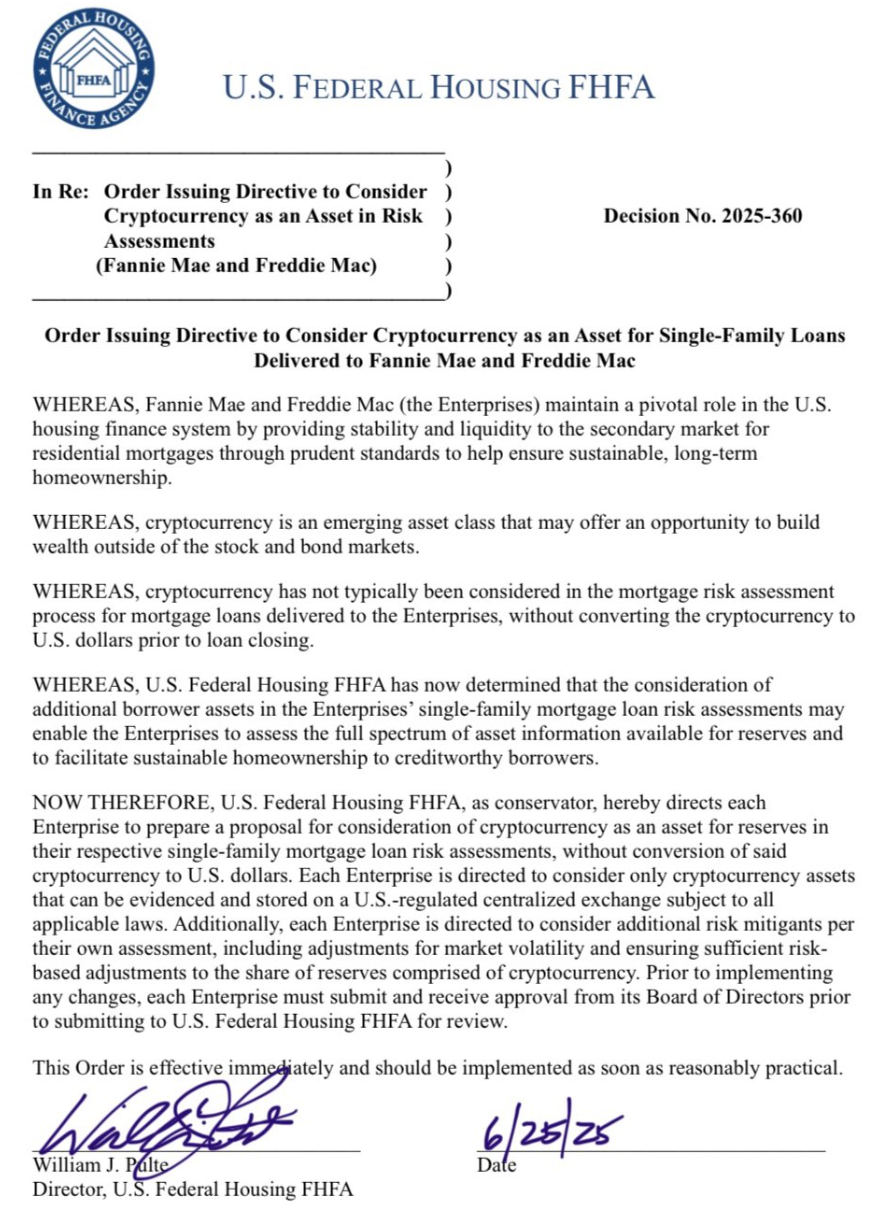
The Better-Coinbase collaboration emerges amidst a broader and accelerating trend of incorporating digital assets into the U.S. mortgage market. The Federal Housing Finance Agency (FHFA) took a significant step in June 2025 by directing Fannie Mae and Freddie Mac to explore and develop proposals for considering cryptocurrency held on U.S.-regulated centralized exchanges as an asset in single-family mortgage risk assessments. Crucially, this directive specified that such consideration should not require the conversion of crypto to U.S. dollars, signaling a fundamental shift in how digital assets might be viewed by government-sponsored enterprises (GSEs). This move by the FHFA is a powerful endorsement of cryptocurrency’s potential role in mainstream finance, tasking the GSEs with navigating the complexities of integrating these assets while also developing risk-mitigation measures for crypto’s notorious volatility. Any proposed changes would, of course, be subject to board approval and subsequent FHFA review, indicating a cautious but determined path forward.
Other traditional U.S. lenders have also begun to acknowledge the burgeoning importance of digital assets. Mortgage lender and servicer Newrez, for instance, announced in January that it would recognize certain cryptocurrency holdings when evaluating mortgage applications, beginning in February. This includes applications for both home purchases and refinancing, demonstrating a growing willingness within the industry to adapt to the evolving financial landscape. These developments collectively indicate a pivotal shift: crypto is no longer solely a speculative investment but is increasingly being recognized as a legitimate component of personal wealth, capable of influencing significant financial decisions like homeownership.
The expansion of Bitcoin-backed home financing comes at a particularly opportune time, as U.S. housing prices remain near historic highs. The median sales price of a new U.S. home hovered around $400,000 in 2026, according to data compiled by the Federal Reserve Bank of St. Louis from the U.S. Census Bureau and Department of Housing and Urban Development. While prices have seen some fluctuations since their peak in 2022, they continue to pose significant affordability challenges for many aspiring homeowners. In this environment, a product that allows individuals to tap into their otherwise illiquid Bitcoin wealth without triggering taxable events or selling off assets they believe in, offers a compelling alternative. It addresses a critical pain point for crypto investors who have accumulated substantial digital wealth but have struggled to deploy it in traditional, large-scale investments like real estate without incurring significant transactional or tax burdens.
The implications of this product extend beyond just a new financing option. It represents a significant step towards the broader acceptance and normalization of cryptocurrency within the traditional financial ecosystem. By partnering with a major federally-backed entity like Fannie Mae (through the underlying mortgage), Better and Coinbase are adding a layer of legitimacy and institutional trust to crypto-backed lending that has been largely absent in previous, often more volatile, decentralized finance (DeFi) initiatives. This regulated approach, backed by established financial institutions, contrasts sharply with the challenges faced by some earlier crypto lenders, offering a more secure and predictable pathway for borrowers.
However, as with any innovative financial product, certain considerations and potential risks remain. While the "no margin call" feature offers a buffer against price drops, the underlying asset’s volatility cannot be entirely ignored. Borrowers are essentially tying up a significant portion of their Bitcoin wealth (250% of the down payment) in an asset that can experience dramatic swings. While they avoid immediate liquidation from market dips, the psychological impact of seeing the collateral value fluctuate, and the opportunity cost of having that BTC locked away, are real. Furthermore, while Coinbase Prime offers robust security, the general risks associated with third-party custody of digital assets, though minimized, are always present. The most severe risk for borrowers, of course, remains the 60-day delinquency clause, which could lead to the forced liquidation of their pledged Bitcoin—a scenario that would not only cost them their home but also their digital assets, potentially at an unfavorable market price.
Looking ahead, the success of Better’s Bitcoin-backed mortgage could pave the way for a new generation of asset-backed financial products leveraging various cryptocurrencies. It could inspire other lenders to explore similar offerings, accelerating the convergence of traditional finance and the digital asset economy. The FHFA’s directive further underscores that regulatory bodies are actively grappling with how to integrate crypto responsibly. The challenges ahead involve educating both consumers and financial professionals, further refining risk models for volatile assets, and establishing clear regulatory frameworks that foster innovation while protecting consumers. Ultimately, this product is more than just a new way to buy a home; it’s a testament to the evolving nature of wealth, recognizing digital assets as a legitimate and powerful force in the future of finance and homeownership.