anjir abdul
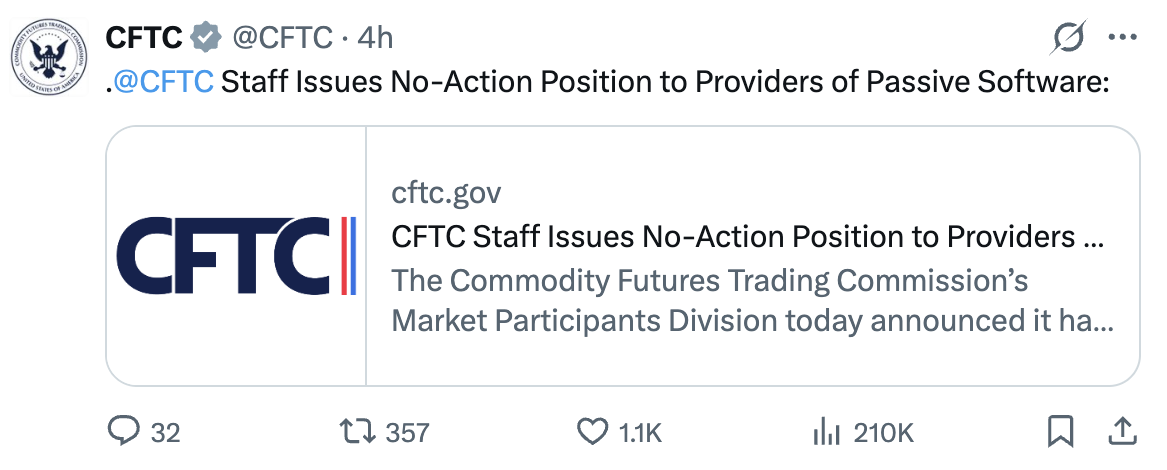
In a pivotal "no-action" position issued on Thursday by the agency’s Market Participants Division, the CFTC signaled it would refrain from recommending enforcement actions against qualifying software providers or their personnel. This relief specifically targets instances where these entities might otherwise be required to register as introducing brokers (IBs) or associated persons (APs) simply for facilitating trading with CFTC-registered firms and exchanges. This exemption is not merely a bureaucratic tweak; it represents a significant reduction in regulatory friction, particularly for innovators seeking to bridge the gap between burgeoning digital asset technologies and established financial markets.
Understanding the Regulatory Landscape and the "No-Action" Position
To fully grasp the import of this decision, it’s essential to understand the roles of introducing brokers and associated persons within the financial regulatory framework. An introducing broker (IB) is generally defined as a firm or individual that solicits or accepts orders for the purchase or sale of futures contracts, options on futures, or swaps, but does not accept money or other assets from customers to support such orders. Instead, they "introduce" customers to a futures commission merchant (FCM) or other regulated entity that handles the actual execution and clearing of trades. An associated person (AP) is typically an individual who solicits or accepts orders for a regulated entity, such as an FCM or IB, or who supervises such individuals. Both IBs and APs are subject to rigorous registration requirements, including background checks, proficiency examinations, and ongoing compliance obligations designed to protect market integrity and investors. These requirements can be costly, time-consuming, and serve as a substantial barrier to entry for smaller tech companies or developers primarily focused on software functionality rather than direct financial intermediation.
A "no-action" position from the CFTC is a formal statement indicating that, based on the facts and representations presented, the agency’s staff will not recommend enforcement action against a particular entity for engaging in certain activities without registering. While not a formal rule or legal precedent, it provides crucial regulatory certainty and guidance, especially in evolving sectors like digital assets where existing regulations may not perfectly fit new business models. By issuing this relief, the CFTC acknowledges the distinction between software that merely provides a conduit and entities that actively solicit, advise, or manage customer funds.
Implications for the Crypto Ecosystem
The direct beneficiaries of this expanded relief are numerous, but the crypto sector stands to gain immensely. The position could substantially ease the path for crypto wallets, decentralized finance (DeFi) applications, and other digital asset interfaces to offer direct access to regulated derivatives products without incurring the burdensome overhead of becoming a CFTic-regulated introducing broker. This is particularly relevant for products like perpetual contracts—a type of derivative that, unlike traditional futures, has no expiry date and is widely popular in crypto markets for its leverage and flexibility—and prediction markets, which allow users to bet on the outcome of future events.
Historically, the regulatory ambiguity surrounding such software has deterred many developers from integrating with regulated venues, fearing they might inadvertently fall under stringent financial intermediary rules. This "no-action" letter provides a clearer framework, encouraging innovation in user-friendly interfaces that can connect directly to compliant, regulated exchanges. This could significantly enhance market access for retail and institutional participants alike, channeling activity towards platforms with robust regulatory oversight, rather than entirely unregulated or offshore alternatives.

Conditions for Qualification: Defining "Passive"
Crucially, this regulatory relief is not a blanket exemption. To qualify, providers must adhere to specific conditions designed to ensure their role remains strictly "passive." These conditions typically include:
- No Discretion Over User Orders: The software must not be capable of exercising any discretion over the initiation, execution, or cancellation of user orders. All trading decisions must originate solely from the user.
- No Custody of User Funds: The provider must not hold, control, or have access to user funds or digital assets. The software should merely facilitate the connection, with funds remaining under the user’s self-custody or directly with the regulated derivatives firm.
- No Investment Advice or Recommendations: The software or its personnel must not offer investment advice, solicit specific trades, or recommend particular derivatives products. Their function is purely technical connectivity.
- No Marketing of Specific Products: The provider should not market specific derivatives products or strategies offered by the connected regulated entities in a manner that could be construed as solicitation.
- Technical Conduit Only: The software should act purely as a technical conduit, transmitting user-generated instructions to the regulated entity without intervening in the substance of the transaction.
By establishing these clear boundaries, the CFTC aims to distinguish between genuine technological facilitators and actual financial intermediaries, ensuring that the intent of introducing broker regulations—to protect investors from fraud, manipulation, and unsuitable advice—is maintained where appropriate, while not stifling innovation in connectivity.
Building on Precedent: The Phantom Technologies Case
This expanded relief is not an isolated incident but rather an evolution of previous regulatory engagements. It explicitly extends a similar "no-action" position granted to Phantom Technologies in March. Phantom, a prominent provider of self-custodial crypto wallet software, had previously secured relief allowing it to provide and market software connecting users with registered futures brokers and exchanges without the necessity of registering as an introducing broker, subject to analogous conditions. This earlier letter was a significant precedent, demonstrating the CFTC’s willingness to adapt its framework to accommodate novel blockchain-based technologies.
The move also reflects proactive engagement from industry stakeholders. Phantom, alongside the Hyperliquid Policy Center, had actively advocated for broader protections in July. Their joint request urged the CFTC to modernize its rules, specifically asking to shield non-custodial wallet providers from introducing broker requirements and to clarify how existing regulations apply to blockchain developers and regulated derivatives firms leveraging on-chain infrastructure. This industry push underscores the critical need for regulatory clarity to foster responsible innovation within the U.S. digital asset ecosystem.
A Swift Regulatory Response Following the CLARITY Act Setback
The timing of the CFTC’s action is particularly noteworthy. It comes just two days after the CLARITY Act failed to advance in the Senate. The CLARITY Act (an acronym for "Clarifying Laissez-faire Approaches to Regulation in the Yield and Transparency of Digital Assets") was a bipartisan legislative effort aimed at establishing a comprehensive regulatory framework for digital assets in the United States. Its primary goal was to provide much-needed clarity on the jurisdictional boundaries between the CFTC and the Securities and Exchange Commission (SEC) over various digital asset types, and to create a tailored regulatory structure for the nascent industry. The bill, however, fell short of the 60 votes required for a cloture motion to proceed to debate, effectively stalling its progress.
The failure of the CLARITY Act left a legislative vacuum, prompting a swift and decisive response from federal regulators. CFTC Chair Michael Selig and Securities and Exchange Commission Chair Paul Atkins wasted no time in signaling their agencies’ intent to press forward with crypto regulation under their existing statutory authorities. Chair Selig, in a post on X, declared, "The CFTC is locked in and ready to ship its rules for the new frontier of finance," while Chair Atkins echoed a similar sentiment, stating the SEC would act "with or without legislation" to provide regulatory certainty for digital assets. These statements underscored a commitment to proactive, agency-led rulemaking in the absence of a comprehensive legislative mandate.
Coordinated Regulatory Push: SEC’s Parallel Action
The CFTC’s no-action position was not an isolated event but part of a coordinated regulatory push. On the same day, the SEC approved a temporary exemption allowing qualifying platforms to facilitate limited on-chain trading of tokenized U.S. stocks through permissioned automated market makers (AMMs) and liquidity pools. This parallel action by the SEC, a temporary measure, indicates a broader regulatory strategy to cautiously integrate blockchain technology into traditional financial markets while maintaining investor protections. Both actions collectively demonstrate a willingness from U.S. regulators to adapt existing frameworks to accommodate new technologies, albeit with a cautious, conditional approach.
Broader Implications and Future Outlook
This expanded regulatory relief from the CFTC carries significant broader implications. Firstly, it fosters innovation by lowering the barrier to entry for software developers who wish to build user-friendly interfaces for regulated derivatives markets. This could lead to a more competitive landscape for financial technology, with a focus on user experience and connectivity. Secondly, it could enhance investor protection by steering users towards regulated venues. While the passive software itself isn’t fully regulated as an IB, the underlying derivatives firms and exchanges it connects to are, providing a layer of oversight and compliance that is often absent in entirely unregulated markets.
Thirdly, this move contributes to the U.S.’s competitiveness in the global digital asset space. By providing clarity and reducing unnecessary burdens, the CFTC is creating an environment where responsible innovation can thrive within regulatory guardrails, potentially preventing talent and capital from migrating to more permissive, but potentially riskier, jurisdictions. Finally, it signals a pragmatic regulatory philosophy that seeks to apply existing rules in a technology-neutral manner, focusing on the function and risks of an activity rather than solely on the technology used.
Despite these positive developments, challenges and ambiguities remain. Defining "passive" in all edge cases will likely require further guidance or iterations of no-action letters. The temporary nature of the SEC’s exemption for tokenized stocks also highlights the ongoing need for a more permanent, comprehensive legislative solution that can provide enduring certainty across the entire digital asset spectrum. Nevertheless, the CFTC’s expanded relief for passive trading software providers marks a crucial step forward, demonstrating regulators’ capacity to adapt and provide clarity in a rapidly evolving financial landscape.