anjir abdul
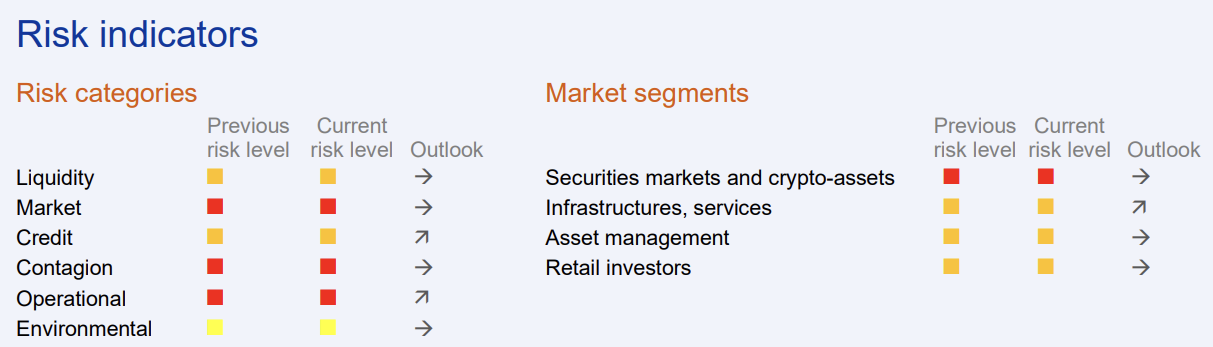
ESMA, headquartered in Paris, serves as the European Union’s financial markets regulator and supervisor. Its core mission is to enhance investor protection, promote stable and orderly financial markets, and ensure the integrity of the EU’s financial system. Given this mandate, its detailed risk assessment carries substantial weight, signaling to policymakers, financial institutions, and market participants the urgent need to address emerging vulnerabilities. The report specifically called for closer monitoring of the "growing linkage between increasingly vulnerable crypto-asset markets and the broader financial system," recognizing that what once seemed like isolated digital phenomena are now beginning to cast a shadow over conventional finance.
The growing interconnectedness stems from several factors. Traditional financial institutions, seeking to capitalize on innovation and demand, are increasingly engaging with crypto assets, whether through offering custody services, launching crypto-linked investment products like exchange-traded funds (ETFs) and exchange-traded products (ETPs), or integrating distributed ledger technology (DLT) into their existing infrastructure. This integration creates new pathways for contagion, meaning that stress or instability originating in the volatile crypto space could potentially ripple through and destabilize traditional markets. For instance, significant institutional holdings of crypto assets or collateralized lending against them could expose traditional balance sheets to sudden market downturns or liquidity crises within the digital asset ecosystem. The past few years have seen numerous high-profile crypto failures, such as the collapse of Terra/Luna, FTX, Celsius, and Three Arrows Capital. While these events largely impacted the crypto-native sector, ESMA’s concern is that with deeper integration, future such events could trigger broader financial instability if traditional firms were significantly exposed.
Among the specific areas of concern, ESMA pointed to the accelerating adoption of tokenized equities. These are traditional shares or securities that are digitally represented on a blockchain, allowing for fractional ownership, potentially faster settlement, and 24/7 trading. While currently representing a negligible fraction of global stock markets, their traction is growing, attracting new participants and infrastructure providers. This innovation, while promising efficiency gains and greater accessibility, introduces complex risks. These include regulatory arbitrage, where tokenized versions of traditional assets might fall into legal gray areas, market fragmentation due to different blockchain networks and token standards, and challenges related to legal enforceability of ownership and cross-border regulatory harmonization. Furthermore, the operational risks associated with new DLT infrastructure and the potential for cybersecurity breaches become critical considerations.
Another significant red flag raised by ESMA relates to decentralized finance (DeFi) exploits. DeFi refers to a collection of financial applications built on blockchain technology, operating without traditional intermediaries like banks. While offering transparency and disintermediation, DeFi protocols are inherently vulnerable to smart contract bugs, flash loan attacks, oracle manipulation, and governance exploits. These vulnerabilities have led to billions of dollars in losses over recent years. ESMA’s concern is that as traditional finance increasingly interacts with DeFi – for example, by providing liquidity, utilizing DeFi protocols for collateral management, or offering DeFi-linked products to clients – these exploits could directly impact traditional financial firms, leading to substantial financial losses, reputational damage, and a loss of confidence that could propagate through the wider system. The "code is law" ethos of DeFi, while powerful, also means that a bug in the code can be exploited with devastating consequences, and recourse is often limited.

Beyond these established and emerging areas, ESMA also flagged prediction markets as a burgeoning risk, particularly due to heightened concerns around insider trading and market manipulation. Prediction markets are platforms where users can bet on the outcome of future events, ranging from political elections and sports results to economic indicators and even future cryptocurrency prices. Many of these markets leverage cryptocurrencies and blockchain technology for betting, collateral, and payouts, which can introduce features like pseudonymous participation and cross-border access.
ESMA warned that the use of crypto in prediction markets can significantly complicate the detection of illicit activities. Insider trading, where individuals trade based on non-public, material information, becomes harder to trace given the often pseudonymous nature of crypto transactions. Similarly, market manipulation tactics such as wash trading (where an investor simultaneously buys and sells the same asset to create misleading activity) and coordinated manipulation schemes (where groups conspire to influence market outcomes) can be more difficult to identify and prosecute in a decentralized, crypto-native environment. The lack of clear regulatory frameworks specifically tailored to these crypto-enabled prediction markets exacerbates these risks, making them fertile ground for unfair practices and undermining market integrity.
ESMA’s warning about prediction markets comes amidst a fierce regulatory battle unfolding in the United States, where authorities are grappling with whether event contracts offered on these platforms fall under federal derivatives law or state gambling regulations. The Commodity Futures Trading Commission (CFTC), the federal agency responsible for regulating derivatives markets in the U.S., has been actively asserting its jurisdiction. Throughout 2026, the CFTC has issued guidance for prediction markets, maintaining that it has exclusive authority over federally regulated event contracts under the Commodity Exchange Act (CEA). The agency views these markets as a form of derivatives and aims to bring them under a structured regulatory framework to protect participants and prevent market abuses.
However, this stance has put the CFTC in direct conflict with several U.S. states. Many state authorities contend that prediction markets are essentially a form of gambling and, as such, should be regulated under state-specific gaming laws, which often prohibit or heavily restrict such activities. This jurisdictional clash has escalated into legal skirmishes, with the CFTC filing lawsuits against various states, including Kentucky, Minnesota, New Mexico, New York, Illinois, and Connecticut. These lawsuits challenge the states’ attempts to apply their gambling laws to prediction market operators that the CFTC considers federally regulated entities. The CFTC argues that state intervention undermines its mandate and creates an inconsistent regulatory landscape.
The dispute reached a critical juncture on September 2, 2026, when New Jersey officials formally petitioned the U.S. Supreme Court. The petition seeks clarity on whether states possess the authority to enforce their sports gambling laws against prediction markets that are registered and overseen by the CFTC. This move is significant, as New Jersey cited ongoing litigation over this precise issue across at least 20 states, highlighting the widespread nature of the regulatory ambiguity and the urgent need for a definitive resolution.
Whether the Supreme Court chooses to hear the case remains uncertain, as the court typically takes only a fraction of the cases submitted to it. However, if the Supreme Court does take up the issue, its future ruling could have profound implications, determining once and for all whether state or federal authorities hold jurisdiction over prediction markets. A decision in favor of the CFTC could lead to a more uniform, federally regulated framework for these markets across the U.S., potentially fostering their growth and institutional adoption under defined rules. Conversely, a ruling that upholds states’ rights could result in a fragmented regulatory landscape, with prediction markets being banned or heavily restricted on a state-by-state basis, hindering their development and accessibility. The outcome will shape the future of this innovative, yet controversial, financial instrument in one of the world’s largest economies.
ESMA’s warnings also resonate within the broader European regulatory context. The EU has been proactive in developing comprehensive legislation for crypto assets through its Markets in Crypto-Assets (MiCA) regulation. MiCA aims to provide legal certainty, foster innovation, ensure consumer protection, and maintain financial stability across the crypto sector. ESMA’s latest report reinforces the need for diligent implementation of MiCA and continuous monitoring of market developments to address risks that may not have been fully anticipated during the initial drafting of the regulation. The increasing complexity and interconnectedness between crypto and traditional finance necessitate a dynamic and adaptive regulatory approach that can keep pace with rapid technological advancements and evolving market structures.
Ultimately, ESMA’s latest risk monitoring report serves as a crucial reminder of the delicate balance regulators must strike between fostering innovation and safeguarding financial stability. The burgeoning ties between crypto and traditional finance, while offering new opportunities, also create new vectors for risk. Proactive monitoring, robust regulatory frameworks, international cooperation, and clear jurisdictional delineations, as sought in the U.S. prediction market battle, are indispensable to navigate this evolving landscape. Without these measures, the potential for crypto-related shocks to amplify and spread through the broader financial system remains a significant and growing concern for regulators worldwide.