anjir abdul
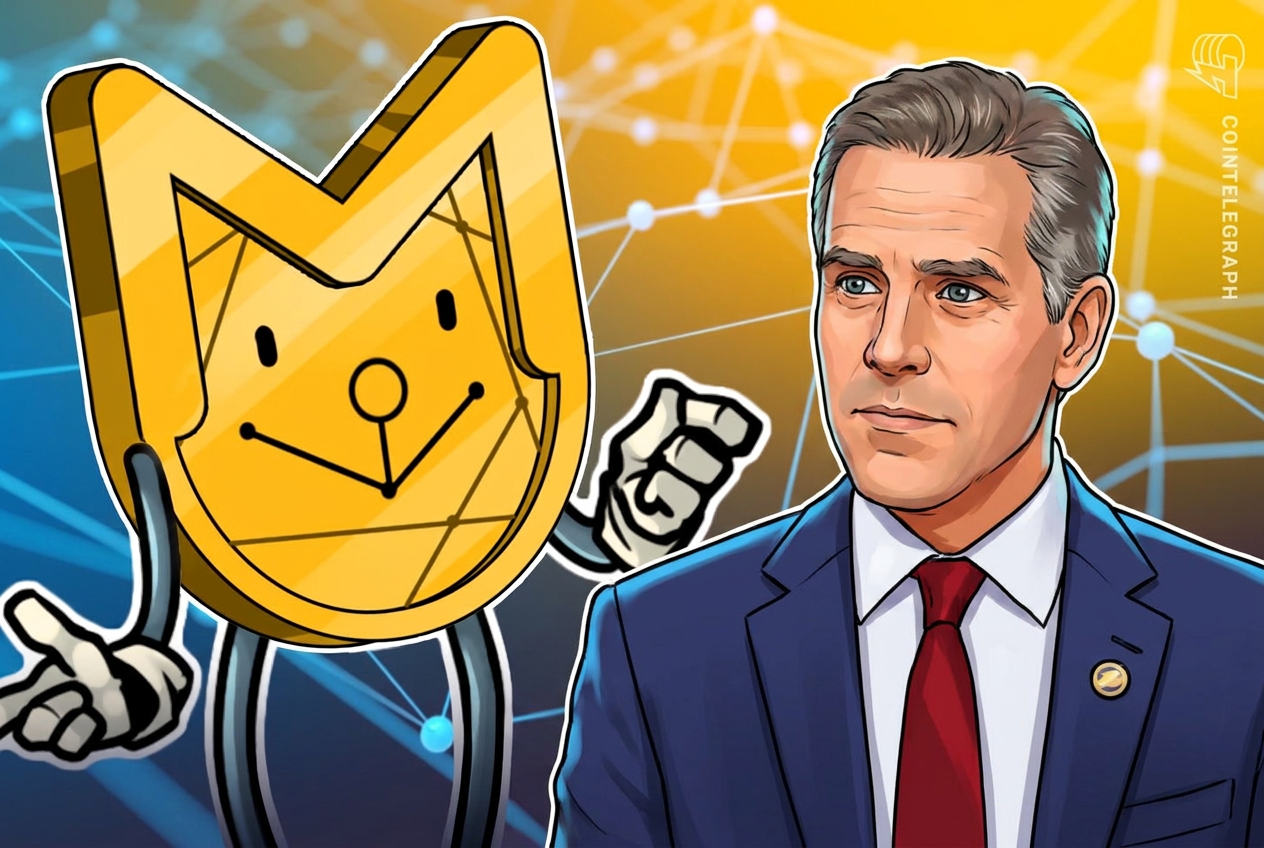
Hunter Biden, son of former US President Joe Biden, has officially announced his intention to launch a new memecoin, drawing immediate attention and controversy by strategically signaling that a significant portion of the tokens will be distributed to holders of the ‘Official Trump (TRUMP)’ memecoin. This audacious move, leveraging the notorious history of his "infamous laptop," thrusts Hunter Biden into the volatile and often politically charged world of cryptocurrency, sparking debate about the intersection of politics, personal narratives, and digital assets.
The announcement came on a Monday via a post on X (formerly Twitter), where Hunter Biden revealed the memecoin’s ticker symbol, $LAPTOP, and indicated a Wednesday launch. The Wall Street Journal, in its detailed report, confirmed that 20% of the planned one-billion token supply would be airdropped to a diverse group including his Substack subscribers, members of a mailing list, and notably, investors in former President Donald Trump’s memecoin, Official Trump ($TRUMP). This specific targeting of $TRUMP holders has been widely interpreted as a deliberate, politically charged maneuver, designed to both troll and engage a community often at odds with the Biden family. The move comes as the $TRUMP memecoin itself has experienced a dramatic downturn, plummeting by approximately 97% since reaching its all-time high price in January 2025, serving as a stark reminder of the extreme volatility inherent in the memecoin market.
The very name of the memecoin, $LAPTOP, is a direct and unambiguous reference to the highly controversial and intensely scrutinized computer belonging to Hunter Biden. This laptop became a focal point of media attention and political debate leading up to the 2020 presidential election, where his father was challenging then-incumbent Donald Trump. The saga began in 2019 when Biden allegedly dropped off the laptop at a Delaware computer repair shop and never retrieved it. Its contents, purportedly including emails detailing Hunter Biden’s international business dealings, illicit images, and personal communications, were later shared with the media by figures like Rudy Giuliani. Initial reports faced skepticism and claims of foreign disinformation, but their authenticity was eventually widely confirmed, leading to ongoing investigations and accusations of media bias. The laptop’s existence and its contents have since been relentlessly invoked by right-wing media figures and political opponents as a symbol of alleged corruption and ethical lapses within the Biden family, profoundly shaping narratives and fueling partisan divisions. Hunter Biden himself has filed two lawsuits over privacy laws related to the dissemination of the laptop’s contents, underscoring the deeply personal and legal ramifications of this infamous device.
Hunter Biden’s foray into the crypto space, particularly with a memecoin rooted in such a contentious personal and political artifact, marks a significant shift in his public engagement. Since his father concluded his term as President in January 2025, Biden has demonstrably amplified his rhetoric concerning cryptocurrency and blockchain technology. This period has seen him transition from a subject of intense scrutiny to a more vocal participant in the digital asset discourse, often using his platform to criticize the Trump family’s own burgeoning entanglements with the industry. His increasingly assertive stance suggests a calculated move to not only engage with the evolving financial landscape but also to directly confront and satirize his family’s political adversaries within a new arena.
A key target of Hunter Biden’s crypto critiques has been the Trump family’s business, World Liberty Financial. In August, Biden took to X to vehemently denounce World Liberty, labeling it as "corruption at a scale we’ve never seen." He drew unsettling parallels between its business practices and those of the now-defunct crypto exchange FTX, which collapsed spectacularly amid allegations of fraud and mismanagement. Biden further pointed to World Liberty’s alleged ties to foreign governments, specifically mentioning the United Arab Emirates (UAE), raising concerns about transparency, influence peddling, and potential illicit financial flows. This criticism aligns with broader concerns within the crypto community and regulatory bodies regarding the lack of oversight and potential for abuse in politically connected digital asset ventures. Ironically, while condemning what he perceives as corruption, Biden has also expressed a broader belief in the transformative potential of blockchain, stating in June that "decentralized digital currency and the blockchain are the inevitable future." This duality presents a complex image: a critic of alleged crypto malpractice who is simultaneously embracing the technology in a highly provocative manner.
The tokenomics of $LAPTOP reveal a carefully constructed strategy, designed to maximize both speculative interest and political impact. With a total supply capped at one billion tokens, the distribution plan is critical to its market entry. The allocation of 20% to Substack subscribers, mailing list members, and especially $TRUMP holders, is a masterstroke of viral marketing. By directly airdropping tokens to a community that is ostensibly politically opposed, $LAPTOP not only guarantees immediate attention but also potentially introduces a new, hostile, yet curious demographic to its ecosystem. The founders of $LAPTOP retain a substantial 30% of the token supply, a common practice in memecoin launches that often raises questions about centralization and potential for market manipulation. However, this large founder allocation comes with an intriguing condition: up to 30% of these tokens will be "burned" based on the outcome of specific events.
These burn conditions are explicitly tied to political and market milestones, underscoring the memecoin’s inherently speculative and politically charged nature. One condition is a Democrat winning the presidency in 2028, directly linking the token’s future value to a major political outcome. Another condition is Bitcoin (BTC) reaching a new all-time high, connecting $LAPTOP’s fate to the broader cryptocurrency market sentiment. Perhaps the most direct challenge is the condition tied to $LAPTOP’s fully diluted value (FDV) exceeding that of $TRUMP. This directly pits the two politically-themed memecoins against each other in a popularity and market capitalization contest, creating an adversarial narrative that is sure to captivate both crypto enthusiasts and political observers. Explaining "fully diluted value," it refers to the market capitalization of a cryptocurrency if its entire supply of tokens were in circulation at the current price. These conditional burns aim to create scarcity and potential price pumps, adding another layer of speculative excitement and risk for investors.
The timing of $LAPTOP’s launch is particularly significant, as it coincides with crucial legislative developments in the United States concerning digital asset regulation. The Digital Asset Market Clarity Act, popularly known as the CLARITY Act, is scheduled for a cloture vote in the Senate on September 15. This comprehensive market structure bill aims to establish a clearer regulatory framework for the digital asset industry, addressing issues of consumer protection, market integrity, and innovation. The launch of a high-profile, politically charged memecoin like $LAPTOP could undoubtedly shine an intensified spotlight on the very issues that the CLARITY Act seeks to address. Lawmakers grappling with how to regulate an industry often characterized by its "Wild West" nature may find such ventures further complicate their task, either by highlighting the need for stricter controls or by demonstrating the difficulty of legislating novel and often satirical financial instruments. The White House, when reached for comment by Cointelegraph, did not provide an immediate response, a typical stance given the highly sensitive and personal nature of Hunter Biden’s private ventures and their potential political implications.
The convergence of celebrity, politics, and the notoriously volatile memecoin market creates a unique financial experiment. Crypto analysts are divided on the implications. "This is either a brilliant piece of political satire disguised as a financial instrument, or a cynical attempt to capitalize on notoriety," commented Sarah Chen, a senior analyst at Blockchain Insights. "The airdrop to $TRUMP holders is a stroke of genius in terms of marketing, but it also creates a potentially chaotic market dynamic." Legal experts are also watching closely. "The blurring lines between political speech, marketing, and financial instruments in the crypto space present novel challenges for regulators," stated Professor David Miller, an expert in financial law. "If the intent is purely satirical, it might fall under free speech, but if it’s primarily a speculative investment vehicle tied to political outcomes, it could invite regulatory scrutiny under securities laws." The precedent set by other politically-themed memecoins, which often see meteoric rises followed by precipitous crashes, serves as a stark warning to potential investors about the inherent risks.
Ultimately, Hunter Biden’s $LAPTOP memecoin represents more than just another digital token; it is a complex, multi-layered statement. It functions simultaneously as a speculative gamble, a provocative political troll, and a potential lightning rod for the ongoing debate surrounding cryptocurrency regulation and the ethical boundaries of personal branding in the digital age. Its success or failure, both in market terms and in public perception, will undoubtedly contribute another fascinating chapter to the intertwined narratives of the Biden family, the Trump political legacy, and the ever-evolving world of decentralized finance.