anjir abdul
The dramatic increase in user engagement coincides with Kalshi grappling with significant legal challenges regarding whether its increasingly popular sports contracts fall under the purview of federal oversight, specifically the Commodities Futures Trading Commission (CFTC), or if they are subject to state gambling laws, a dispute that has escalated to the highest judicial level with New Jersey taking the matter to the US Supreme Court. This landmark legal battle is not merely a procedural hurdle for Kalshi; it represents a pivotal moment for the entire prediction market industry, potentially setting precedents for how these innovative financial instruments are defined, regulated, and ultimately allowed to operate in the future. The core of the debate revolves around the fundamental nature of prediction markets: are they genuine financial derivatives offering legitimate price discovery and hedging opportunities, or are they glorified forms of gambling that should be regulated as such, often falling under stricter state-level prohibitions?
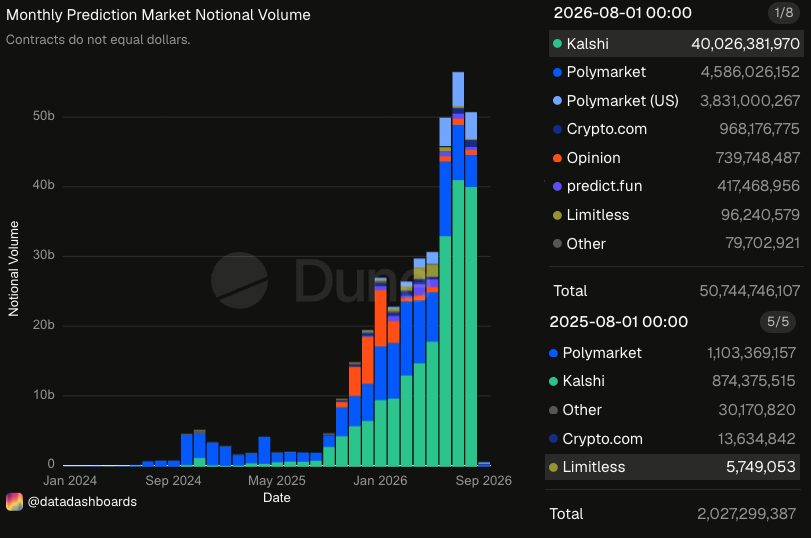
Beyond web traffic, Kalshi’s trading activity has demonstrated an even more breathtaking acceleration, showcasing the immense capital flowing through its platform. The company recorded approximately $40 billion in monthly notional trading volume in August, a monumental leap from $874 million just a year prior, representing an increase of roughly 4,500%, as detailed by a Dune Analytics prediction market data dashboard. This astounding growth in trading volume far outpaces the already impressive surge in web traffic, indicating that not only are more users flocking to the platform, but they are also engaging in significantly larger and more frequent trades. This points to a deepening liquidity and confidence in Kalshi’s markets, attracting serious participants alongside casual users.

The broader prediction market industry has also seen remarkable expansion during this period, with monthly notional volume across all platforms rising to $50.7 billion from about $2 billion over the same year. Crucially, Kalshi dominates this burgeoning sector, accounting for nearly 79% of the total volume, cementing its position as the undisputed leader in a rapidly evolving market. This market dominance highlights Kalshi’s successful strategy in attracting and retaining users, building robust market infrastructure, and offering a diverse range of contracts that resonate with a wide audience. A significant driver of this trading volume, and indeed the regulatory friction, comes from its sports contracts, which alone accounted for 83% of Kalshi’s trading volume in July, as reported by Barron’s. This concentration in sports-related markets amplifies the "gambling" perception in the eyes of state regulators, intensifying the legal scrutiny.
The regulatory environment for prediction markets is notoriously complex and fragmented. The CFTC, which traditionally oversees derivatives markets, has generally taken a more permissive stance, recognizing the potential for prediction markets to offer valuable economic insights and price discovery mechanisms. Kalshi itself operates as a CFTC-regulated designated contract market (DCM), a status it actively sought to legitimize its operations. However, various states, including New Jersey and Michigan, argue that many of Kalshi’s contracts, particularly those related to sports outcomes, cross the line into illegal gambling under state laws. This jurisdictional conflict creates a precarious operating environment for platforms like Kalshi, forcing them to navigate a patchwork of regulations and legal challenges that could fundamentally alter their business model. The Supreme Court’s involvement signals the national importance of this issue, as its ruling could provide much-needed clarity or, conversely, create further complications for an industry striving for mainstream acceptance.
Adding another layer of complexity, Kalshi has also observed growing traffic from jurisdictions where its direct platform access is currently restricted, such as Canada and the United Kingdom. Canada generated approximately 450,000 visits to Kalshi’s website in July, a substantial increase from roughly 50,000 in August 2025. Similarly, UK traffic surged to 296,000 visits from 31,000 over the same period. Kalshi’s member agreement explicitly prohibits users from directly accessing or trading on its platform from these countries, raising questions about how this traffic is being generated. While it’s possible some users employ VPNs or other methods to circumvent geographical restrictions, Kalshi has also pursued alternative strategies for international engagement. For instance, in June, Kalshi partnered with Canadian financial services company Wealthsimple to provide access to nearly 4,000 eligible Kalshi contracts through a separate, regulated app, offering a potential explanation for some of the Canadian traffic. This partnership model could represent a template for Kalshi’s future international expansion, navigating local regulations by integrating with established financial entities.
Despite the absolute increase in visits from Canada and the UK, their proportional share of Kalshi’s total traffic has actually slipped. From August 2025 to July 2026, Canada’s share fell from 3.8% to 2.3%, while the UK’s share decreased from 2.4% to 1.5%. This indicates that while international interest is growing, the platform’s core growth remains overwhelmingly concentrated in the US, further highlighting the significance of the domestic regulatory battles. The company has not yet provided comment on the specific nature of the traffic from restricted jurisdictions, leaving open questions about the effectiveness of its access restrictions and the full impact of its international partnership strategies.
The implications of the ongoing legal battles extend far beyond Kalshi. A Supreme Court decision in favor of state gambling laws could severely curtail the types of contracts prediction markets can offer, especially those with perceived similarities to sports betting. Conversely, a ruling that upholds the CFTC’s jurisdiction and the financial derivative classification could open the floodgates for even broader innovation and adoption of prediction markets across a wider array of real-world events. This legal ambiguity poses significant risks for investors and users, as the status of their contracts could change based on judicial outcomes. For Kalshi, maintaining its growth trajectory and market dominance will depend not only on its ability to innovate and attract users but also on its success in navigating these complex legal waters. The company’s vision of democratizing access to markets and providing valuable tools for hedging and price discovery hinges on a clear and favorable regulatory framework.
In conclusion, Kalshi is at a critical juncture, experiencing unprecedented growth in both user engagement and trading volume, solidifying its position as a dominant force in the prediction market industry. This impressive expansion, however, is occurring under the looming shadow of intense regulatory scrutiny and a high-stakes legal battle that could redefine the future of prediction markets in the United States. The New Jersey Supreme Court case, now escalated to the federal level, will be a watershed moment, determining whether Kalshi’s popular event contracts, particularly those related to sports, are treated as financial instruments under federal oversight or as forms of gambling subject to state prohibitions. As Kalshi strategically explores international partnerships to expand its reach, the core challenge remains domestic: harmonizing its innovative offerings with the fragmented and often conflicting regulatory interpretations across US jurisdictions. The outcome of these legal contests will undoubtedly shape not only Kalshi’s trajectory but also the broader landscape of financial innovation and regulatory governance in the digital age.