Imroatul Nasiyah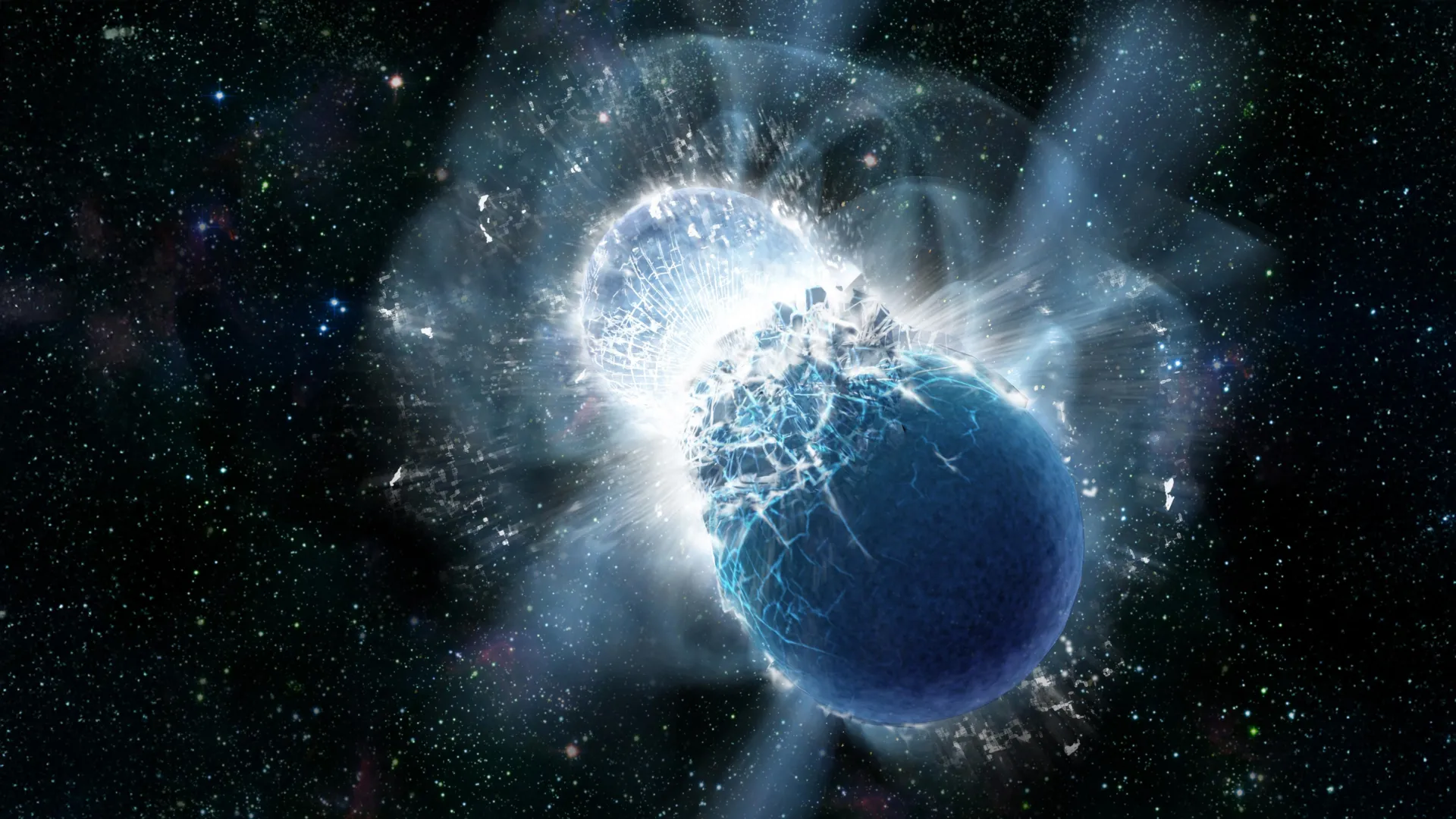
The universe’s elemental tapestry, from the lightest hydrogen to the heaviest naturally occurring elements, is woven through a series of spectacular cosmic dramas. Many of the chemical elements that populate our planet and the wider cosmos, particularly those residing at the heavier end of the periodic table, owe their very existence to the immense energies released during extreme astrophysical phenomena. Among the most pivotal of these cosmic forges are supernova explosions, the explosive deaths of massive stars, and the awe-inspiring collisions of neutron stars, the incredibly dense remnants of stellar collapse. These titanic events provide the extreme conditions necessary to drive the rapid neutron capture process, scientifically known as the r-process, which is the primary mechanism responsible for the creation of these heavy atomic nuclei.
The r-process itself is a testament to the chaotic yet elegant physics of the early universe. In this process, atomic nuclei, already existing from earlier nucleosynthesis stages, are subjected to an overwhelming flood of free neutrons. These neutrons are rapidly absorbed by the atomic nuclei. In a crucial subsequent step, some of these captured neutrons undergo beta decay, transforming into protons. This addition of protons increases the atomic number of the nucleus, thereby transforming it into a heavier element. This chain reaction of neutron capture and proton transformation allows nuclei to grow progressively larger, ultimately leading to the formation of many of the heavy elements we encounter in nature today, including gold, platinum, uranium, and many others.
However, accurately simulating the myriad nuclear reactions and the subsequent physical evolution of the ejected material during these events presents one of the most significant and computationally intensive challenges in the field of nuclear astrophysics. The sheer complexity of modeling the interactions between countless nuclei and neutrons, coupled with the vast range of energies and densities involved, demands astronomical amounts of computational power. This computational burden has historically necessitated significant simplifications in theoretical models, often leading to approximations that may limit the accuracy and predictive power of the simulations.
"Scientists across the globe are dedicated to unraveling the mysteries of these complex nuclear reactions through theoretical simulations," explains Dr. Oliver Just, the lead author of the study and a distinguished researcher within the "Nuclear Astrophysics & Structure" department at GSI/FAIR. "However, the process of modeling all the relevant parameters requires an almost unfathomable level of computing power, which is precisely why these models have often been forced into a state of oversimplification." Dr. Just continues, "Our newly developed model, RHINE, which leverages the power of artificial intelligence, offers a remarkably efficient and effective alternative, promising to bridge this critical gap in our understanding."
The innovative system, RHINE, stands as a testament to the transformative potential of machine learning in scientific research. At its core, RHINE employs a deep learning neural network, a sophisticated type of artificial intelligence, to accurately and efficiently estimate the amount of energy released during the nuclear reactions that characterize the r-process. This estimation is performed dynamically, in real-time, as the hydrodynamic simulations of stellar explosions and mergers are running. This energy release, often referred to as "heating" in astrophysical contexts, plays a profoundly important role in dictating the fate of the matter ejected during these violent cosmic events. It directly influences both the velocity at which this material is expelled into interstellar space and the subsequent emission of light, which astronomers observe as the brilliant glow of a kilonova in the case of neutron star mergers.
Traditionally, each simulation would require performing a complete and computationally expensive nuclear reaction network calculation for every time step. RHINE fundamentally changes this paradigm. Before being deployed in a live simulation, the AI model is meticulously trained on an extensive and comprehensive library of reference calculations. This training data is generated using complete, high-fidelity nuclear reaction networks, allowing the AI to learn the intricate relationships between nuclear processes and energy release. Once trained to a high degree of accuracy, RHINE can then predict the heating rates with remarkable precision, all while demanding only a minuscule fraction of the computational resources that would be needed for a full, first-principles calculation.
"The methodology involves a two-stage process," elaborates Dr. Zewei Xiong, another key scientist in GSI/FAIR’s "Nuclear Astrophysics & Structure" department and a principal architect of the machine learning models. "Initially, the machine learning models are rigorously trained using a vast quantity of reference calculations that incorporate the complete set of nuclear reactions relevant to the r-process. Subsequently, these trained models are integrated into running hydrodynamical simulations, where they efficiently approximate the heating rates during the r-process with minimal computational overhead."
Dr. Xiong further emphasizes the rigorous validation process: "Through detailed and exhaustive comparisons, we have meticulously validated our machine learning scheme against established reference data. The exceptionally high degree of agreement observed strongly suggests that the judicious application of machine learning models can lead to a monumental saving in computing time, a critical resource in astrophysical research." He adds, "Furthermore, our analysis of the results has led us to the significant deduction that r-process heating is not a peripheral effect but rather a crucial factor that warrants much more careful and detailed consideration in future modeling efforts."
The implications of RHINE extend far beyond mere computational efficiency. The researchers anticipate that this advanced AI tool will empower them to conduct significantly more detailed and nuanced simulations of neutron star mergers and other r-process nucleosynthesis events. This enhanced simulation capability, achieved while drastically reducing the demand on computational resources, holds the promise of unlocking deeper insights into the precise mechanisms by which heavy elements are created and distributed throughout the universe. These improved models are expected to play a pivotal role in bridging the gap between cutting-edge experimental research at upcoming facilities like FAIR and the observational data gathered by astronomers studying distant stellar explosions and neutron star mergers. This synergistic approach will allow scientists to test theoretical predictions against real-world cosmic phenomena with unprecedented accuracy, accelerating the pace of discovery in nuclear astrophysics.
In a move that underscores their commitment to open science and collaborative research, the RHINE source code has been made publicly available. This accessibility allows the broader scientific community to not only examine the methodology but also to build upon this foundational work, fostering further innovation and accelerating progress in the field. The development of RHINE was made possible through significant co-funding from various international organizations, including the esteemed European Research Council (ERC), highlighting the global recognition of its scientific importance and potential impact.