anjir abdul
Potentially taxable on-chain crypto activity is projected to reach at least a staggering $457 billion globally by 2025, yet a new report from blockchain analytics firm Chainalysis reveals that the Organisation for Economic Co-operation and Development’s (OECD) Crypto-Asset Reporting Framework (CARF) is poised to capture only a small fraction of this immense sum. This significant disparity underscores the profound challenges facing global tax authorities as they grapple with the complexities of taxing the rapidly evolving decentralized crypto ecosystem, potentially leaving hundreds of billions in tax revenue unaccounted for.
The Chainalysis report, a deep dive into the opaque world of on-chain transactions, paints a clear picture of both the scale of crypto economic activity and the limitations of current international reporting standards. While the global estimate stands at $457 billion, the United States alone accounts for an estimated $112.6 billion of this total, making it a critical hub for taxable crypto activity. Regionally, North America leads the pack with $134.6 billion, closely followed by the European Union at $125.1 billion, highlighting the pervasive nature of crypto adoption and its associated tax implications across developed economies. These figures, compiled through sophisticated on-chain analysis, represent a conservative estimate of the economic value generated and moved within the transparent yet often pseudonymous ledgers of various blockchains.
Crucially, the Chainalysis estimates are not all-encompassing. They meticulously include realized gains from crypto asset sales, income derived from active participation in blockchain networks such as mining, staking, and lending, as well as crypto-denominated payments across six major blockchains. This methodology focuses specifically on activities that leave a verifiable trace on public ledgers. However, it explicitly excludes trading and other financial activities conducted within centralized exchanges. This exclusion is particularly significant because CARF, by its very design, does aim to cover transactions facilitated by centralized crypto service providers. The fact that Chainalysis’s on-chain estimate still reaches nearly half a trillion dollars, even without including centralized exchange activity, suggests that the total universe of taxable crypto activity is far larger than $457 billion, further emphasizing the scale of the tax compliance challenge.
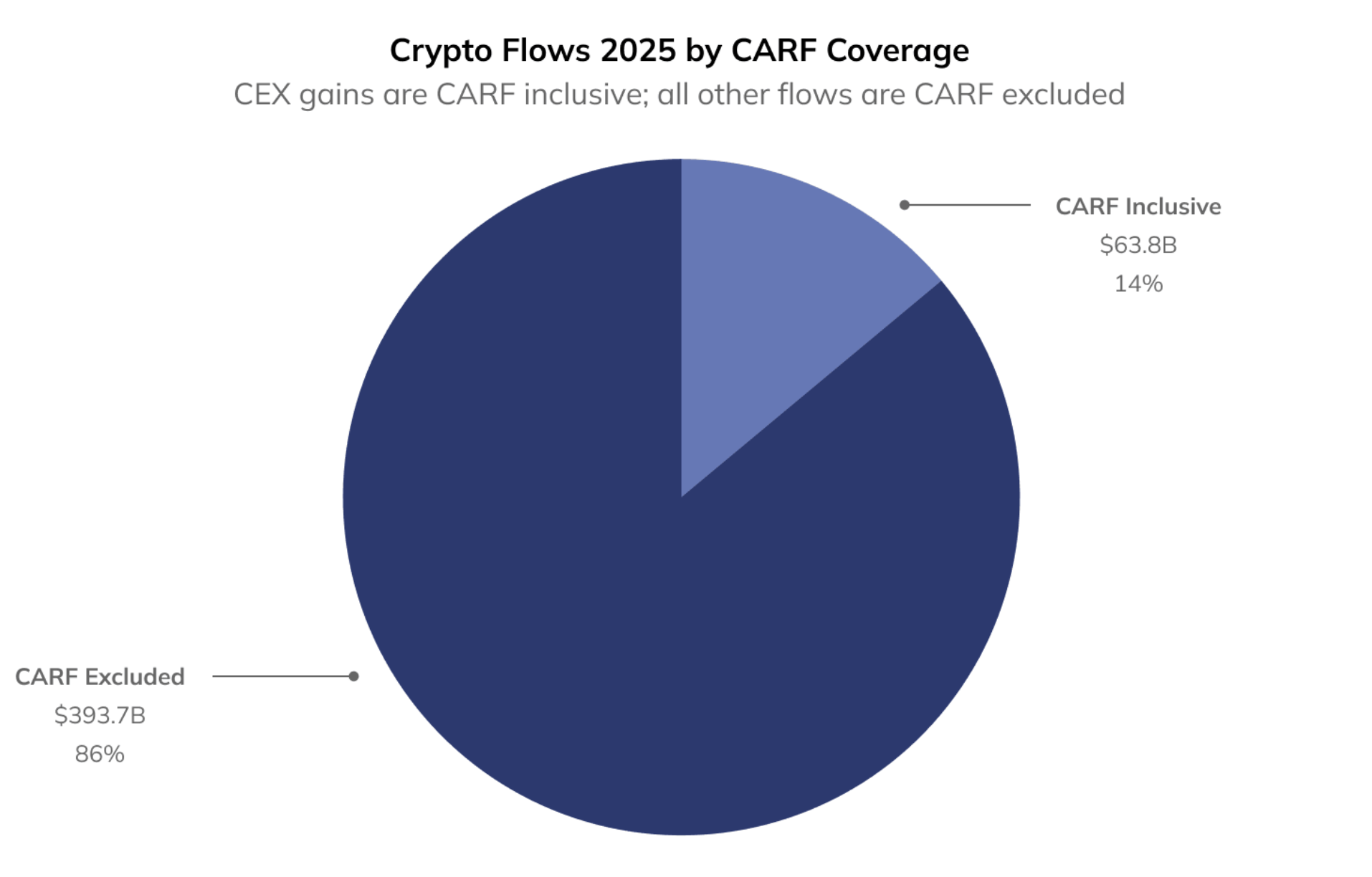
The most startling revelation from the Chainalysis report is the stark inefficiency of CARF in addressing the broader crypto landscape. The firm’s analysis indicates that transactions covered by CARF account for a mere 14% of the identified on-chain taxable activity. This means a colossal 86% of potentially taxable on-chain activity falls outside CARF’s reporting perimeter. This vast unreported segment includes activity on decentralized exchanges (DEXs), direct peer-to-peer (P2P) transfers between individuals, various on-chain income streams that bypass intermediaries, and direct crypto payments. This gap represents a gaping hole in the global tax net, allowing a significant portion of crypto wealth generation to potentially evade traditional reporting mechanisms.
Developed by the OECD in 2022, the Crypto-Asset Reporting Framework (CARF) was conceived as a landmark international standard for the automatic exchange of information on crypto-assets. Its primary objective is to enhance tax transparency and combat tax evasion by requiring covered crypto service providers (CSPs) to collect and report customer transaction data to their domestic tax authorities. These authorities can then exchange this information with other jurisdictions where the customer is a tax resident, mirroring the success of the Common Reporting Standard (CRS) for traditional financial assets. The framework was hailed as a crucial step towards bringing crypto assets into the fold of global tax compliance, a necessary adaptation to the increasingly digitized and globalized financial landscape.

The operationalization of CARF began on January 1, 2026, across 48 jurisdictions, including major economic blocs like the United Kingdom and the European Union. Under this framework, in-scope crypto providers are mandated to collect comprehensive customer information, including tax residency details, and report specific transaction data. This data encompasses exchanges between crypto assets and fiat currencies, exchanges between different crypto assets, transfers of crypto assets, and certain other transactions. The aim is to provide tax administrations with the necessary visibility into crypto transactions facilitated by regulated entities, thereby enabling them to enforce tax obligations more effectively.
However, Chainalysis’s findings reveal the inherent limitations of CARF’s design, which largely stems from its focus on intermediaries. As Colby Mangels, a former OECD adviser who contributed to CARF’s development, previously told Cointelegraph, the framework was designed around entities that facilitate crypto transactions as a business. This foundational principle, while effective for centralized exchanges and other regulated service providers, creates an immediate and substantial blind spot for the burgeoning decentralized finance (DeFi) sector.
Much of decentralized finance operates without a centralized operator or a traditional custodial relationship that would typically trigger reporting requirements under CARF. Decentralized exchanges (DEXs) allow users to trade directly from their self-custodied wallets, often interacting only with smart contracts. Lending and borrowing protocols enable peer-to-peer financial activities without a central bank or financial institution. Yield farming, liquidity provision, and other complex DeFi strategies generate income directly on-chain, often without any identifiable "service provider" in the traditional sense. These activities, by their very nature, bypass the intermediary-centric reporting structure of CARF, leaving the vast majority of their potentially taxable value untracked by the framework.
The implications of this 86% gap are profound and far-reaching. Firstly, it represents a potentially enormous loss of tax revenue for governments worldwide. With nearly half a trillion dollars in on-chain taxable activity, even a modest tax rate could translate into tens or even hundreds of billions in lost revenue annually. This shortfall could impact public services, fiscal stability, and the overall fairness of the tax system.
Secondly, it creates a significant inequity in the tax system. Individuals and entities who primarily use centralized exchanges, which are covered by CARF, will find their crypto activities reported to tax authorities. In contrast, those who engage heavily in DeFi, P2P transfers, or other direct on-chain activities may face little to no external reporting, placing a disproportionate burden on the former and potentially incentivizing a migration towards less regulated segments of the market. This regulatory arbitrage undermines the very goal of a fair and transparent tax system.
Thirdly, the gap presents immense challenges for tax authorities. Without automated reporting, they must rely on individual self-reporting, which is notoriously difficult to verify for complex on-chain activities. This necessitates a shift towards more sophisticated investigative techniques, including the use of on-chain analytics tools like those provided by Chainalysis, to identify and trace potentially taxable events. This is a resource-intensive and technically challenging endeavor for even the most advanced tax administrations.
The Chainalysis report implicitly highlights the urgent need for regulators to adapt their frameworks to the realities of decentralized technology. Colby Mangels’s observation that tax authorities are closely watching developments in anti-money laundering (AML) regulation is particularly pertinent here. Efforts to determine when DeFi platforms or their operators should be treated as regulated crypto service providers for AML purposes could pave the way for similar classifications in the tax realm. However, the truly decentralized nature of some protocols makes identifying a responsible reporting entity extremely difficult, if not impossible, under current legal paradigms.
Looking ahead, addressing this colossal tax gap will require a multi-faceted approach. One avenue involves the development of new regulatory frameworks that specifically target decentralized protocols, perhaps by imposing reporting obligations on developers, smart contract deployers, or even front-end interface providers. Another involves the creation of "responsible DeFi" standards, where protocols are designed with built-in features that facilitate tax compliance, such as enhanced on-chain transparency for tax reporting or integration with third-party compliance solutions.
Furthermore, the onus will increasingly fall on individual crypto users to understand and comply with their tax obligations for on-chain activities. This necessitates improved educational resources from tax authorities, clearer guidance on how to calculate gains and income from various DeFi activities, and the proliferation of user-friendly crypto tax software that can analyze wallet activity and generate comprehensive tax reports. Companies like Chainalysis, with their advanced analytics capabilities, will undoubtedly play a crucial role in assisting both government agencies and private enterprises in navigating this complex landscape.
In conclusion, the Chainalysis report serves as a stark warning and a critical call to action. While the OECD’s CARF is a commendable step towards global crypto tax transparency, its current scope is demonstrably insufficient to capture the vast and growing volume of taxable activity within the decentralized crypto ecosystem. The estimated $457 billion in potentially taxable on-chain activity by 2025, with 86% falling outside CARF’s purview, underscores the urgent need for innovative regulatory solutions that can bridge the gap between traditional tax enforcement and the borderless, permissionless nature of blockchain technology. The ongoing evolution of the crypto market demands an equally adaptive and comprehensive approach from tax authorities worldwide to ensure fairness, prevent tax evasion, and secure legitimate public revenues in the digital age.