Faris Adani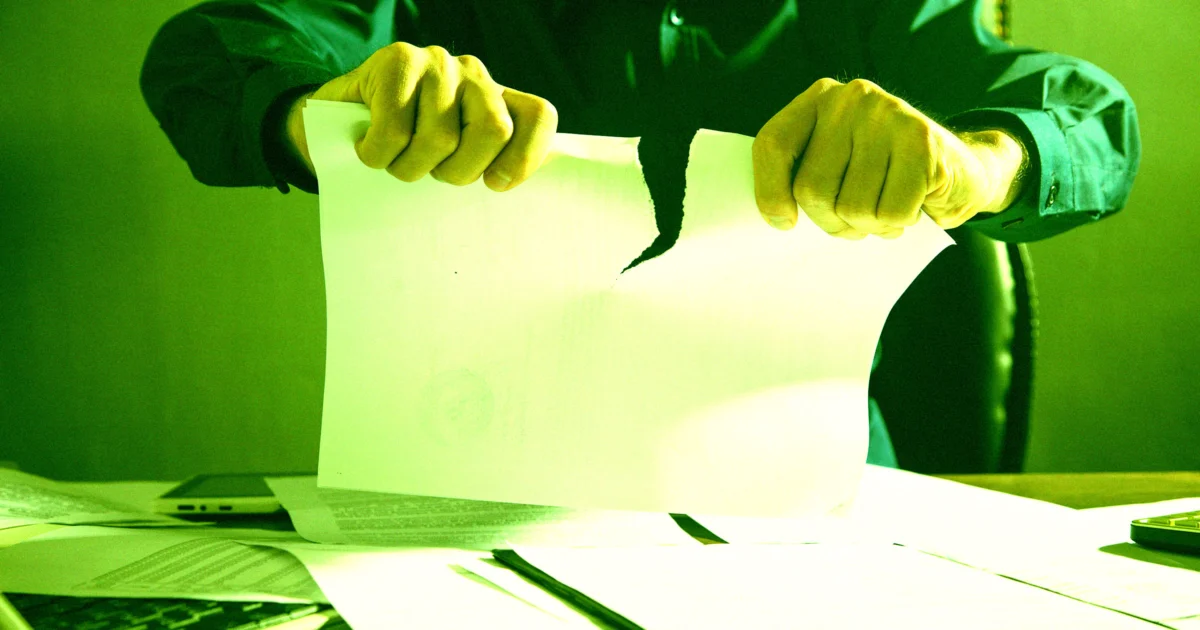
Major Publisher Cans $2.4 Million Book Deal After Author Was Accused of Using AI, for a Very Cynical Reason
In a stunning development that reverberates through the global publishing industry and Hollywood, Minotaur Books, an imprint of the prestigious Macmillan US, has sensationally withdrawn from a staggering $2.4 million deal for an unpublished debut novel, “Call Me, I’ll Hide the Body,” by emerging author Jerry Falade. This unprecedented move, first reported by Deadline, casts a harsh spotlight on the escalating crisis of artificial intelligence in creative fields, particularly within literature, exposing the profound uncertainties and existential threats it poses to established practices and artistic integrity. The decision, however, wasn’t driven by a sudden moral awakening or a clear ethical stand against AI-generated content; rather, it stemmed from a deeply pragmatic, almost cynical, concern over the potential inability to secure copyright for a work suspected of containing AI-generated passages, thus rendering the publisher’s multi-million dollar investment inherently risky and indefensible.
This revelation marks a precarious inflection point for an industry already grappling with the rapid proliferation of generative AI. The core issue for Minotaur Books, and by extension, Macmillan US, is not just the perceived “authenticity” of the author’s voice, but the very legality and protectability of the literary asset itself. Under current U.S. copyright law, works must demonstrate human authorship to be eligible for protection. If portions of Falade’s manuscript were indeed crafted by AI, even partially, it could jeopardize the entire work’s copyright status. This uncertainty makes the book a financial liability, as the publisher would struggle to defend its rights against infringement, license it effectively for adaptations, or even sell subsidiary rights globally. It’s a stark illustration of how rapidly evolving technology is forcing traditional industries to confront fundamental questions about ownership, creativity, and economic viability.
The situation underscores a growing crisis where “AI slop” – a derogatory term for low-quality, often unoriginal content generated by algorithms – is making it increasingly arduous for genuine human writers to distinguish themselves and gain recognition. The very accusation of AI usage, regardless of its veracity, has become a potent weapon capable of derailing careers and undermining trust. The technology has unleashed a maelstrom of confusion and suspicion in the publishing world, creating a messy landscape that seems to defy any straightforward cleanup. This incident highlights not just the technological challenge but also the profound psychological impact on authors, publishers, and readers who are left to navigate a new reality where the line between human ingenuity and algorithmic output is increasingly blurred and contested.
The stakes for “Call Me, I’ll Hide the Body” were extraordinarily high. Even before its official publication, the crime novel had generated significant buzz, attracting fierce competition from film and television studios worldwide vying for adaptation rights. This widespread interest made the discovery of alleged AI “fingerprints” – tell-tale signs or stylistic anomalies indicative of algorithmic generation – particularly devastating. These “fingerprints” are often identified through specialized AI detection software, which analyzes text for patterns, syntax, and vocabulary common to large language models. While Falade has vehemently denied the accusations, maintaining his innocence and asserting sole human authorship, the mere presence of these indicators was enough to trigger alarm bells and ultimately dismantle a deal that promised to launch both a novel and a career into the stratosphere.
Sandy Hodgman, an independent agent at Hodgman Literary, conveyed the gravity of the situation in an email to international publishers, obtained by Deadline. Her words reveal the profound disappointment and the breakdown of trust that precipitated the withdrawal. “[The author] produced an incredible manuscript that dazzled us and the top publishing professionals around the world,” Hodgman wrote, underscoring the initial enthusiasm and belief in the work’s quality. However, the subsequent paragraphs delivered the crushing blow: “Unfortunately, we are no longer able to authenticate how the manuscript fully evolved from origin to completion.” This statement is critical, indicating a fundamental inability to verify the author’s process, which is now paramount in an era where AI can mimic human creativity with unsettling accuracy.
Hodgman further elaborated on the agency’s due diligence, revealing the extent to which AI concerns are already integrated into the submission process. “During the submission process we vetted the manuscript with [the author] for AI and felt trusting in his reassurance that it was written without utilizing AI as a resource in the writing or editorial process,” she added. This implies that the agency had directly questioned Falade about AI use and received assurances. The subsequent retraction — “We can no longer substantiate that, and we are withdrawing the book” — speaks volumes about the weight given to these AI detection results and the publisher’s legal team’s concerns, overriding initial trust and enthusiasm. As a direct consequence, several companies that had already initiated the sale of rights to the hotly anticipated crime novel promptly ceased operations, pulling out of the project entirely, leaving a significant void and financial losses in their wake.
This incident is not an isolated one but rather a potent symbol of an industry in turmoil, reeling from an overwhelming influx of AI-generated content. The ethical quandaries are numerous: human authors are witnessing their life’s work being unceremoniously scraped and repurposed by generative AI tools, often without consent or attribution, leading to accusations of systemic plagiarism. Online marketplaces, most notably Amazon, are being inundated with entirely AI-generated books, making it increasingly difficult for legitimate human authors to stand out and reach their audiences. This digital deluge not only devalues original content but also creates an unfair playing field where algorithms can produce vast quantities of text at speeds and scales impossible for human creators, drowning out authentic voices and narratives.
The problem has grown so severe that even leading AI developers are taking notice. OpenAI, the creator of the blockbuster chatbot ChatGPT, recently directed its model to start refusing requests to mimic a specific author’s style, as reported by Ars Technica. This policy change, likely influenced by growing legal pressures and public backlash, acknowledges the ethical minefield of AI appropriating distinct human creative voices. While a step towards greater responsibility, it also highlights the inherent capabilities of these models to replicate and simulate, further complicating the definition of originality and creative ownership in the digital age.
Yet, despite these developments, glaring questions surrounding the use of AI and the thorny issue of copyright infringement remain largely unanswered, as countless lawsuits slowly work their way through the court system. Just earlier this month, a formidable coalition of major publishers, including industry giants, launched a lawsuit against Google, accusing the tech behemoth of illegally scraping millions of copyrighted books to train its advanced Gemini AI model. These legal battles represent the publishing world’s desperate attempt to assert control and protect intellectual property in the face of an AI revolution that threatens to upend established legal frameworks and revenue streams. The outcomes of these cases will undoubtedly set precedents that could redefine the future of authorship and publishing.
The precise extent of AI involvement in Jerry Falade’s sought-after novel remains murky, making the unfolding situation particularly intriguing and emblematic of the larger crisis. Entertainment journalist Jeff Sneider reported that Falade would now be required to return the substantial advance money, adding financial injury to the professional and reputational damage. Falade’s raw, emotional response, shared with Sneider over the phone, paints a poignant picture of an author caught in a technological crossfire he doesn’t fully comprehend. “The accusations are wrong, and I am completely innocent,” the author asserted, his voice filled with a sense of injustice. “I was on the verge of success, and then all of a sudden, there were rumors, but no one asked me anything. I don’t know why my agency did not have my back.”
His subsequent words conveyed a profound sense of isolation and despair. “I’ve lost so much already,” Falade added. “I have no one to call… no friends in this industry. I don’t know anything. I simply wrote my manuscript, and it sparked crazy bidding wars across multiple countries.” This personal account humanizes the abstract discussions around AI, revealing the devastating impact on individual creators whose lives and livelihoods are intertwined with their art. It exposes the vulnerability of authors in a system where unproven accusations, fueled by technological uncertainty, can lead to the instantaneous collapse of years of hard work and dreams.
This incident follows closely on the heels of a similar controversy earlier this year involving author Mia Ballard, whose novel, “Shy Girl,” was pulled from shelves back in March after she faced widespread accusations of using AI to assist in its writing, as extensively reported by The New York Times. Ballard’s experience mirrors Falade’s in its public nature and devastating personal toll. “This controversy has changed my life in many ways and my mental health is at an all time low and my name is ruined for something I didn’t even personally do,” she told the newspaper, underscoring the severe psychological and reputational damage that can result from such allegations, whether proven or not. Both cases serve as stark warnings to aspiring and established authors alike, illustrating the fragile nature of trust and reputation in an age dominated by generative AI.
The Minotaur Books decision is more than just a cancelled book deal; it’s a seismic event that signifies a critical turning point for the publishing industry. It highlights the urgent need for clearer guidelines, robust ethical frameworks, and potentially new legal definitions of authorship in the age of AI. Publishers are no longer just evaluating literary merit but also the provenance of the text itself. Authors face an added layer of scrutiny, where proving human authenticity might become as crucial as crafting compelling narratives. As the dust settles on this $2.4 million loss, the industry is left with the daunting task of navigating a future where the creative landscape has been irrevocably altered, and the very essence of what it means to be an “author” is being challenged and redefined.
More on authors and AI: Novel Pulled From Shelves After Author Is Accused of Using AI