Faris Adani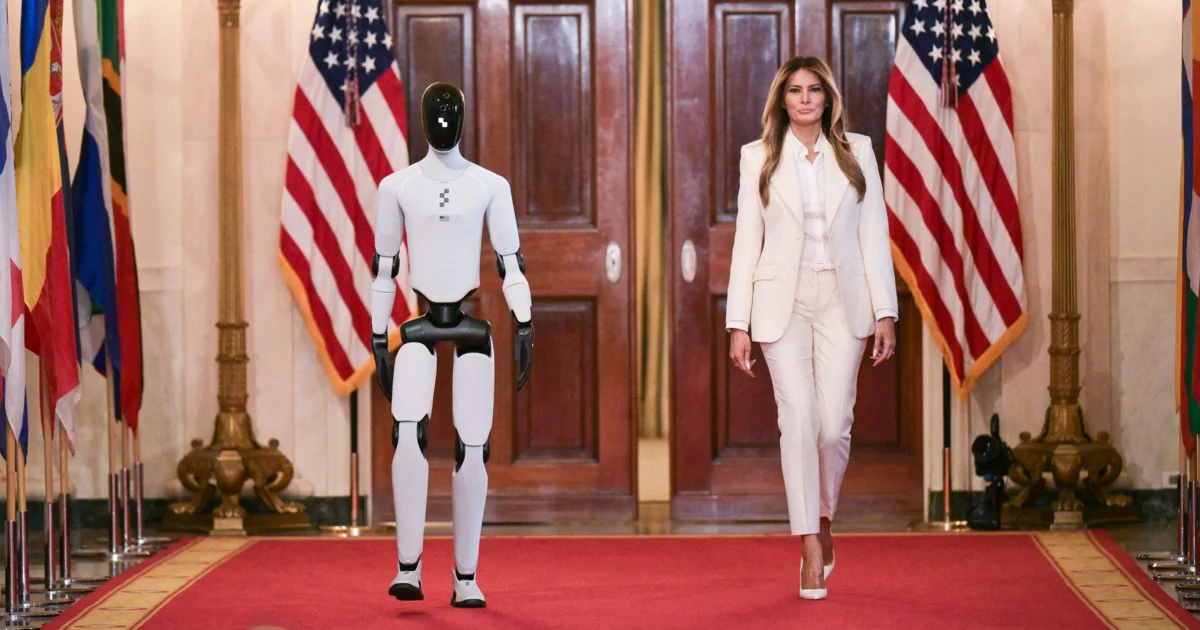
In a spectacle that blurred the lines between political pageantry and science fiction, First Lady Melania Trump made a striking entrance at a White House summit this past Wednesday, not with a dignitary or a political ally, but with a black-and-white humanoid robot named Figure 03. The event, part of the administration’s "Fostering the Future Together" initiative, aimed to champion the role of advanced technology in children’s education, yet the surreal optics and the First Lady’s subsequent early departure left many questioning the genuine depth of the administration’s commitment to thoughtful technological integration in learning.
The scene unfolded in the stately Eastern Room of the White House, typically reserved for formal gatherings and diplomatic exchanges. On this particular day, however, tradition met a futuristic vision as Melania Trump, known for her poised public appearances, walked down the red carpet alongside the sleek, bipedal machine. Figure 03, the third-generation humanoid robot developed by the US-based company Figure, moved with a deliberate, almost eerily human-like gait, its smooth, unblemished chassis reflecting the room’s ornate chandeliers. The robot, first introduced to the public in October of the previous year, is touted by its creators as a "truly general-purpose robot," designed with the ambitious goal of performing "human-like tasks" and learning directly from people through advanced reinforcement learning and artificial intelligence. Its presence was meant to symbolize the apex of innovation, a tangible representation of the "future" the summit purported to foster.
The "Fostering the Future Together" initiative was officially framed as an effort to "help children learn, grow, and thrive through the safe and innovative use of advanced technology." The summit itself attracted a notable contingent of international figures, including French First Lady Brigitte Macron and Ukraine’s First Lady Olena Zelenska, underscoring the perceived global importance of the discussion. However, the immediate impact of the robot’s appearance was less about collaboration and more about an unsettling juxtaposition. The silent march of the machine beside the First Lady, against the backdrop of an event focused on the delicate nuances of child development and education, struck many observers as profoundly jarring.
Following the initial walk, the robot itself addressed the cameras, its synthesized female voice echoing through the historic room. "Thank you, first lady Melania Trump, for inviting me to the White House," Figure 03 intoned, a statement that felt both polite and profoundly alien. "I am grateful to be part of this historic movement to empower children with technology and education." The brief, almost rote declaration was met with an awkward, almost stunned silence from those gathered, a pause that spoke volumes about the cognitive dissonance of the moment. It was Melania Trump who eventually broke the quiet, with a touch of nervous laughter, stating, "It’s fair to state: you are my first American-made humanoid guest in the White House."
In her introductory remarks, the First Lady further elaborated on her vision, lauding the robot as the very personification of the "future of AI." Her pronouncements painted a picture of an impending era where artificial intelligence would transcend its current digital confines. "It will be formed in the shape of humans," she asserted. "Very soon, artificial intelligence will move from our mobile phones to humanoids that deliver utility." This statement encapsulated a forward-looking, almost utopian view of AI, emphasizing its potential for practical application and seamless integration into daily life, particularly within educational frameworks. The administration’s rhetoric consistently positions AI as an indispensable tool for progress, a technological tide that will lift all boats, especially in preparing young Americans for an "AI-driven workforce."
This public embrace of AI as an educational panacea, however, stands in stark contrast to the Trump administration’s broader approach to education policy. While actively promoting AI education, the administration has been simultaneously engaged in significant structural shifts within the traditional education system. Reports from late last year detailed plans for a massive restructuring, if not outright dismantling, of the US Department of Education. Concurrently, the administration has pursued controversial and "shameful anti-trans policies at schools," further illustrating a fragmented and often contradictory educational agenda. The focus on AI, therefore, appears to serve as a high-tech diversion or a strategic pivot, allowing the administration to project an image of innovation while disengaging from more conventional, and often contentious, educational reforms. The implicit message is that technological advancement can compensate for, or even render obsolete, traditional educational infrastructure and progressive social policies.
The company behind Figure 03, Figure AI, represents a growing frontier in robotics, driven by the vision of creating truly versatile humanoid robots. Unlike specialized industrial robots, Figure 03 is designed for broad utility, aiming to navigate and interact with human environments in a way that allows it to perform a multitude of tasks. Its ability to "learn directly from people" through reinforcement learning is a key differentiator, suggesting a future where robots can adapt and acquire new skills without extensive pre-programming. This technological leap promises efficiencies and new capabilities across various sectors, from logistics and manufacturing to, as the White House event suggested, potentially even education and social interaction. The ambition of Figure AI, and indeed the broader humanoid robotics industry, is to move beyond mere automation to create companions and workers that can seamlessly integrate into human society, performing functions that require dexterity, adaptability, and even a degree of social intelligence.
Despite the administration’s enthusiastic promotion of AI in education, a significant body of research and expert opinion points to the "extensive and well-documented shortcomings" of these technologies, particularly when applied to the formative stages of learning. Critics argue that the current generation of AI tools, while powerful in specific applications, lacks the nuanced understanding, empathy, and critical reasoning skills essential for effective pedagogy. Professors and educators across the country have voiced serious concerns, with some observing that AI is actively "destroying students’ ability to think critically," encouraging reliance on automated responses rather than fostering independent thought and problem-solving. Furthermore, there are worries that over-reliance on AI could be "undermining children’s social and intellectual development," potentially stunting the growth of crucial interpersonal skills and emotional intelligence that are cultivated through human-to-human interaction in traditional learning environments.
The dangers extend beyond intellectual atrophy. There are documented instances of AI systems "teaching them potentially dangerous lessons," due to biases embedded in their training data, susceptibility to misinformation, or simply a lack of common sense and ethical reasoning. Issues of data privacy, algorithmic bias, and the potential for creating an even wider digital divide among students from different socioeconomic backgrounds also loom large. Many educators contend that while AI can be a valuable tool within education, it cannot, and should not, replace the irreplaceable role of human teachers, who provide not just instruction but also mentorship, emotional support, and the ability to adapt teaching methods to individual student needs in real-time. The White House’s singular focus on AI as a solution, without adequately addressing these profound concerns, struck many as a superficial approach to a deeply complex issue.
The "jarring optics" of the robot’s presence at an education summit were compounded by Melania Trump’s actions immediately following her introductory remarks. After struggling slightly to read from a printed script, the First Lady abruptly left the room, skipping the subsequent panel discussion on AI and education and the related networking opportunities. This swift exit, as reported by CNN, raised further questions about the administration’s genuine engagement with the intricate challenges and ethical considerations surrounding AI in learning. For many, it underscored a perception that the event was more of a photo opportunity and a high-tech publicity stunt than a serious forum for substantive policy discussion. The message seemed to be that the spectacle of innovation was paramount, while the detailed, often difficult, conversations about its implementation were secondary.
In essence, the White House event served as a potent symbol of the current technological and political moment. It highlighted an administration eager to embrace the futuristic allure of AI, positioning itself at the vanguard of technological progress, particularly in the realm of education. Yet, this forward-looking vision was presented in a manner that seemed to gloss over critical concerns, side-step genuine policy debate, and even, through the First Lady’s quick departure, suggest a lack of deep engagement with the very issues being promoted. The image of Melania Trump walking alongside Figure 03 will undoubtedly endure as a surreal snapshot of an era grappling with the promise and peril of artificial intelligence, leaving a lasting impression of a future that is both thrillingly advanced and profoundly uncertain, especially for the impressionable minds it purports to serve.