Faris Adani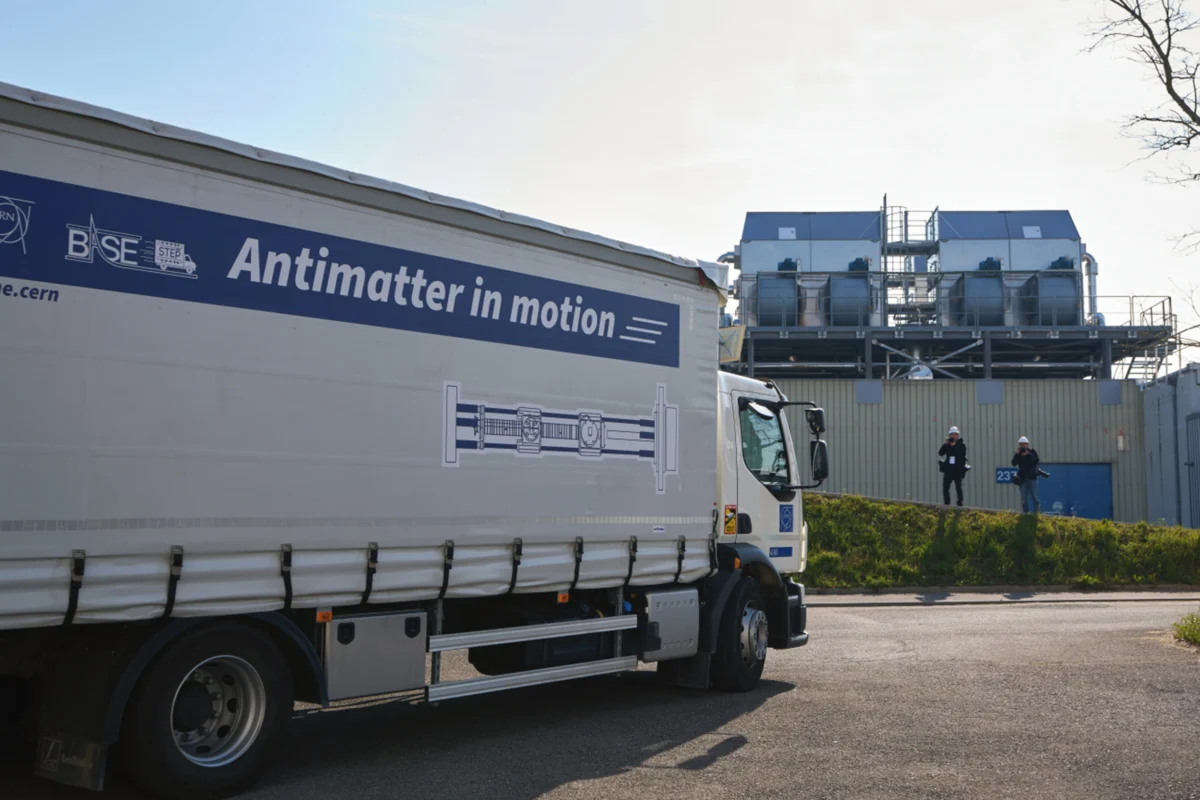
In a monumental stride for fundamental physics, a dedicated team of researchers at the European Organization for Nuclear Research (CERN) has achieved the world’s inaugural transport of antimatter particles, a feat previously confined to the realm of science fiction. On a Tuesday morning, a custom-designed truck meticulously traversed the CERN campus on the outskirts of Geneva for thirty tense minutes, carrying 92 precious antiprotons sealed within a state-of-the-art cryogenic vacuum bottle. This historic journey, undertaken at a cautious 26 miles per hour, marks a pivotal moment, enabling antimatter to be moved from its primary production site to another on-campus laboratory, mitigating "experimental noise" and paving the way for distributed antimatter research beyond CERN’s formidable walls.
Antimatter, often described as matter’s elusive mirror image, consists of particles that possess the same mass as their ordinary matter counterparts but with opposite electrical charges and other quantum numbers. For instance, an antiproton, the cargo of this groundbreaking delivery, carries a negative charge, contrasting with the positive charge of a proton. The inherent challenge with antimatter lies in its extreme instability; upon contact with ordinary matter, it undergoes mutual annihilation, converting both mass into pure energy. This fundamental property makes antimatter extraordinarily difficult to produce, store, and manipulate, let alone transport over any distance. For decades, the notion of "bottling" antimatter and moving it was considered an ambitious, distant dream, primarily due to the intricate conditions required to isolate it from all ordinary matter.
CERN stands as the undisputed global epicenter for antimatter production and research. Its "antimatter factory," primarily composed of the Antiproton Decelerator (AD) and the more recent Extra Low ENergy Antiproton (ELENA) facilities, is the only place on Earth capable of producing and slowing down antiprotons to energies low enough for experimental study and trapping. These facilities generate antiprotons by smashing high-energy protons into iridium targets, creating a shower of particles, from which antiprotons are then carefully selected, decelerated, and cooled. Given the minuscule quantities that can be captured and contained, each individual antiproton is an incredibly valuable scientific resource, representing countless hours of complex accelerator operation and meticulous experimental work.
The imperative for this daring transport arose from the need to conduct certain experiments in an environment free from the "experimental noise" generated by the bustling particle accelerator complex. As reported by Nature, physicists recognized that subtle background radiation, electromagnetic interference, and other environmental factors within the main accelerator area could subtly impact the ultra-precise measurements they aimed to perform on antiprotons. Moving the contained antimatter to a quieter, dedicated laboratory on campus would provide the pristine conditions necessary for unprecedented accuracy in their investigations.
To achieve this unprecedented feat, the 92 antiprotons were meticulously sealed within a specially designed Penning trap. This sophisticated device utilizes a combination of powerful electric and magnetic fields to confine charged particles, preventing them from touching the trap’s walls and thereby avoiding annihilation. Crucially, the entire system was cooled to an astonishing 4 Kelvin (approximately -452.47 degrees Fahrenheit or -269.15 degrees Celsius) – just a few degrees above absolute zero. Such extreme cryogenic temperatures are essential to minimize thermal motion of the antiprotons, making them easier to control and preventing them from escaping the trap. The vacuum within the bottle was maintained at an ultra-high level, ensuring that even stray air molecules, which are ordinary matter, would not compromise the precious cargo.
Christian Smorra, the physicist who spearheaded this pioneering project, articulated the profound significance of the achievement, stating to Nature, "Now it’s finally possible." His colleague, Stefan Ulmer, echoed this sentiment, describing the event as "something humanity has never done before, it is historic." The successful transport represents the culmination of more than three decades of aspiration since CERN’s antiproton facilities first became operational. The collective euphoria among the scientific community was palpable, with Ulmer revealing, "We bought a lot of champagne, and we invited the entire antimatter community to celebrate with us today." This celebration was not merely for a technical success, but for unlocking a new frontier in the study of fundamental particles.
A natural concern for many, especially given antimatter’s depiction in popular culture, is the potential danger associated with its transport. CERN has proactively addressed these concerns, providing clear scientific reassurances. A note on CERN’s antimatter hub explicitly states, "If the trap fails during transport and the antiparticles annihilate, the energy released will be about a millionth of a Joule. A single key press on a keyboard is about 10,000 times more than that. So antimatter transportation is no more dangerous than any other form of goods transportation." This crucial clarification dispels any sensationalized fears, emphasizing that the minuscule quantity of antimatter involved in these experiments poses absolutely no risk to human life or the environment. The destructive potential often imagined is only relevant if one were to transport vastly larger, practically unobtainable quantities of antimatter, far beyond anything conceivable with current technology.
The successful demonstration of stable antimatter transportation holds immense implications for the future of physics. Foremost among them is the potential to democratize antimatter research. Up until now, any experiment requiring antiprotons had to be conducted directly within CERN’s complex. With this proven transport method, researchers at other institutions, potentially thousands of miles away, could theoretically receive their own shipments of antiprotons. This distributed access could accelerate discovery by fostering new collaborations, enabling a wider array of specialized experiments, and allowing different laboratories to focus on unique aspects of antimatter behavior without the logistical constraints of being physically located at CERN.
One of the primary scientific goals driving antimatter research is to precisely compare the properties of antimatter with those of ordinary matter. The Standard Model of particle physics, our most successful theory describing fundamental particles and forces, predicts a perfect symmetry between matter and antimatter (CPT symmetry). Experiments like those conducted with antiprotons aim to test this symmetry to an unprecedented degree of precision. Any minute deviation could point towards new physics beyond the Standard Model, potentially offering clues to one of the universe’s greatest mysteries: why there is so much more matter than antimatter in the observable universe (the baryon asymmetry problem).
Specifically, transported antiprotons could be used in experiments to measure their gravitational acceleration. While theory strongly suggests antimatter should fall downwards under gravity just like matter, this has never been directly observed. Such experiments, which require extremely stable and isolated antimatter, could be significantly advanced by the ability to move antiprotons to specialized gravity-measuring facilities. Other investigations could include even more precise measurements of the antiproton’s magnetic moment or its interaction with photons, further probing the fundamental symmetries of nature.
Tara Shears, a physicist at the University of Liverpool, enthusiastically encapsulated this vision for the future, telling Nature, "I love the idea of CERN becoming the Deliveroo of antimatter." This playful yet profound remark highlights the transformative potential of this logistical breakthrough. It envisions a future where CERN, rather than being the sole consumer of its antimatter production, becomes a central hub for distributing this exotic material to a global network of scientific inquiry. This paradigm shift could unlock a new era of collaborative research, accelerating our understanding of the fundamental building blocks of the universe and perhaps, one day, shedding light on the very origins of matter itself. The successful delivery of 92 antiprotons is not just a scientific first; it is the first step on a new journey of discovery, bringing the mysteries of antimatter closer to the grasp of researchers worldwide.