Imroatul Nasiyah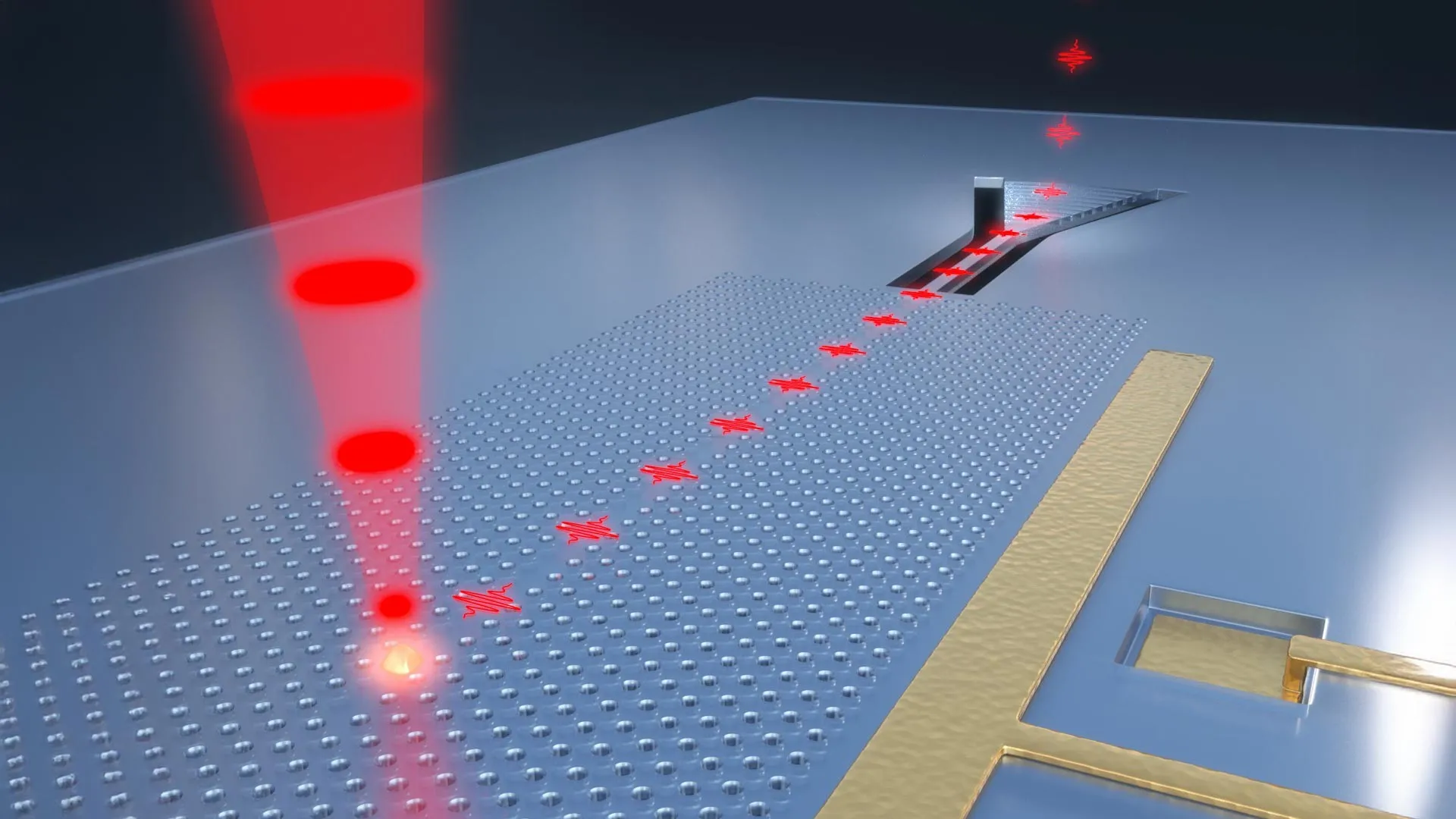
The scientific endeavor at the University of Iowa has meticulously tackled two formidable obstacles that have historically hindered the generation of a consistent and reliable stream of single photons. These elusive single photons are the fundamental building blocks for a host of next-generation technologies, including the highly anticipated photonic quantum computers and the ultra-secure communication networks that promise to redefine digital interactions. The challenges identified by the research team are not minor inconveniences but rather fundamental impediments that have long vexed physicists and engineers working at the forefront of quantum optics.
One of the primary hurdles encountered in generating pure single photons is a phenomenon known as laser scatter. The conventional method involves using a laser to excite an atom, prompting it to release a photon. However, this process is far from perfect. The intense laser light, while intended to trigger the emission of a single photon, can inadvertently cause the atom to release additional, unwanted photons. These extraneous particles act as disruptive elements within an optical circuit, analogous to how stray electrical currents can degrade the performance of traditional electronic circuits. This unwanted "noise" reduces the efficiency of the system and can introduce errors into quantum computations or compromise the integrity of secure communication channels. The presence of these extra photons obscures the intended single-photon signal, making it difficult to discern and control the precise quantum states required for advanced applications.
Compounding this issue is a second, equally problematic aspect related to the inherent behavior of atoms when interacting with laser light. In certain instances, atoms do not conform to the desired single-photon emission protocol. Instead, they can, by chance, emit more than one photon simultaneously. This multi-photon emission event is particularly detrimental to quantum operations, which rely on the precise, sequential delivery of individual photons. When multiple photons are released at once, the intended one-by-one flow, crucial for maintaining quantum coherence and executing complex algorithms, is disrupted. The precise timing and order of photons are paramount in quantum computing, and any deviation, such as the simultaneous emission of several photons, can lead to a breakdown in the quantum sequence, rendering the system unreliable and inaccurate.
In a remarkable turn of events, the research conducted by Matthew Nelson, a graduate student in the Department of Physics and Astronomy, has unearthed an unexpected and elegant solution to these intertwined problems. His pivotal discovery lies in recognizing a deep and previously unacknowledged connection between laser scatter and multi-photon emission. Nelson observed that when an atom emits multiple photons, the resulting spectral characteristics and waveform of these unwanted photons bear a striking resemblance to those of the original laser light used to initiate the process. This similarity is not a mere coincidence; it represents a fundamental property of the light-matter interaction that the researchers have now learned to exploit.
The profound implication of this discovery, as articulated by the University of Iowa team, is that these two signals – the unwanted multi-photon emission and the interfering laser scatter – can be meticulously tuned and adjusted to precisely cancel each other out. In essence, the very phenomenon that has been a persistent nuisance, laser scatter, can be ingeniously repurposed to actively suppress the emission of unwanted, multiple photons. This counterintuitive approach transforms a long-standing obstacle into a powerful tool for enhancing the purity of single-photon sources.
Ravitej Uppu, an assistant professor in the Department of Physics and Astronomy and the study’s corresponding author, eloquently summarizes the significance of this breakthrough: "We have shown that stray laser scatter, typically considered a nuisance, can be harnessed to cancel out unwanted, multi-photon emission," he stated. "This theoretical breakthrough could turn a long-standing problem into a powerful new tool for advancing quantum technologies." This statement underscores the paradigm shift represented by their findings, moving from a passive acceptance of noise to an active manipulation of it for beneficial outcomes.
The importance of single photons cannot be overstated when considering the future of quantum computing. Photonic computing, a burgeoning field, proposes to leverage the properties of light, rather than electricity, to perform complex calculations. This approach holds the promise of vastly superior speed and efficiency compared to conventional computing paradigms. Traditional computers operate on the principle of bits, which are represented by electrical or optical pulses signifying either a one or a zero. In stark contrast, quantum computers utilize qubits, which can exist in superposition and entanglement, offering exponentially greater computational power. Photons, being fundamental particles of light, are ideal candidates for representing these qubits due to their speed, low interaction with the environment, and ease of manipulation.
Numerous forward-thinking technology companies are investing heavily in photonic platforms, recognizing their pivotal role in realizing the full potential of quantum computing. The success of these ventures hinges on the availability of a stable, well-controlled, and, crucially, pure stream of single photons. The method developed at the University of Iowa directly addresses this critical need, paving the way for more practical and scalable quantum computing architectures.
The benefits of an orderly photon stream extend beyond computational power to encompass enhanced security. The researchers aptly draw an analogy to managing a cafeteria line. Guiding students through the line one at a time is far more orderly and manageable than allowing them to move as a disorganized crowd. Similarly, a neatly ordered stream of single photons reduces the likelihood of data being intercepted or "overheard" during transmission. This is fundamental to quantum communication networks, where the inherent properties of quantum mechanics can be leveraged to create communication channels that are theoretically unbreakable, offering unprecedented levels of security for sensitive information.
The key to this novel purification technique, as explained by Uppu, lies in the precise control of the laser beam. "If we can control exactly how the laser beam shines on an atom — the angle at which it’s coming, the shape of the beam, and so on — you can actually make it cancel out all the additional photons that the atom likes to emit," he elaborated. "We would be left with a stream that is actually very pure." This level of precision control over the interaction between light and matter is what enables the remarkable cancellation effect, effectively "cleaning" the light at its source.
This theoretical work demonstrates the potential to simultaneously address two major obstacles that have historically impeded the development of faster and more efficient photonic circuitry. If these findings are successfully validated through experimental verification, this pioneering technique could significantly accelerate the pace of progress in building advanced quantum computers and establishing more secure communication systems. The research team is optimistic about the future and plans to conduct further experiments to translate this theoretical breakthrough into a tangible reality.
The groundbreaking study, titled "Noise-assisted purification of a single-photon source," has been published in the esteemed journal Optica Quantum, a testament to its scientific merit and potential impact. The research received crucial financial backing from the Office of the Under Secretary of Defense for Research and Engineering within the U.S. Department of Defense, highlighting the strategic importance of this work for national security and technological advancement. Additionally, the project received vital initial support through a seed grant from the University of Iowa Office of the Vice President for Research via the P3 program, an initiative dedicated to fostering innovative research and launching promising new projects. This multidisciplinary support underscores the collaborative nature of scientific discovery and the shared vision for a future empowered by quantum technologies.