anjir abdul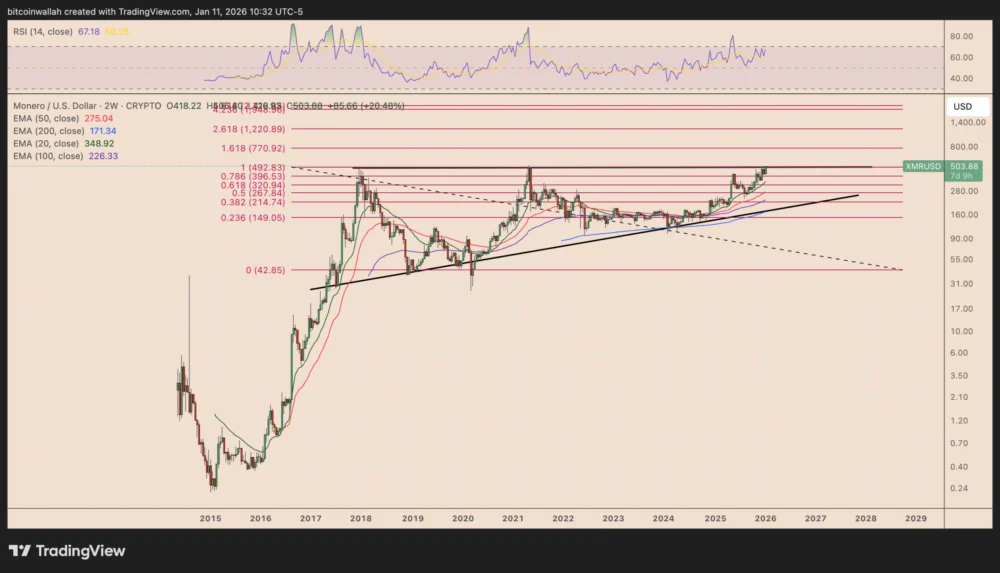
Monero (XMR) has achieved a significant milestone, surging past the $500 mark for the first time since its peak in May 2021, a rally largely catalyzed by internal turmoil within its privacy-focused rival, Zcash (ZEC). The privacy-centric cryptocurrency briefly touched $500.66, demonstrating robust upward momentum with a more than 6% increase on Sunday alone, contributing to an impressive 20% gain over the past week. This ascent positions Monero tantalizingly close to its all-time record high of approximately $517.50, established in April 2021, signaling renewed investor confidence and a potential shift in market preference within the privacy coin sector.
The backdrop to Monero’s impressive performance is a stark contrast to the recent upheaval experienced by Zcash. The Electric Coin Company (ECC), the development team behind Zcash, faced a mass resignation of its core members on Wednesday. The departing team cited a deteriorating work environment, intolerable working conditions, and unresolved board disputes concerning the project’s strategic direction and crucial asset allocations, particularly involving the "Bootstrap Project." This exodus laid bare deep-seated governance issues and internal strife within Zcash’s leadership, raising serious questions about the project’s long-term stability and future development trajectory. The immediate fallout from this crisis was a sharp and dramatic price plummet for ZEC, which saw its value decrease by over 20% in the days following the resignations, reaching a weekly low of around $360 over the weekend. This sudden downturn in Zcash’s fortunes appears to have directly benefited Monero, as traders and investors seeking exposure to the privacy coin segment seemingly rotated their capital into XMR, perceiving it as a more stable and reliable alternative amidst Zcash’s internal disarray.
Beyond the immediate market dynamics spurred by Zcash’s troubles, Monero has also garnered significant support from a wave of bullish institutional commentary. Leading cryptocurrency research firms and investment entities, including Grayscale and Coinbase, have highlighted privacy coins as a key growth theme in their latest market reports and outlooks for the coming year. These institutions underscore a rising demand for financial confidentiality and anonymity, particularly in an increasingly regulated and scrutinized cryptocurrency landscape. The narrative suggests that as global financial regulators intensify their focus on Know Your Customer (KYC) and Anti-Money Laundering (AML) compliance within the digital asset space, the intrinsic value proposition of privacy coins becomes more pronounced for users and entities seeking to maintain a degree of transactional discretion.
This growing institutional recognition lends credibility to the privacy coin sector, signaling that it is not merely a niche interest but a vital component of the broader crypto ecosystem. While the concept of "compliance-friendly privacy tools" might seem paradoxical to some, it speaks to the evolving understanding that privacy can coexist with necessary regulatory frameworks, even if Monero’s robust, untraceable nature often places it at the more extreme end of the privacy spectrum compared to Zcash’s selective disclosure model. The current environment, where Zcash faces significant internal challenges, positions Monero as the de facto leader for those looking for cleaner, more straightforward exposure to the privacy narrative, attracting both retail and institutional interest seeking genuine financial confidentiality.
However, despite the current bullish momentum, a technical analysis of Monero’s price history presents a cautionary note. As of January, XMR is on the cusp of entering a price discovery phase, with eyes firmly set on a potential breakout above its all-time record high of approximately $517.50. Historically, similar breakout attempts have occurred seven times in the past, each instance ultimately failing to sustain the upward trajectory and invariably followed by sharp corrections. These historical pullbacks have ranged significantly, from roughly 40% to as much as a staggering 95%, typically retracing towards an ascending trendline support that has historically acted as a crucial rebound zone.

Should history repeat itself, Monero risks entering a prolonged correction phase from its current elevated levels. In such a scenario, its price could potentially retreat towards the $200-$270 range. This area aligns with the established lower trendline support, which has proven resilient in past downturns, and also corresponds with prevailing Fibonacci retracement lines, suggesting a strong confluence of technical indicators that could act as a significant support level. This bearish fractal pattern, if it plays out, would represent a substantial drawdown from current prices and test the conviction of recent investors.
Conversely, a sustained and decisive breakout above the critical $500-$520 resistance zone would effectively invalidate this bearish fractal pattern, signaling a powerful shift in market dynamics. Such a breakthrough would indicate that Monero is not merely repeating past cycles but is forging a new, independent trajectory. In this highly anticipated scenario, XMR could follow the path of other cryptocurrencies that have successfully broken out after multi-year consolidations in recent times, such as Bitcoin and Ethereum in their respective bull runs. A successful breakout could open the door for a robust rally, potentially propelling Monero towards a new price target of $775. This target, also aligning with a significant Fibonacci retracement line, would mark a new all-time high for the cryptocurrency within the current year, cementing its position as a leading privacy asset in the evolving digital economy. The confirmation of such a breakout would ideally be accompanied by substantial trading volume, lending further credence to the move and indicating strong institutional and retail buying interest.
The unfolding events present a pivotal moment for Monero and the broader privacy coin sector. The dramatic shift in market sentiment following Zcash’s internal strife has undeniably redirected investor attention and capital towards XMR, highlighting its perceived robustness and leadership in the privacy domain. Simultaneously, the increasing institutional interest in financial confidentiality within a regulated crypto landscape provides a strong fundamental tailwind. However, technical indicators suggest that XMR now stands at a crucial juncture, balancing the promise of a historic breakout against the historical precedent of significant corrections. The coming weeks will be critical in determining whether Monero can defy its past fractals and establish a new paradigm for privacy coins, or if it will succumb to familiar market forces, making it an asset to watch closely for both technical traders and fundamental investors alike.

This article does not contain investment advice or recommendations. Every investment and trading move involves risk, and readers should conduct their own research when making a decision. While we strive to provide accurate and timely information, Cointelegraph does not guarantee the accuracy, completeness, or reliability of any information in this article. This article may contain forward-looking statements that are subject to risks and uncertainties. Cointelegraph will not be liable for any loss or damage arising from your reliance on this information.