anjir abdul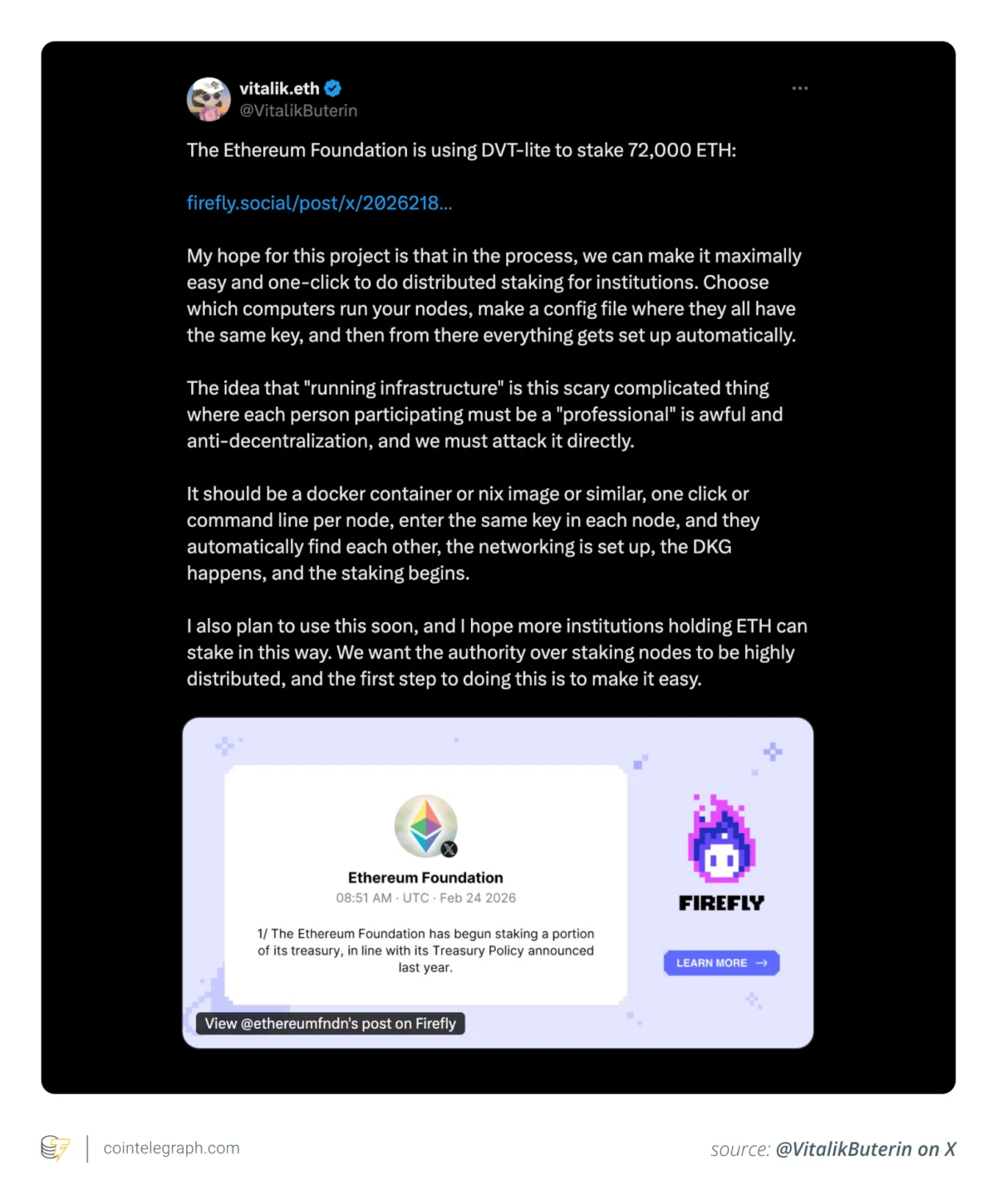
The transition to PoS has cemented staking as a cornerstone of the decentralized finance (DeFi) ecosystem, leading to a significant surge in validator engagement and reinforcing the network’s security and vitality. However, as articulated by Ethereum co-founder Vitalik Buterin, a formidable barrier persists: the inherent technical complexity of operating a validator remains prohibitively high, deterring both individual participants and, more critically, large institutions from directly contributing to network consensus. To bridge this critical gap, leading engineers and core developers are vigorously pursuing innovations to simplify validator setup, spearheading an initiative centered around a "one-click" user experience. This endeavor, often referencing "DVT-lite" or simplified distributed validator technology, aims to empower organizations to manage their own staking nodes without necessitating an in-house team of specialized blockchain technicians. This article delves into the profound motivations driving Ethereum developers to champion one-click staking, exploring its potential to simplify validator deployment for institutions, mitigate reliance on centralized intermediaries, bolster network decentralization, and unlock a broader, more robust validator ecosystem.
Ethereum’s urgent re-evaluation of the institutional staking user experience (UX) stems from a recognition that despite the substantial growth in staking participation post-Merge, a significant segment of major financial players remains hesitant to engage directly due to an array of operational hurdles. While Ether (ETH) staking has indeed matured considerably, with a growing percentage of the total ETH supply locked in staking contracts, the current staking ratio still suggests immense untapped potential, particularly within institutional treasuries. Large organizations—ranging from crypto funds and fintech innovators to established corporations holding substantial Ether on their balance sheets—typically shy away from direct staking. Their reluctance is less about the attractive potential rewards and more about the daunting operational complexities involved. Direct validator operation, at present, demands a multi-faceted commitment, including sophisticated hardware provisioning, meticulous software configuration (encompassing both execution and consensus clients), robust network infrastructure to ensure continuous uptime, vigilant monitoring for performance and security, and the ongoing management of software updates and patches. For institutions accustomed to the highly standardized, streamlined processes of traditional finance, these technical and continuous responsibilities often appear overly burdensome, resource-intensive, and fundamentally misaligned with their standard operational frameworks and risk management protocols.
The concept of "one-click staking," as envisioned by Buterin, represents a paradigm shift away from traditional, labor-intensive validator setup. Crucially, this initiative is distinct from custodial "earn products" offered by centralized exchanges, which delegate control to third parties. Instead, one-click staking aims to simplify the deployment of native, self-managed validators, granting institutions full control over their staked assets and validator operations. Under this transformative model, an institution would merely initiate the process—perhaps by depositing the requisite 32 ETH or higher (post-Pectra upgrade) and confirming their intention to stake—and the underlying system would then automatically handle the intricate technical backend. This automated management would encompass everything from the deployment of necessary software components (execution and consensus clients), the secure generation and management of validator keys, and the configuration of distributed validator technology (DVT) for enhanced resilience, to the ongoing monitoring of validator performance and the execution of critical software updates. Buterin has specifically suggested leveraging standardized containerization technologies such as Docker containers or Nix images. These tools would allow node operators to deploy and manage validators with the same ease and efficiency as modern cloud applications, requiring little more than a single command or a simple click on each node. The profound implication is that staking infrastructure would evolve from a niche blockchain operation into a routine software deployment task, readily integrated into existing IT frameworks.
Today’s validator setup continues to intimidate institutions primarily due to its labyrinthine technical complexity. Operating a single Ethereum validator necessitates the simultaneous management of several distinct, yet interconnected, software components. This includes an execution client (like Geth or Erigon) to process transactions and manage the state of the Ethereum Virtual Machine, and a consensus client (like Prysm, Lighthouse, or Teku) responsible for participating in the PoS consensus mechanism. Furthermore, institutions must grapple with the secure management of validator keys, often requiring specialized hardware security modules (HSMs) or robust key management systems. Beyond software, there are significant operational risks to mitigate: ensuring 24/7 uptime to avoid missing block proposals, protecting against slashing penalties (for double signing or inactivity), maintaining robust cybersecurity to prevent key compromise, and navigating the complexities of Maximal Extractable Value (MEV) to optimize returns. Even organizations with considerable financial resources often lack the highly specialized in-house blockchain expertise required to efficiently manage these multifaceted requirements. This frequently compels them to rely on third-party staking providers, a reliance that, if concentrated among too few large service providers, could inadvertently introduce significant centralization risks to the network.

Buterin vehemently opposes a staking ecosystem confined exclusively to specialist or professional operators, viewing such a scenario as a direct affront to Ethereum’s foundational decentralization principles. He has consistently criticized the notion that validator operation should remain an arcane, expert-only domain, characterizing this mindset as detrimental and antithetical to the network’s ethos. If staking infrastructure were to become dominated by a narrow cadre of professional providers, it would inevitably lead to a concentration of power, increasing the network’s vulnerability to censorship, regulatory capture, and single points of failure. Such centralization would undermine the very resilience and trustlessness that define blockchain technology. For these critical reasons, Buterin champions simplifying validator deployment through initiatives like one-click setups and lower operational barriers, seeing it not merely as a user experience enhancement but as a strategic imperative to safeguard and reinforce Ethereum’s decentralization.
Distributed Validator Technology (DVT) plays a pivotal role in these efforts to enhance staking accessibility and resilience. Instead of relying on a single machine controlling a validator via a sole private key, DVT enables multiple independent nodes to collaboratively operate a single validator. In this innovative setup, the validator’s private key is securely sharded among several operators, requiring a threshold number of these "key shares" to sign off on any validator action. This distributed control significantly enhances fault tolerance, as the failure of one or even several nodes will not incapacitate the validator. Crucially, DVT also drastically reduces the risk of slashing penalties, which can arise from downtime or erroneous behavior, by distributing the responsibility and risk across multiple participants. Numerous projects within the Ethereum ecosystem have been actively advancing DVT implementations, showcasing its potential for robust, shared validator operation.
While full DVT offers substantial benefits, its implementation can still entail considerable technical complexity. To accelerate broader institutional adoption, Buterin has advocated for a streamlined variant dubbed "DVT-lite." This simplified approach retains the core advantages of distributed control while judiciously eliminating more burdensome elements. DVT-lite focuses on ease of deployment, often foregoing complex threshold signature schemes for more straightforward distributed key generation and management. The emphasis is on minimizing unnecessary complexity, enabling institutions to deploy resilient, distributed validators rapidly and efficiently. Rather than requiring bespoke, highly customized staking setups, organizations can leverage standardized, automated tools that abstract away most of the configuration intricacies, making validator operation akin to deploying a standard enterprise application.
The Ethereum Foundation has already commenced a critical real-world test of this simplified approach. According to Buterin, the Foundation is actively staking a substantial 72,000 Ether through a DVT-lite system. This ambitious pilot program serves as a practical evaluation of whether streamlined distributed staking can function reliably and securely at an institutional scale. A successful outcome from this experiment would provide a compelling, real-world template for crypto funds, corporations, and digital asset treasuries seeking to stake their Ether directly, thereby reducing their reliance on third-party intermediaries. The Foundation’s active involvement and investment in this initiative underscore that improved validator accessibility is not merely a theoretical concept but a critical developmental priority for Ethereum’s future.
If the vision of one-click staking fully materializes, it could fundamentally reshape the economics of institutional Ether holdings. Entities already possessing substantial Ether reserves would gain the unprecedented ability to earn staking yield internally, directly from the protocol, without the necessity of delegating their assets to third-party providers. This would bring several key advantages: significant cost savings by eliminating intermediary fees, enhanced security through direct control over their assets and validator keys, greater transparency into validator performance, and a higher degree of regulatory compliance by minimizing reliance on external parties. For organizations managing thousands, or even millions, of Ether, these combined changes could decisively tip the balance in favor of direct, self-managed staking participation, transforming idle assets into productive, yield-generating capital.

From a protocol standpoint, expanding validator participation through simplified staking tools is unequivocally seen as a profound strengthening of the Ethereum network. A larger, more diverse, and geographically distributed set of participants running validators directly translates into enhanced network resilience against attacks, increased censorship resistance by diversifying control, and an overall improvement in the network’s security model. By lowering the technical and operational barriers to entry, both institutions and individual operators can participate more readily as validators, thereby reinforcing Ethereum’s core value proposition as a robust and decentralized global settlement layer. This strategic approach aligns perfectly with Ethereum’s longstanding emphasis on broad, permissionless participation over reliance on centralized, single points of failure.
The timing of this push for simplified institutional staking in 2026 is particularly significant, coinciding with several concurrent developments across the Ethereum network. Upcoming Ethereum upgrades are specifically designed to enhance validator efficiency and scalability. For instance, proposals tied to the anticipated Pectra upgrade aim to significantly raise the maximum effective balance for validators from the current 32 Ether to 2,048 Ether. This crucial change would allow operators, particularly institutions, to manage substantially larger stakes within a single validator instance, thereby dramatically reducing the operational burden of running numerous separate 32-ETH validators. When synergistically paired with simplified DVT deployments, these upgrades could collectively diminish the technical and managerial hurdles involved in institutional staking to an unprecedented degree. Simultaneously, the broader staking ecosystem continues to exhibit robust momentum, with increasing total staked ETH and a growing number of active validators, reflecting sustained, long-term confidence in Ethereum’s underlying staking mechanism. The very concept of "one-click deployment" in crypto draws inspiration from mature cloud computing platforms like Amazon Web Services (AWS) and Kubernetes, where complex infrastructure can be provisioned with minimal manual configuration, signaling a natural evolution towards greater user accessibility.
Despite the immense potential of one-click staking, significant challenges persist. Among the primary hurdles are the ongoing technical complexities of abstracting away intricate blockchain operations without compromising security. Developers must meticulously balance the imperative for ease of use with the necessity for robust safeguards, ensuring that increased automation does not inadvertently introduce unforeseen vulnerabilities or centralize control around a few dominant software solutions. Furthermore, the ecosystem needs to address educational gaps and ensure that institutions fully understand the nuances and responsibilities of direct validator operation, even with simplified tools.
Moreover, overly simplified tools, if not carefully designed, could inadvertently introduce new centralization risks. If only a handful of "one-click" solutions become dominant, or if the underlying DVT-lite implementations are not diverse, it could lead to a concentration of operational methodology or even smart contract risk. Institutions might also become complacent regarding their responsibilities if the process becomes too abstracted. Ethereum developers must therefore prioritize not only accessibility but also the continued maintenance of a diverse, resilient, and robust validator infrastructure, fostering a healthy competitive landscape for staking solutions.
If the one-click staking vision successfully comes to fruition, it could herald several transformative changes for the Ethereum ecosystem. Running a validator could evolve into a standard infrastructure task, much like deploying a server in the cloud, rather than a highly specialized technical undertaking. This would lead to a significantly more diverse and geographically distributed validator set, enhancing network security and censorship resistance. Ultimately, it would reduce the network’s reliance on large, centralized staking service providers, empowering institutions and individuals alike to participate directly in securing and governing the world’s leading smart contract platform, realizing Ethereum’s core promise of broad, decentralized participation.