anjir abdul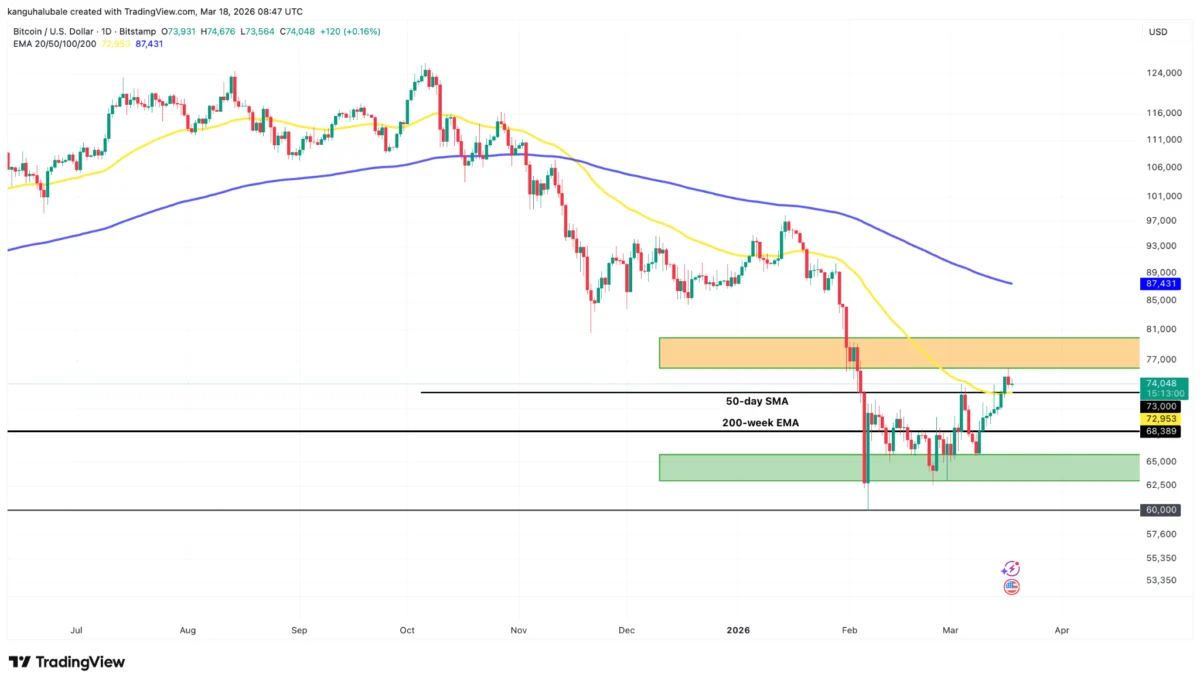
Bitcoin (BTC) found itself navigating treacherous waters, trading around $74,000 on Wednesday, a slight retreat of 2.6% from its recent six-week peak of $76,000 achieved on Tuesday. This delicate positioning occurred as the crypto market braced for potential volatility, with all eyes fixed on the impending policy decision from the U.S. Federal Reserve regarding interest rates and, more critically, the subsequent remarks from Fed Chair Jerome Powell. The cryptocurrency’s recent ascent had been met with a formidable resistance at the $76,000 mark, a level that has proven difficult to breach, leading many traders to anticipate significant price swings in the coming days.
The core of the market’s current anxiety stems from the ongoing Federal Open Market Committee (FOMC) meeting, which typically concludes with a policy announcement and a press conference. This week’s meeting, with its interest rate decision scheduled for Wednesday at 2:00 PM ET, followed by Powell’s speech at 2:30 PM ET, is universally recognized as a pivotal moment. While the outcome of the interest rate decision itself appears to be a foregone conclusion, the nuances of Powell’s language are what truly hold the power to move markets, including the highly sensitive Bitcoin.
The Fed’s Unanimous Hold: A Foregone Conclusion?
Market participants have largely priced in a scenario where the Federal Reserve opts to maintain the status quo on interest rates. Data from various predictive markets and financial tools overwhelmingly points to this outcome. Polymarket bettors, a popular platform for event-based predictions, currently assign a near 100% probability that the current interest rates will remain unchanged, specifically within the 3.5% to 3.75% range. This leaves a minuscule chance, less than 1%, for a 0.25% rate cut. Similarly, futures market traders, leveraging tools like the CME FedWatch Tool, have locked in an even higher certainty, with a 98.9% chance that the Fed will leave interest rates untouched, ruling out any possibility of a 25 basis points (bps) reduction.
This widespread consensus suggests that the immediate impact of the rate decision itself might be minimal. As many analysts point out, any potential downside price action stemming from unchanged interest rates is already "priced in" by the market. This means investors have already adjusted their portfolios and expectations to account for no rate cuts, diminishing the element of surprise. The Fed’s prolonged battle against inflation, coupled with relatively robust employment figures, has instilled a strong belief among economists and traders that the central bank will continue its cautious approach, opting for stability over aggressive policy shifts, at least for now.

Why Powell’s Words Matter More Than the Rate Decision
If the interest rate decision is already a given, then why the heightened anticipation? The answer lies squarely in Federal Reserve Chair Jerome Powell’s post-meeting press conference. This is where the Fed provides its "forward guidance" – signals about the future direction of monetary policy. Powell’s tone, choice of words, and responses to questions will be meticulously scrutinized for any hints of a shift in the Fed’s outlook, whether towards a more "hawkish" (favoring higher rates/tighter policy) or "dovish" (favoring lower rates/looser policy) stance.
A hawkish tone might suggest that the Fed sees inflation as more persistent than previously thought, or that the economy is overheating, potentially pushing back the timeline for future rate cuts. Conversely, a dovish tone could indicate growing confidence in disinflationary trends or concerns about economic slowdown, potentially signaling earlier or more aggressive rate cuts down the line. Even subtle changes in phrasing, such as discussing "data dependency" with more emphasis on weaker economic indicators, or conversely, stressing the need for more evidence of sustained inflation cooling, can trigger significant market reactions. For risk assets like Bitcoin, a dovish tilt from Powell would generally be seen as bullish, as lower interest rates reduce the cost of borrowing and make alternative investments more attractive. A hawkish stance, however, could inject fear into the market, potentially leading to a sell-off in risk assets.
As veteran trader Matthew Dixon aptly noted in an X post, "The rate decision is fully priced in so low surprise risk… The real volatility catalyst is Powell’s tone." This sentiment is echoed by many market watchers who understand that the Fed’s communication strategy is as powerful as its policy decisions.
Navigating a Volatile Macro Landscape
Beyond the Fed’s immediate actions, traders must also contend with a complex web of other macroeconomic and geopolitical factors that could inject volatility into the market. The ongoing geopolitical tensions, particularly the escalating conflict between the U.S. and Israel with Iran, pose a significant risk. Any major escalation could lead to spikes in oil prices, reigniting inflation concerns and potentially forcing the Fed to maintain a tighter monetary policy for longer. This uncertainty creates a challenging environment for risk assets like Bitcoin, which tend to be sensitive to global stability.

Domestically, concerns about persistent U.S. inflation continue to loom. While inflation has cooled from its peak, its "stickiness" in certain sectors, coupled with a robust labor market, complicates the Fed’s path. Furthermore, the political landscape adds another layer of complexity, with figures like former President Donald Trump publicly pressuring Powell to cut interest rates immediately. While the Fed is designed to operate independently, such political rhetoric can sometimes influence market sentiment or add perceived pressure on policymakers. These myriad factors contribute to a highly unpredictable environment, making Powell’s upcoming speech even more critical for setting market direction.
Bitcoin’s Technical Gauntlet: Key Levels to Watch
From a technical perspective, Bitcoin’s immediate future hinges on its ability to overcome the formidable resistance at $76,000. This level, representing a recent six-week high, has proven to be a significant psychological and technical barrier. For the bulls to maintain momentum and target higher highs above $80,000, BTC/USD must decisively "flip" this $76,000 resistance level into support. This means not only breaking above it but holding above it, with subsequent pullbacks finding buying interest at this newfound support.
A crucial indicator for this bullish continuation is Bitcoin’s position relative to its 50-day Simple Moving Average (SMA). The cryptocurrency recently broke above this key short-term trend indicator on March 1, a significant development as it was the first time since January 1. Sustaining its position above the 50-day SMA (yellow line on the daily chart) is vital for confirming the strength of the current uptrend. Should Bitcoin successfully conquer and hold above the $76,000-$80,000 resistance zone, the next significant target for the bulls would be the 200-day SMA, currently hovering around $87,411. The 200-day SMA is widely regarded as a critical long-term trend indicator, and a break above it would signal robust bullish sentiment and potentially open the door for a retest of all-time highs.
However, the bears are not without their strength. They will fiercely defend the $76,000 resistance level, aiming to keep it intact. A failure to break through this ceiling could increase the likelihood of a significant retracement, pushing Bitcoin back into the $72,000-$65,000 range. Within this range lies the 200-week Exponential Moving Average (EMA), another important long-term support level that traders closely monitor. A break below $65,000 would be a concerning development, with the next key area of interest falling between $62,500 and $60,000. Such a drop would effectively erase all the gains Bitcoin has accumulated since February 6, potentially signaling a more prolonged correction. As Cointelegraph previously reported, a decisive close below these moving averages would indeed tilt the advantage back to the bears, turning the recent rally into a classic "bull trap," where optimistic buyers are caught on the wrong side of a reversal.
The Unseen Hand: Spot Bitcoin ETF Inflows

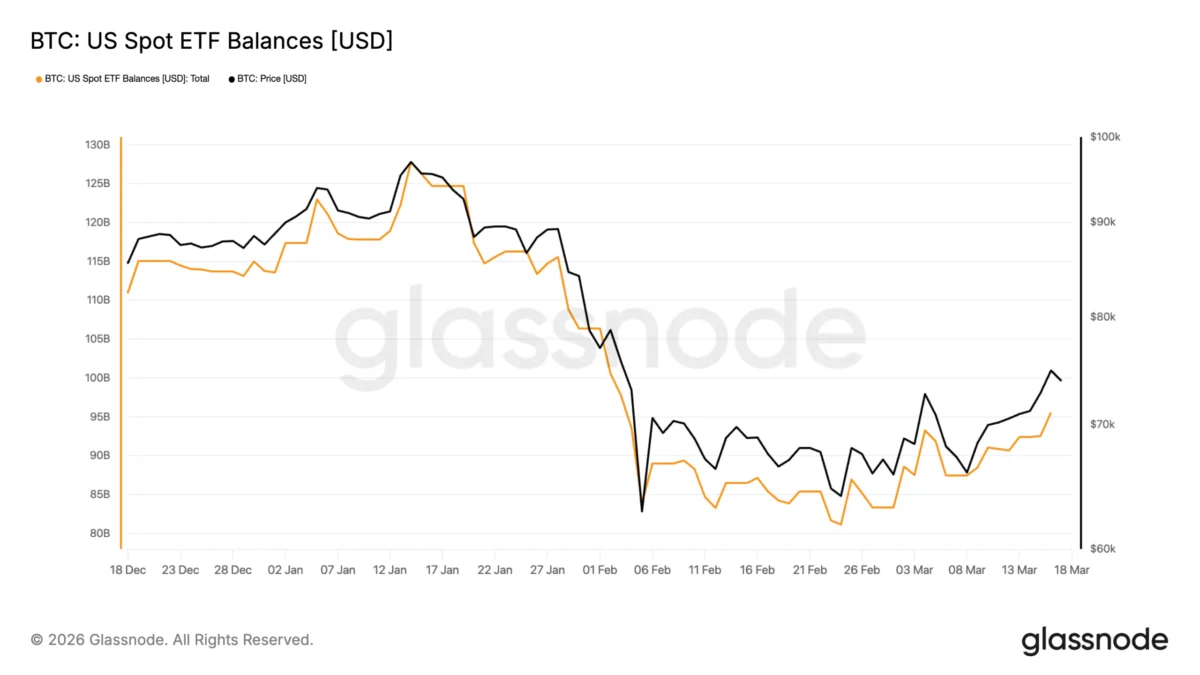
Adding a powerful fundamental catalyst to Bitcoin’s recent resilience is the sustained demand from spot Bitcoin Exchange-Traded Funds (ETFs). These investment vehicles, which allow traditional investors to gain exposure to Bitcoin without directly holding the asset, have significantly altered market dynamics since their launch. On March 17, Bitcoin ETFs registered a remarkable $199 million in inflows, marking the seventh consecutive day of positive net inflows. This consistent institutional demand provides a strong underlying bid for Bitcoin, helping to absorb selling pressure and establish a higher floor for the price. The sustained appetite from these large-scale investors is a testament to growing mainstream adoption and confidence in Bitcoin as a legitimate asset class, acting as a crucial counterweight to potential macro-economic headwinds.
Expert Insights: Decoding the Market Mood
The consensus among many crypto analysts and traders emphasizes the importance of Powell’s upcoming remarks. Matthew Dixon’s assertion that the "real volatility catalyst is Powell’s tone" underscores the market’s laser focus on the Fed Chair’s communication. Traders will be listening for specific keywords and phrases that signal the Fed’s comfort level with current inflation trends, its assessment of economic growth, and its outlook on future rate cuts. Any deviation from the expected neutral tone, whether overtly hawkish or surprisingly dovish, could trigger an immediate and significant market reaction.
Crypto analyst Sykodelic offers an intriguing perspective, suggesting, "Jerome Powell is going to make things sound as good as he can on his last meeting. This is his legacy." If this holds true, a positive or optimistic tone from Powell could lead to a significant "unwinding of hedges" – a scenario where investors who had taken protective positions (like shorting Bitcoin or buying put options) against potential market downturns begin to close those positions. This unwinding typically involves buying back assets, which could fuel further rallies in both equities and Bitcoin, creating a "juice" effect.
However, historical patterns present a cautionary note. Crypto trader BitcoinHyper highlighted that Bitcoin’s price has historically moved lower after the last six FOMC meetings. This observed pattern suggests a potential "sell the news" reaction, where an initial surge of anticipation gives way to profit-taking or disappointment, regardless of the actual decision. Whether this historical trend will hold true in the current environment, especially with the newfound influence of spot Bitcoin ETFs, remains a key question.
Conclusion and Outlook

As the market awaits Fed Chair Powell’s pivotal speech, Bitcoin stands at a critical juncture. While the expectation of unchanged interest rates is widely priced in, the path forward for the leading cryptocurrency will largely be dictated by the nuances of Powell’s forward guidance. Bullish momentum is contingent on a decisive break and hold above the $76,000 resistance, paving the way for targets like $80,000 and potentially the $87,411 200-day SMA, bolstered by continued ETF inflows. Conversely, a rejection at $76,000, coupled with any hawkish undertones from Powell, could see Bitcoin retrace to the $72,000-$65,000 range, or even lower to $62,500-$60,000, invalidating recent gains and confirming a potential bull trap.
Traders are advised to remain vigilant, as the confluence of macro-economic factors, geopolitical tensions, and technical resistance levels creates an environment ripe for volatility. The coming hours will undoubtedly shape Bitcoin’s trajectory for the short to medium term, making Powell’s words the most anticipated market catalyst of the week.
This article does not contain investment advice or recommendations. Every investment and trading move involves risk, and readers should conduct their own research when making a decision. While we strive to provide accurate and timely information, Cointelegraph does not guarantee the accuracy, completeness, or reliability of any information in this article. This article may contain forward-looking statements that are subject to risks and uncertainties. Cointelegraph will not be liable for any loss or damage arising from your reliance on this information.