anjir abdul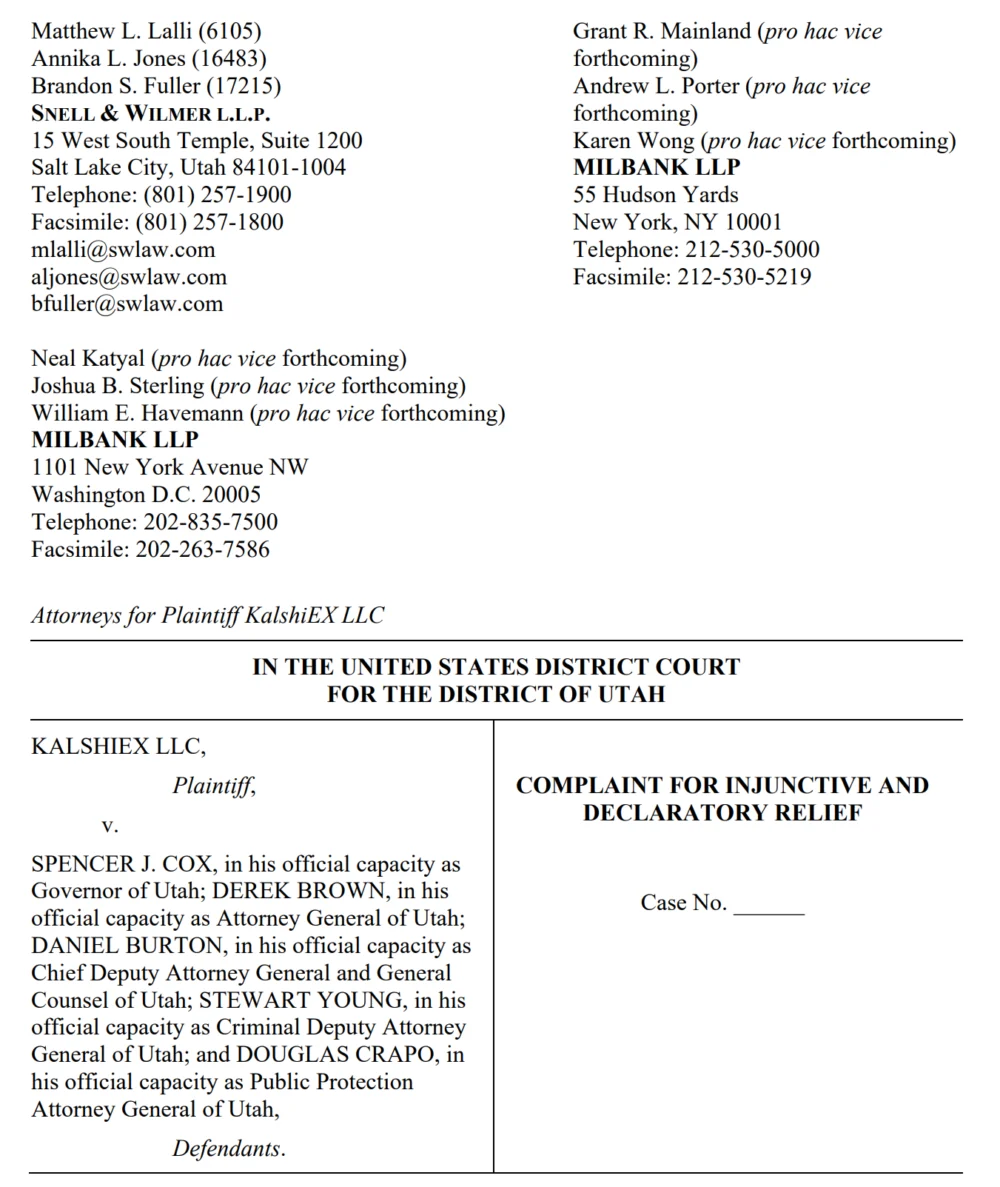
On Wednesday, Utah’s HB243 bill completed its legislative journey, successfully navigating through the state House on February 10 and securing Senate approval on February 27, before being transmitted to Governor Spencer Cox’s desk. The core of this legislation lies in its expansive redefinition of "proposition betting" to include it squarely within the realm of illegal gambling. Traditionally, proposition bets, or "prop bets," refer to wagers on specific events or occurrences within a larger game, such as an athlete’s performance metrics or whether a team achieves a particular statistical milestone, rather than merely betting on the final outcome. Utah’s new definition is explicitly designed to cast a wide net, capturing not just traditional sports-related prop betting but also encompassing platforms that market themselves as "prediction markets" rather than conventional sportsbooks.
The explicit objective behind HB243 is to erect a robust legal barrier against companies seeking to offer any form of sports-related prediction or prop betting within Utah’s borders. This includes platforms like Kalshi and Polymarket, which, despite their differing operational models, facilitate wagers on future events. Governor Spencer Cox has made his intentions unequivocally clear, stating his plan to sign the legislation into law, as reported by the Associated Press on Thursday. His comments reflect a deep-seated concern, articulated vividly: "We are putting a casino in the pocket of every single American, and they are targeting especially young people. It is really awful what they are doing, and we are going to make sure this doesn’t happen in our state." This strong rhetoric underscores Utah’s historically firm anti-gambling stance, deeply rooted in the state’s dominant cultural and religious values, particularly those influenced by the Church of Jesus Christ of Latter-day Saints, which views gambling as a moral vice.
The implications of Utah’s legislative action extend far beyond its state lines, fueling a broader national debate on the classification and regulation of prediction markets. Are they sophisticated financial derivatives, offering valuable economic signals and forecasting tools, or are they merely thinly veiled forms of gambling, preying on vulnerable populations? This question lies at the heart of the burgeoning conflict between state legislatures, which often view these markets through the lens of gambling laws, and federal agencies like the Commodity Futures Trading Commission (CFTC), which assert jurisdiction over them as regulated financial instruments. The outcome of this dispute will undoubtedly shape the future of innovation and regulation in the burgeoning prediction market sector across the United States.
Kalshi’s Aggressive Legal Counter-Offensive
In anticipation of Utah’s legislative move, Kalshi, a CFTC-regulated prediction market platform, launched a preemptive legal strike in February, suing the state and petitioning a federal judge to block the enforcement of its gambling restrictions against the platform. This lawsuit was filed shortly after the Utah Senate Business and Labor Committee unanimously approved the HB243 bill, signaling the state’s unwavering intent to proceed with the ban. Kalshi’s legal argument hinges on a fundamental assertion: its event contracts are not gambling but are federally regulated derivatives. The company contends that under the Commodity Exchange Act (CEA), the Commodity Futures Trading Commission (CFTC) possesses exclusive authority over these types of markets. This exclusivity, Kalshi argues, preempts states like Utah from imposing their own bans or regulatory frameworks on such financial products. The legal battle in Utah is a direct challenge to state sovereignty in the face of perceived federal preemption, setting a precedent that could reverberate across other states contemplating similar bans.
The concept of a "derivative" is central to Kalshi’s argument. A derivative is a financial contract whose value is derived from an underlying asset, index, or event. In the case of prediction markets, the "underlying event" could be anything from the outcome of an election to a specific economic indicator or, as in the controversial cases, the performance of an athlete. Kalshi’s position is that its contracts, approved by the CFTC, function like other federally regulated futures or options contracts, allowing participants to hedge against risks or speculate on future events. By defining these as derivatives, Kalshi seeks to distance itself from the legal and social stigma associated with gambling, placing itself under the protective umbrella of federal financial regulation.
Kalshi’s legal strategy is not confined to Utah. On Wednesday, the company also initiated a lawsuit against the state of Iowa, asserting that this preemptive action was necessary due to the imminent risk of enforcement action from Iowa regulators. This mirrors a broader proactive legal posture adopted by Kalshi to safeguard its operations nationwide. These legal maneuvers highlight the regulatory uncertainty and the fragmented legal landscape prediction markets currently face in the U.S.
The timing of these lawsuits is particularly telling, coming shortly after a significant setback for Kalshi in Ohio. A federal judge in Ohio on Monday denied Kalshi’s request to block state regulators from enforcing gambling laws against its sports event contracts. This ruling in Ohio is a crucial blow to Kalshi’s argument of federal preemption and CFTC’s exclusive jurisdiction. While the specifics of the Ohio ruling are not fully detailed in the original brief, such a denial suggests that the court found the state’s gambling laws applicable, at least in that specific context, or that Kalshi failed to demonstrate sufficient grounds for an injunction. This Ohio precedent will likely be scrutinized closely by Utah and other states, potentially emboldening them to pursue similar bans, viewing it as an affirmation of their right to regulate what they perceive as gambling.
The legal challenges faced by Kalshi are not new. The company has also been involved in other controversies, including a lawsuit over a "death carveout" in a prediction market related to Iranian Supreme Leader Ali Khamenei. These incidents underscore the complex ethical and regulatory dilemmas that arise when prediction markets delve into sensitive or potentially manipulative events, further fueling the debate over their classification and oversight. The core issue remains: how to balance the innovative potential of these markets with the imperative to prevent exploitation and uphold public welfare.
CFTC’s Assertions of Authority and the "Truth Machine" Concept
Amidst these state-level battles, the Commodity Futures Trading Commission (CFTC) has consistently asserted its comprehensive regulatory authority over prediction markets. Chairman Michael Selig has adopted a firm stance, publicly declaring, "To those who seek to challenge our authority in this space, let me be clear, we will see you in court." This statement is a direct challenge to any state or entity attempting to legislate or regulate prediction markets outside the CFTC’s framework, signaling the federal agency’s determination to maintain its jurisdictional claim.

Speaking at an industry conference in Florida on Monday, Chairman Selig further elaborated on the CFTC’s perspective, portraying prediction markets not merely as financial instruments but as potentially powerful tools for "discovering information about future events." He famously described well-functioning prediction markets as "truth machines." This characterization is rooted in the economic theory of efficient markets, where the aggregated wisdom of diverse participants, motivated by financial incentives, can produce more accurate forecasts than traditional methods like expert opinions or polls. When individuals back their views with real money, Selig argues, markets can generate transparent and accountable signals that offer superior reliability.
The "truth machine" concept posits that prediction markets, by aggregating dispersed information and incentivizing accurate forecasting, can yield valuable insights into future occurrences, from economic trends and political outcomes to scientific breakthroughs and public health crises. Unlike opinion polls, which merely capture sentiment, prediction markets require participants to put capital at risk, thereby filtering out noise and encouraging more rigorous analysis. Proponents argue that these markets can serve as invaluable tools for policymakers, businesses, and researchers, offering real-time, data-driven predictions that could inform decision-making. For example, a market predicting the success rate of a new drug or the likelihood of a policy passing could provide crucial information that is not easily obtainable through other means.
The CFTC’s interest in regulating these markets stems from its mandate to ensure the integrity and stability of U.S. derivatives markets, prevent manipulation, and protect market participants. If prediction markets are indeed derivatives, then the CFTC believes it is uniquely positioned to provide the necessary oversight, establishing rules for transparency, fair trading practices, and investor protection. This federal oversight, they argue, is crucial to prevent the proliferation of unregulated, potentially fraudulent, or manipulative markets that could undermine public trust and financial stability. The CFTC aims to foster an environment where legitimate prediction markets can thrive under a clear regulatory framework, distinct from the unregulated gambling industry.
However, the CFTC’s position is not without its complexities and internal debates. While Chairman Selig champions the potential of "truth machines," the agency has historically taken a cautious approach to approving novel prediction market contracts. The line between legitimate hedging or forecasting and pure gambling can be blurry, and the CFTC must carefully vet each proposed market to ensure it serves a "useful economic purpose" and does not violate public interest concerns. This internal tension within the CFTC itself, coupled with the aggressive stance of state regulators, underscores the multi-faceted challenges in carving out a clear and consistent regulatory path for prediction markets in the United States.
The Broader Regulatory Quagmire and Future Outlook
The situation in Utah, alongside Kalshi’s legal battles in Ohio and Iowa, epitomizes a larger regulatory quagmire confronting the prediction market industry in the United States. The absence of a unified, comprehensive federal framework has created a patchwork of state-level restrictions and prohibitions, conflicting with the CFTC’s assertions of exclusive jurisdiction. This fragmented approach fosters an environment of legal uncertainty, hindering innovation and creating significant operational challenges for platforms seeking to operate legally across state lines.
One of the primary drivers behind state-level bans is the pervasive perception that prediction markets, regardless of their financial structuring, are fundamentally a form of gambling. Many states, like Utah, maintain strict anti-gambling laws, often reflecting deeply held moral or social convictions. They view these platforms as another vector for problem gambling, particularly concerning the potential for targeting young individuals, as articulated by Governor Cox. From this perspective, the "derivative" label is merely a legal artifice to circumvent existing gambling prohibitions.
Conversely, proponents of prediction markets and the CFTC argue for their classification as legitimate financial instruments, emphasizing their utility beyond mere entertainment or speculation. They point to the potential for enhanced price discovery, risk management, and the generation of valuable foresight for various sectors. The federal preemption argument is critical here: if these markets are indeed derivatives, then the Commodity Exchange Act grants the CFTC the sole authority to regulate them, overriding state laws. This ensures a uniform national standard, preventing a confusing and inefficient state-by-state regulatory maze.
The ongoing legal battles are crucial for setting precedents. The outcome of Kalshi’s lawsuits against Utah and Iowa, and particularly the appeal of the Ohio decision, will significantly influence the future trajectory of prediction markets. If courts uphold state bans, it could embolden other states to follow suit, effectively strangling the industry’s growth within the U.S. If, however, federal courts side with Kalshi and the CFTC, affirming federal preemption, it would pave the way for a more consistent regulatory environment, allowing CFTC-regulated platforms to operate more freely nationwide.
Beyond Kalshi, the decentralized nature of platforms like Polymarket adds another layer of complexity. Operating on blockchain technology, often without a central intermediary and accessible globally, Polymarket and similar platforms present unique challenges for traditional regulatory frameworks. While Kalshi strives for legitimacy through CFTC approval, decentralized markets often operate in a legal gray area, making them even more contentious from a regulatory standpoint, particularly for states concerned about consumer protection and financial crime.
Ultimately, the dispute over prediction markets is a microcosm of broader tensions in the U.S. regulatory system, particularly concerning novel technologies and financial products. It pits state concerns over social welfare and local control against federal mandates for economic efficiency, innovation, and national regulatory coherence. The resolution of this conflict will likely require either definitive federal legislation that clarifies jurisdiction or a series of landmark court decisions that establish clear boundaries between state gambling laws and federal derivatives regulation. Until then, the future of prediction markets in the U.S. remains highly uncertain, characterized by ongoing legal skirmishes and a fragmented regulatory landscape. The actions taken by Utah, and the responses from platforms like Kalshi, are pivotal chapters in this unfolding saga, with far-reaching implications for finance, technology, and public policy.