Faris Adani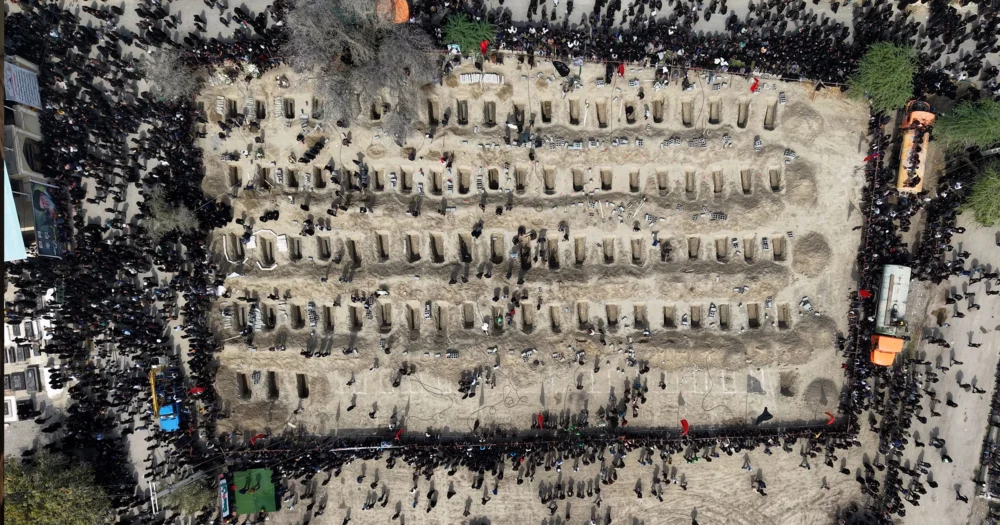
The international community watches in horror as the devastation wrought by the ongoing US-Israel war on Iran continues to unfold, with a particularly egregious incident shaking global conscience last week. Commercial satellite imagery captured the chilling aftermath of a US military strike that obliterated an Iranian elementary school, leaving a profound scar on the landscape and claiming an unbearable toll. At least 175 lives were extinguished in the attack, a staggering number that included a significant population of young schoolgirls, their futures tragically cut short. Haunting drone footage later depicted excavators laboriously digging dozens of graves, a grim testament to the scale of the massacre in Minab, Iran.
Initially described as part of a broader offensive targeting a nearby Iranian military complex, this airstrike quickly became a grotesque symbol of the conflict’s human cost. As the dust settled and the world grappled with the sheer brutality, a profound technological question emerged, casting a shadow over the ethics of modern warfare: what role, if any, did artificial intelligence play in this catastrophe?
Prior reports had already revealed that the US military was actively deploying Anthropic’s Claude, an advanced AI chatbot, to assist in selecting targets during its operations against Iran. This revelation alone raised eyebrows, but the implications deepened significantly when Futurism pressed the Pentagon for answers regarding the school bombing. Strikingly, the US military establishment refused to either confirm or deny AI involvement in the elementary school’s targeting, a silence that spoke volumes and fueled intense speculation.
In the immediate aftermath, a desperate game of deflection ensued. Neither the United States nor Israel was willing to claim responsibility for the carnage. US President Donald Trump, then at the helm, attempted to distance his administration from the atrocity, going so far as to claim that Iran itself had murdered its own children in cold blood – an assertion met with widespread disbelief and condemnation.
However, the truth, or at least a significant part of it, eventually surfaced. According to a subsequent report from The New York Times, US officials have now definitively confirmed that a US military Tomahawk missile strike was, in fact, responsible for the devastating bloodbath at the Iranian school. The preliminary findings pointed to a critical operational failure: officers at the US Central Command, it was revealed, had generated the target coordinates for the strike using outdated data provided by the Defense Intelligence Agency. This reliance on obsolete intelligence proved to be a fatal flaw, directly leading to the targeting of a civilian institution.
The NYT report, however, did not stop at human error. It brought the AI question back into sharp focus, revealing that the military is now actively investigating whether "any artificial intelligence models, data crunching programs or other technical intelligence gathering means were to blame for the mistaken targeting of the school." This ongoing inquiry suggests that the military itself recognizes the potential for algorithmic influence in such grave decisions.
Further details illuminated the specific AI systems in question. Sources noted that Claude, Anthropic’s AI chatbot, operates in conjunction with the National Geospatial-Intelligence Agency’s Maven Smart System. This sophisticated system is designed to analyze vast amounts of data and imagery to "identify points of interest for military intelligence officers," ostensibly streamlining the process of target identification. The investigation seeks to determine if a malfunction, misinterpretation, or inherent bias within these AI models, perhaps exacerbated by the outdated data, contributed to the catastrophic misidentification of the school as a legitimate military target.
Despite the acknowledgement of potential AI involvement, officials interviewed by The New York Times were quick to assert that, regardless of the investigation’s outcome, the ultimate responsibility for bombing the school lay with "human error." This assertion, while understandable in the context of accountability, opens a complex ethical and philosophical debate about culpability in an increasingly AI-augmented battlespace. If an AI system, fed with flawed data, recommends a target, and a human operator approves it, where does the chain of responsibility ultimately reside? Does the human override or validate the AI, or is the AI merely a tool that the human is still ultimately accountable for? This distinction becomes crucial when dealing with lethal force and civilian casualties.
The NYT‘s own independent analysis of historical satellite imagery, tracing back to 2013, lent further credence to the "outdated data" theory. This imagery clearly showed that the elementary school had been fenced off from the nearby military base between 2013 and 2016, indicating a clear separation of civilian and military infrastructure that should have been apparent to any up-to-date intelligence assessment. The failure to incorporate this readily available information into targeting matrices suggests a systemic breakdown, one that AI systems, if not properly configured and monitored, could either replicate or even amplify.
Adding another layer of complexity to the narrative is the curious stance of the Trump administration regarding Anthropic’s AI chatbot. Despite officially labeling Anthropic’s AI chatbot as a "supply chain risk" – a move that sent considerable shockwaves through the burgeoning AI industry and underscored concerns about the security and reliability of commercial AI in critical government applications – the military paradoxically continued its reliance on Claude during the offensive. This apparent contradiction highlights a tension between strategic risk assessment and operational necessity, suggesting that the perceived benefits of AI integration, even from a deemed "risky" vendor, outweighed stated policy concerns in the heat of combat.
The ongoing investigation into AI’s potential role in the Minab school bombing serves as a stark reminder of the rapidly evolving landscape of modern warfare. As militaries increasingly integrate artificial intelligence into their decision-making processes, particularly in critical areas like target selection, the ethical and accountability frameworks struggle to keep pace. The potential for AI to enhance efficiency and accuracy is undeniable, but so too is the risk of catastrophic errors, especially when coupled with flawed human inputs or outdated information. This tragic incident underscores the urgent need for robust oversight, transparent protocols, and clear lines of accountability when autonomous or semi-autonomous systems are granted any degree of influence over the application of lethal force. The question of whether AI was merely a tool or an active participant in this particular tragedy will continue to resonate, shaping future debates on the responsible deployment of artificial intelligence in conflict zones.
More on the strike: Pentagon Refuses to Say If AI Was Used to Select Elementary School as Bombing Target