anjir abdul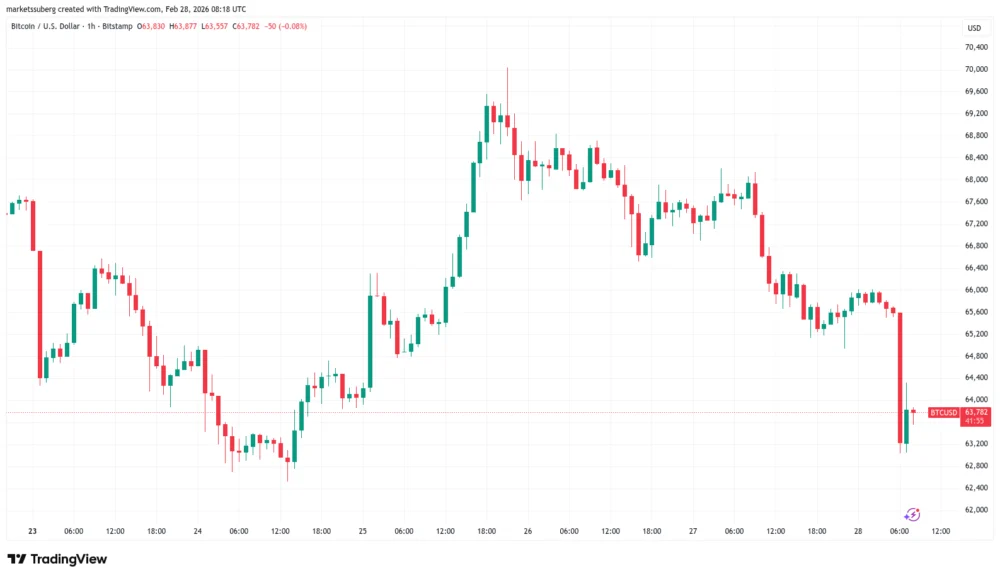
Bitcoin found itself navigating the treacherous waters of geopolitical instability in isolation this past weekend, as a significant military maneuver involving the US and Israel targeting Iran unfolded while traditional financial markets remained shuttered. The digital asset witnessed a sharp downward trajectory, pushing its price perilously close to the crucial $63,000 support level, though for the moment, key technical safeguards appeared to be holding.
The sudden escalation of tensions in the Middle East sent immediate ripples through the crypto landscape. On Saturday, Bitcoin (BTC) registered daily losses nearing 4% following the announcement of a joint US and Israeli military operation against Iran. This move, coming over a weekend, meant that global equity, bond, and commodity markets were closed, leaving Bitcoin as one of the primary assets to react in real-time to the unfolding crisis, often amplifying its inherent volatility.
The nature of the military operation, while initially described as targeting Iran’s nuclear infrastructure, was further complicated by a direct and provocative message from former US President Donald Trump. In a video address shared on Truth Social, Trump explicitly called upon the Iranian populace to "take over your government" once the operation concluded. "When we are finished, take over your government; it will be yours to take," he stated, adding, "This will be, probably, your only chance for generations. For many years, you have asked for America’s help, but you never got it." This rhetoric, perceived by many as an open incitement for regime change, added a layer of profound geopolitical uncertainty, suggesting the scope of the intervention could extend far beyond initial military objectives and potentially destabilize the region for years to come.
Data from TradingView starkly illustrated Bitcoin’s immediate response, showing BTC price action aggressively testing the $63,000 mark. This level holds significant psychological and technical importance for traders, representing a critical support zone that, if breached, could pave the way for further substantial declines. The crypto market’s swift reaction underscored its sensitivity to global events, particularly those that inject a high degree of unpredictability into the global economic and political order.

The absence of traditional market activity left crypto assets, particularly Bitcoin, in a unique position to absorb and reflect the initial shockwaves. With US stock market futures yet to open, and other major global indices dormant, Bitcoin became the de facto barometer of investor sentiment concerning the fresh geopolitical instability. This isolation often leads to exaggerated price movements in crypto, as liquidity can be thinner and reactions less diluted by diverse market participants.
The immediate fallout was palpable across the derivatives market. Data from CoinGlass revealed a dramatic spike in liquidations, with over $250 million in leveraged positions being wiped out within a mere four hours of the news breaking. Such mass liquidations are a common feature of sudden, sharp market downturns, as traders betting on price increases (long positions) are forced to sell their holdings to cover margin calls, exacerbating the downward pressure. This cascade of forced selling contributed significantly to Bitcoin’s rapid descent toward the $63,000 threshold.
Market observers were quick to draw parallels to previous episodes of regional conflict. Trading resource The Kobeissi Letter, via a post on X, noted, "The US and Israel now appear to be at war with Iran for the second time in 8 months." They referenced a previous Iranian offensive in 2025, an event that had similarly sparked an immediate, volatile reaction across crypto and broader risk assets. The recurrence of such conflicts, and Bitcoin’s consistent volatile response, highlights an ongoing debate within the financial community: Is Bitcoin a true "safe haven" asset akin to gold, or does it behave more like a high-beta tech stock, susceptible to risk-off sentiment during times of crisis? This latest incident leaned heavily towards the latter, as investors appeared to shed risk rather than flock to the digital asset for protection.
The fresh escalation arrived at an already precarious time for Bitcoin traders, coinciding with the final hours ticking down to the February monthly close. The timing was particularly unfortunate, given Bitcoin’s recent performance. As Cointelegraph previously reported, the BTC/USD pair was already down roughly as much as it had been in February 2025. More significantly, it was poised to seal its fifth consecutive month of losses – a bearish streak not encountered in seven years. This extended period of underperformance meant that investor sentiment was already fragile, making the geopolitical shock even more potent. The market was already grappling with headwinds, and this new development served to intensify the prevailing bearish mood.

Adding to the pressure on Bitcoin bulls was the release of hot US inflation data on Friday, just hours before the weekend’s geopolitical developments. Higher-than-expected inflation figures typically fuel expectations of tighter monetary policy from central banks, leading to higher interest rates. In such an environment, risk assets like Bitcoin often become less attractive as investors seek safer, yield-bearing alternatives. Bulls had attempted and failed to reclaim key support levels closer to $70,000 in the preceding days, suggesting a broader struggle to maintain upward momentum even before the Iran news broke. The combination of persistent inflation concerns and escalating geopolitical conflict created a perfect storm for Bitcoin’s price action.
Technically, the $63,000 level represents the lower boundary of a critical accumulation zone established earlier in the year. A sustained break below this point could trigger further sell-offs, potentially targeting the $60,000 psychological support, and even lower, towards the $58,000-$56,000 range, where previous strong buying interest was observed. Conversely, a bounce from $63,000 would signal resilience, but Bitcoin would face immediate resistance at the $65,000 and then the $68,000-$70,000 levels, which now represent formidable overhead supply. The February monthly close, if it confirms a fifth consecutive red candle, would be a strong bearish signal, potentially indicating a deeper correction is underway.
The incident once again highlights Bitcoin’s evolving role in the global financial ecosystem. While proponents often champion its decentralized nature and independence from traditional financial systems as a hedge against state-sponsored instability, events like these demonstrate its susceptibility to broader market sentiment and macro-geopolitical forces. The fact that it was the primary liquid asset available to react over the weekend might also explain the intensity of its move, as all available risk-off capital flows found their outlet in crypto.
As the world awaits the opening of traditional markets and further developments in the Middle East, Bitcoin’s immediate future hangs in the balance. Its ability to rebound from the $63,000 support and demonstrate resilience in the face of such significant global turmoil will be a crucial test of its maturity and its potential to truly act as a store of value or safe haven in an increasingly unpredictable world. The coming days will reveal whether this dip is a temporary panic or the harbinger of a more prolonged period of market weakness, driven by the convergence of geopolitical unrest and challenging macroeconomic conditions.