Faris Adani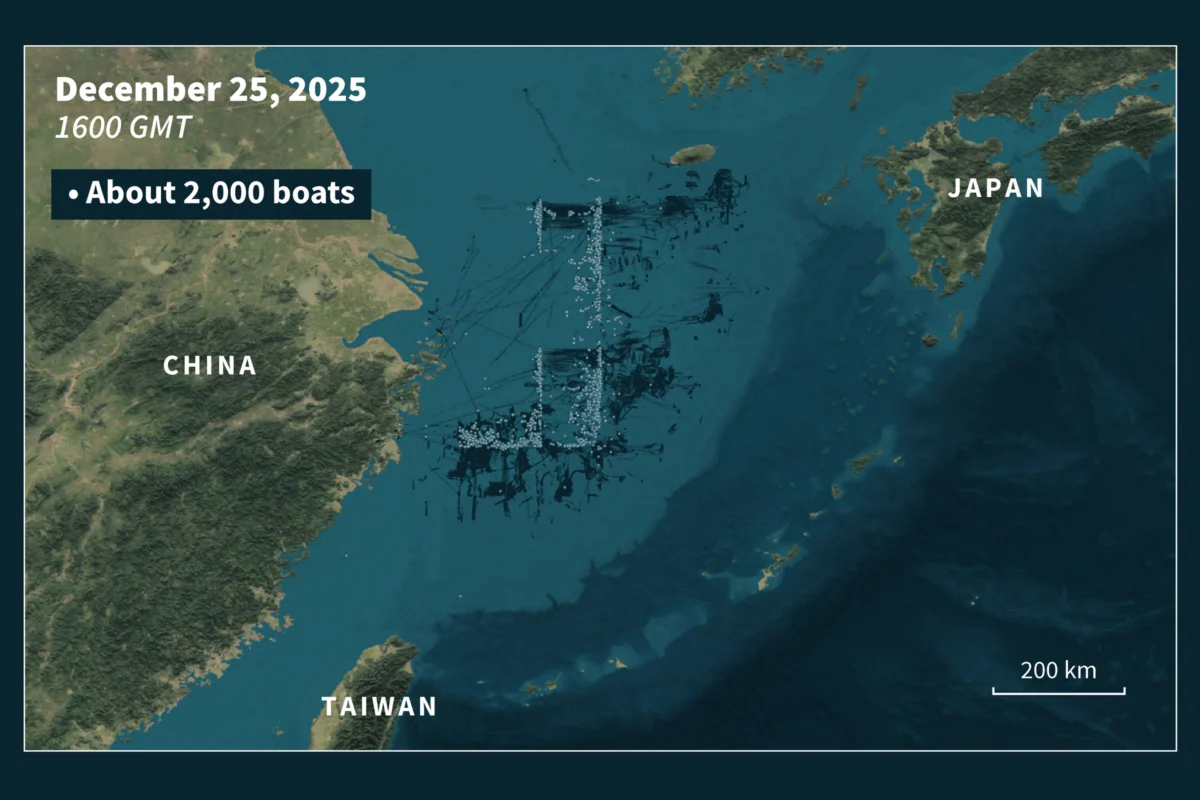
The tranquil expanse of the East China Sea, a vital artery for global commerce and a crucible of geopolitical tension, has recently been witness to a series of bewildering maritime spectacles. Far from the expected chaos of busy shipping lanes, thousands of Chinese commercial fishing vessels have been observed coalescing into impossibly vast, highly organized formations – an aquatic ballet of unprecedented scale and precision that has ignited concerns among international observers and security analysts alike. This peculiar phenomenon, detected through advanced satellite imagery and maritime analytics, is far removed from the romanticized notion of ancient leviathans or submerged cities; instead, it points to a calculated and potentially provocative display of strategic intent by Beijing, utilizing its vast civilian fleet in what some describe as "gray zone" operations.
The initial sightings, which began in December 2025, painted a stark picture of coordinated activity. Over 2,000 small ships, typically expected to scatter across the rich fishing grounds, instead aligned themselves into two distinct, inverted-L shaped arrangements off the coast of Shanghai. This initial configuration, remarkable for its sheer size and geometric regularity, was merely a precursor to subsequent, equally perplexing displays. Just weeks later, in January 2026, the vessels reformed, this time creating a colossal rectangle. This "wall of boats," as it was dubbed, stretched for an astonishing 240 nautical miles, a barrier so dense and impenetrable that commercial cargo ships navigating the busy East China Sea were reportedly forced to execute intricate, unorthodox maneuvers, zig-zagging through the narrow gaps to avoid collision, as reported by the New York Times. The intensity of this coordinated activity then appeared to subside somewhat in February, only to resurface with renewed vigor in early March 2026, when approximately 1,200 commercial fishing vessels once again converged, this time forming two long, parallel lines – another display of synchronized movement that defied conventional maritime logic.
For those accustomed to the digital spaghetti of GPS tracks generated by fishing fleets worldwide, these organized patterns are nothing short of astounding. The East China Sea, in particular, is one of the busiest maritime regions on Earth, traversed by an estimated 1.5 million ships annually. Its waters are a constant swirl of cargo vessels, tankers, passenger ferries, and fishing boats, their movements typically appearing as a dense, haphazard scatter plot on any tracking system. To witness thousands of individual vessels, often operating independently or in small groups, come together in such a disciplined and vast display of formation-keeping, is an anomaly that demands scrutiny.
Jason Wang, Chief Operating Officer at the satellite analytics firm ingeniSpace, articulated this sentiment clearly, telling Agence France-Presse, "Something didn’t look right to me because in nature very rarely do you see straight lines. We’ve seen like two, 300, up to a thousand [Chinese fishing boats congregate], but anything exceeding a thousand I thought was unusual." This observation underscores the profound difference between typical fishing activities and these orchestrated maneuvers. Normal fishing operations, even when large fleets target specific areas, rarely involve such precise, large-scale geometric formations over extended periods. The level of coordination implied by these patterns suggests a centralized command and control structure, far beyond what commercial fishing enterprises would typically employ for purely economic purposes.
Mark Douglas, an analyst at the Maritime Intelligence firm Starboard, echoed this astonishment in his comments to the NYT, stating, "The sight of that many vessels operating in concert is staggering. The level of coordination to get that many vessels into a formation like this is significant." His assessment points to the logistical complexity involved. Orchestrating thousands of individual vessels, each with its own crew and captain, to maintain precise positions within a larger formation over vast distances and for extended periods, requires sophisticated communication, precise navigation, and a clear, overarching directive. This is not the spontaneous gathering of a fishing frenzy; it is a meticulously planned and executed operation.
The implications of these strange formations have quickly resonated through geopolitical circles, particularly among those monitoring China’s expanding maritime influence. Many "China hawks" in the United States and allied nations are interpreting these exercises as de-facto naval drills conducted with civilian vessels. The prevailing theory is that the People’s Republic of China is leveraging its enormous fishing fleet as a "maritime militia" – a para-military force disguised as civilian craft – to conduct "gray zone" operations. These tactics involve actions that fall below the threshold of conventional warfare, allowing a state to exert pressure, assert claims, and test responses without triggering a direct military confrontation.
The concept of a maritime militia is not new to China’s strategy. Beijing has long been accused of using its vast fishing fleet to advance its territorial claims, particularly in the South China Sea. These vessels, often subsidized and sometimes directly commanded by military or coast guard personnel, can swarm disputed areas, harass foreign vessels, conduct surveillance, and establish a de facto presence that complicates the responses of other nations. By blurring the lines between civilian and military assets, China gains plausible deniability, making it difficult for other navies to respond without risking an international incident.
The specific location of these formations – in the East China Sea, bordering China, Taiwan, and Japan – significantly amplifies these concerns. The primary fear is that these exercises are in preparation for a potential confrontation with Chinese Taipei, more commonly known as Taiwan. China considers Taiwan a breakaway province that must be reunified with the mainland, by force if necessary. A potential invasion or blockade of Taiwan is a scenario that has long preoccupied strategists in Washington, Tokyo, and Taipei. In such a scenario, a vast fleet of ostensibly civilian vessels could play multiple roles:
- Blockade Enforcement: A "wall of boats" like the rectangular formation observed in January could effectively cordon off parts of the Taiwanese coast or major shipping lanes, disrupting trade and isolating the island without deploying overt military assets, thereby presenting a less escalatory façade.
- Screening and Deception: Such a large number of vessels could act as a screen, obscuring the movements of actual naval warships or amphibious landing craft, making it harder for intelligence agencies to track military preparations.
- Harassment and Intimidation: The sheer presence of thousands of Chinese vessels could be used to intimidate Taiwanese coast guard or naval patrols, or to harass shipping attempting to enter or leave Taiwanese ports.
- Logistical Support: In a conflict scenario, these vessels could potentially be repurposed for logistics, transport, or even as auxiliary platforms for intelligence gathering.
The economic implications of such a blockade, even a simulated one, are immense. Taiwan is a critical hub in the global supply chain, particularly for semiconductors. Any disruption to its maritime access would send shockwaves through the world economy. The presence of these formations thus serves as a stark reminder of the potential economic leverage China could wield through non-military means.
Beyond Taiwan, the East China Sea is also a hotbed of other territorial disputes, most notably over the uninhabited Senkaku Islands (Diaoyu Islands in China) administered by Japan but claimed by China. The use of maritime militia in this region could also be a means for China to assert its claims more aggressively against Japan, testing Tokyo’s resolve and the readiness of its self-defense forces.
While the overwhelming consensus among analysts points to a state-directed operation, it’s worth briefly considering alternative, albeit less plausible, explanations. Could these simply be massive, coordinated fishing efforts? While China operates the world’s largest fishing fleet, and large-scale operations are common, the geometric precision and repeated patterns observed are highly atypical for purely commercial fishing. Such formations are inefficient for maximizing catch and would incur significant fuel and communication costs without an obvious commercial benefit. Furthermore, the explicit comments from experts about the unusual nature of the coordination strongly refute a simple commercial explanation.
The detection of these formations highlights the critical role of modern satellite analytics and maritime intelligence firms. By aggregating and analyzing vast amounts of Automatic Identification System (AIS) data – transponder signals broadcast by ships – alongside satellite imagery, these companies can identify anomalies and patterns that would be invisible to traditional surveillance methods. This technological edge is crucial for exposing "gray zone" activities that intentionally seek to operate in the shadows between war and peace.
In conclusion, the bizarre constellations formed by thousands of Chinese fishing vessels in the East China Sea represent a significant escalation in Beijing’s use of its maritime militia. These are not random occurrences but meticulously choreographed maneuvers that strongly suggest state direction and a strategic purpose. Whether these are explicit drills for a Taiwan contingency, a broader show of force in disputed waters, or a sophisticated test of regional responses, their existence underscores the evolving nature of maritime power projection. As nations grapple with the complexities of "gray zone" warfare, the international community faces the daunting challenge of distinguishing between legitimate civilian activity and state-sponsored paramilitary operations, demanding heightened vigilance and a coordinated diplomatic and strategic response to safeguard stability in one of the world’s most critical and contested regions.