Faris Adani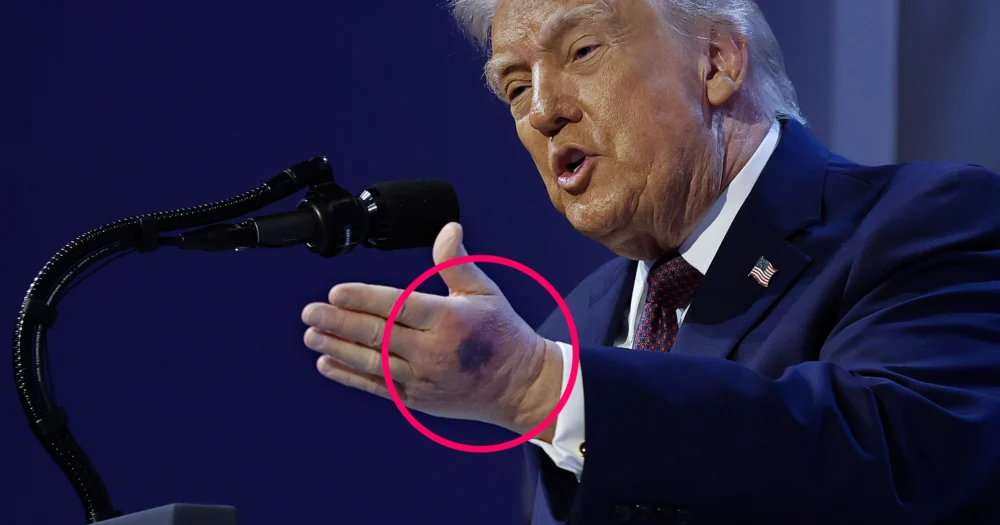
Trump’s Other Hand Is Also Now Showing a Grisly Mark
The ongoing saga surrounding former President Donald Trump’s physical health has taken another intriguing turn, with new photographs revealing a disconcerting bruise on his left hand, echoing similar markings that appeared on his right hand just last year. This recurring medical mystery has intensified public and expert scrutiny, raising profound questions about the former president’s overall well-being and the transparency of his inner circle regarding his health status. Last year, a distinct, large, and greenish bruise on Trump’s right hand first sparked widespread speculation. At the time, White House press secretary Karoline Leavitt offered an explanation that many found difficult to reconcile with the visual evidence, attributing the bruises to the sheer volume of handshakes Trump engaged in daily as part of his relentless work schedule. This explanation, however, faced immediate skepticism, particularly given the unusual appearance of the mark.
Now, the appearance of an almost identical, equally alarming bruise on his left hand has all but dismantled Leavitt’s previous defense. Onlookers have pointed out the logical inconsistency: for the “shaking hands” explanation to hold, Trump would have to have dramatically shifted his primary hand for greeting world leaders and constituents. The emergence of this new mark has fortified the belief among many that the administration’s earlier statements were, in fact, another instance of the Trump administration’s documented struggles with factual accuracy and its often-contentious relationship with the truth. The visual evidence is compellingly grim. Photographs capturing Trump at this year’s prestigious World Economic Forum in Switzerland show an even more pronounced and “gnarlier” darkish bruise on his left hand, drawing immediate attention and reigniting the health debate.
Medical professionals, while cautious about offering direct diagnoses without a full examination, have coalesced around several plausible explanations for these persistent and prominent bruises. A leading theory suggests that the bruising is the residual effect of blood being drawn, most likely via an intravenous (IV) needle. This explanation holds significant weight as needles, when puncturing the delicate walls of veins, can sometimes cause blood to leak into the surrounding tissues, leading to the formation of a hematoma or bruise. This phenomenon can be exacerbated by various factors, including the skill of the phlebotomist, the fragility of the patient’s veins, or the use of certain medications.
This intravenous needle theory dovetails seamlessly with other crucial details that have gradually emerged regarding Trump’s medical situation. In a related development, after the then-79-year-old was observed with significant swelling in his legs, the White House confirmed in July that Trump had been diagnosed with chronic venous insufficiency (CVI). CVI is a common condition prevalent among older individuals, characterized by the impaired flow of blood back to the heart, leading to blood pooling in the extremities, most notably the legs and ankles. This condition can also contribute to more fragile veins and capillaries, making individuals more susceptible to bruising, even from minor trauma or medical procedures like blood draws. The combination of CVI and frequent medical interventions could easily explain the recurring and prominent bruises.
Further bolstering the medical explanations, Professor Jonathan Reiner of George Washington University, a prominent cardiologist, informed *CNN* last month that he has frequently observed similar bruising patterns in his patients who are undergoing treatment with potent blood-thinner medications. These medications, which can be significantly more potent than even aspirin – a drug Trump is widely known to consume – work by reducing the blood’s ability to clot. While vital for preventing strokes and other cardiovascular events, a side effect of blood thinners is an increased propensity for bruising and, in some cases, internal bleeding, even from relatively minor impacts or procedures. Given Trump’s age and previously reported cardiovascular health markers, the possibility of him being prescribed such medications is a significant consideration.
Any attempts by the media or medical community to gain further clarity or offer informed speculation on Trump’s health have consistently been met with a wall of hostility and sharp rebuke from his administration officials. This defensiveness strongly suggests that the topic is highly sensitive and perhaps even a source of considerable concern within Trump’s inner circle. Steven Cheung, the White House communications director, vehemently condemned such inquiries in a statement to *CNN*, fuming that “Any so-called medical professionals engaging in armchair diagnosis or false speculation for political purposes are clearly breaking the Hippocratic Oath they’ve sworn to, and they should get their head examined.” While Cheung’s statement underscores the administration’s frustration, such aggressive pushback often serves to intensify, rather than diminish, public speculation, leading many to question what exactly the administration might be trying to conceal. The lack of transparent, verifiable medical information only fuels the narrative of a potential health issue being downplayed or hidden.
Beyond the specific mystery of the hand bruises, a broader spectrum of observations has continued to fuel questions regarding Trump’s overall physical and cognitive health. His public appearances have, at times, featured an inability to form coherent sentences, a noticeable garbling of words, and a recent, more pronounced shuffling of his feet. These recurring behaviors have once again prompted a wider discussion among medical experts and the general public about the president’s physical stamina and mental acuity, especially given the immense demands of the highest office.
Last week, during a revealing podcast appearance, Bruce Davidson, a distinguished professor of medicine at Washington State University, presented a compelling argument. Davidson suggested that Trump appears to have suffered a stroke, a cerebrovascular event that he believes is now impacting the former president’s ability to move and articulate clearly. Strokes, even minor ones, can have lasting effects on motor skills, balance, speech, and cognitive functions, making such expert observations particularly concerning when applied to a prominent public figure.
The scrutiny extends beyond physical health to long-standing concerns about Trump’s cognitive well-being. Experts and political observers have speculated for years about his mental faculties, and these discussions have recently gained new momentum. Just this week, Ty Cobb, a former White House attorney who worked closely with Trump, shared his candid assessment, speculating that there has been a “significant decline” in Trump’s mental capabilities. Speaking on *MS Now* on Wednesday, Cobb remarked, “He’s always been driven by narcissism. But I think the dementia and the cognitive decline are, you know, palpable, as do many experts, including many physicians.” While these comments are not medical diagnoses, they reflect a growing sentiment among those who have observed Trump over time, adding another layer of complexity to the ongoing public health debate.
The health of a presidential candidate, and especially a former president vying for a return to the White House, is not merely a private matter; it is a subject of profound public interest. The physical and cognitive demands of the presidency are immense, requiring sustained stamina, sharp decision-making, and unwavering mental clarity. The persistent questions surrounding Trump’s health, from the mysterious hand bruises and diagnosed chronic venous insufficiency to concerns about his gait, speech, and cognitive function, underscore a significant dilemma. The administration’s defensive posture and lack of transparent medical disclosures only exacerbate the situation, leaving the public and experts to piece together a complex narrative from observations and informed medical speculation. As the political landscape heats up, the question of Donald Trump’s fitness for office, both physically and mentally, remains a central and unresolved concern, shaping perceptions and influencing the broader discourse about leadership in an increasingly demanding world.