Imroatul Nasiyah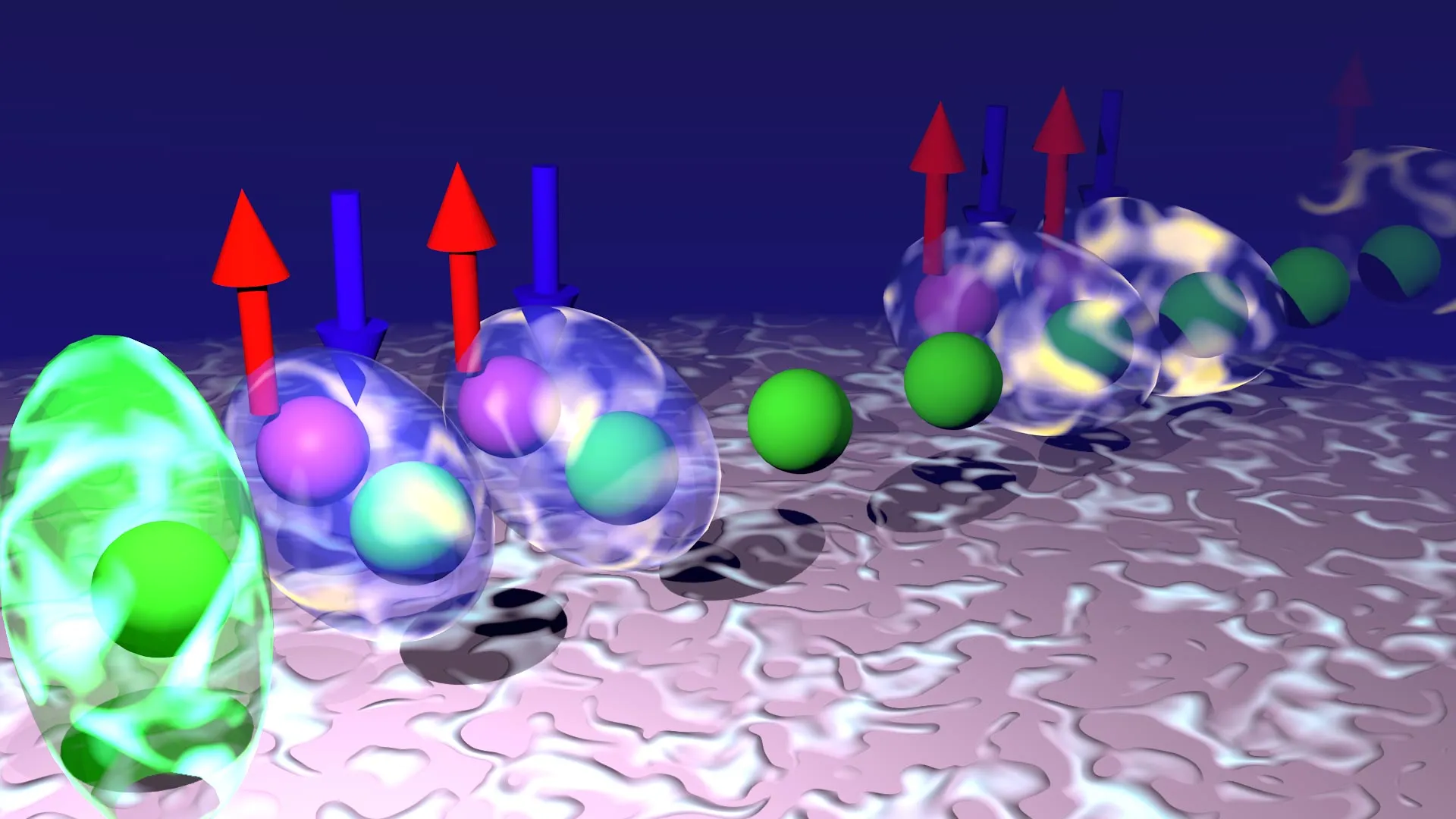
At the fundamental level of the universe, the rules of physics operate in ways starkly different from our everyday macroscopic experience. Here, the bizarre yet potent principles of quantum physics govern the behavior of particles. These principles allow particles to exist in multiple states simultaneously and to influence each other in ways that defy classical intuition. It is precisely these peculiar quantum phenomena that form the bedrock of quantum computing, offering the tantalizing prospect of machines capable of tackling problems currently intractable for even the most advanced supercomputers.
However, before the transformative potential of quantum calculations can be fully realized and benefit society, physicists face a formidable challenge: the extreme fragility of qubits, the fundamental building blocks of quantum computers. Even the most minute environmental fluctuations – a slight shift in temperature, a subtle change in a magnetic field, or even imperceptible microscopic vibrations – can disrupt the delicate quantum states of qubits. This loss of quantum state, known as decoherence, effectively renders the qubits incapable of performing complex calculations reliably, severely limiting the practical utility of current quantum computing architectures.
In response to this critical obstacle, researchers have, in recent years, embarked on an intensive quest to engineer materials that can intrinsically offer enhanced protection against these disruptive environmental influences and internal noise. The focus of this research has increasingly shifted towards exploiting the concept of topology. Quantum states that are not merely localized but are fundamentally rooted in and maintained by the underlying structural properties of the material are termed topological excitations. These excitations possess a remarkable inherent stability and resilience, making them significantly more robust against decoherence than their non-topological counterparts. The central challenge, therefore, has been the identification and development of materials that naturally support these highly stable topological quantum states.
Newly Developed Material Offers Superior Protection Against Disturbances
The recent work by a collaborative research team from Chalmers University of Technology, Aalto University, and the University of Helsinki represents a significant leap forward in this endeavor. They have successfully developed a novel quantum material engineered specifically for qubits that demonstrably exhibits robust topological excitations. This achievement is a pivotal step towards the realization of practical topological quantum computing, as it embeds stability directly into the very fabric of the material’s design.
"This represents a completely new class of exotic quantum material, one that possesses the extraordinary ability to preserve its quantum properties even when subjected to external disturbances," explains Guangze Chen, a postdoctoral researcher in applied quantum physics at Chalmers and the lead author of the study, which has been published in the prestigious journal Physical Review Letters. "This material has the potential to be a cornerstone in the development of quantum computers that are sufficiently robust to reliably execute complex quantum calculations in real-world applications."
The term ‘exotic quantum materials’ serves as an umbrella designation for several emerging categories of solid-state materials that exhibit extreme and often counterintuitive quantum mechanical properties. The ongoing scientific pursuit of such materials, characterized by their exceptional resilience and unique quantum behaviors, has been a long-standing and highly sought-after objective within the physics community.
Magnetism Emerges as the Key Ingredient in the New Strategy
Historically, the established approach to generating topological excitations has relied on a specific quantum interaction known as spin-orbit coupling. This phenomenon describes the intricate link between an electron’s intrinsic angular momentum, its spin, and its orbital motion around the atomic nucleus. By carefully manipulating spin-orbit coupling within a material, researchers could engineer the conditions necessary for topological states to emerge. However, this ‘recipe’ has a significant limitation: spin-orbit coupling, while crucial, is a relatively rare quantum interaction, meaning that this established method can only be applied to a limited subset of materials, thereby restricting the scope of research and development.
The research team’s innovative approach, detailed in their study, presents a fundamentally new strategy that bypasses the reliance on spin-orbit coupling. Instead, they leverage magnetism – a far more ubiquitous and accessible quantum interaction – to achieve the same desired outcome of generating robust topological excitations. By skillfully harnessing the inherent magnetic interactions within a material, the researchers have successfully engineered the critical topological excitations essential for the advancement of topological quantum computing.
"The primary advantage of our newly developed method lies in the widespread prevalence of magnetism," Guangze Chen elaborates. "You can think of it like baking a cake using everyday pantry staples rather than relying on exotic, hard-to-find spices. This accessibility means we can now explore a significantly broader spectrum of materials for topological properties, including many that were previously considered unsuitable or overlooked."
Paving the Way for Next-Generation Quantum Computer Platforms
To further accelerate the discovery and development of new materials possessing desirable topological properties, the research team has also engineered a sophisticated new computational tool. This innovative software is designed to directly calculate and quantify the degree to which a material exhibits topological behavior. By providing a predictive capability, this tool can significantly streamline the screening process for potential candidate materials.
"Our ultimate hope is that this integrated approach – combining novel material design with advanced computational tools – will serve as a powerful catalyst for the discovery of many more exotic materials with tailored topological characteristics," states Guangze Chen. "In the long term, this could fundamentally transform the landscape of quantum computing, leading to the development of entirely new generations of quantum computer platforms. These next-generation systems will be built upon materials that possess an intrinsic resistance to the very environmental disturbances that currently plague and limit the performance of existing quantum technologies."
The implications of this research are far-reaching. By mitigating the critical issue of qubit decoherence, this magnetic-based approach to creating topological excitations has the potential to unlock the true power of quantum computing. It moves the field closer to realizing quantum computers that are not only theoretically capable of solving monumental problems but are also practically robust enough to operate reliably in real-world environments. This could accelerate breakthroughs in fields such as drug discovery, materials science, financial modeling, and artificial intelligence, ushering in an era of unprecedented computational capability and scientific advancement. The simple elegance of using a common physical phenomenon like magnetism to overcome a profound quantum mechanical challenge underscores the ingenuity of the researchers and offers a beacon of hope for the future of quantum technology.