Faris Adani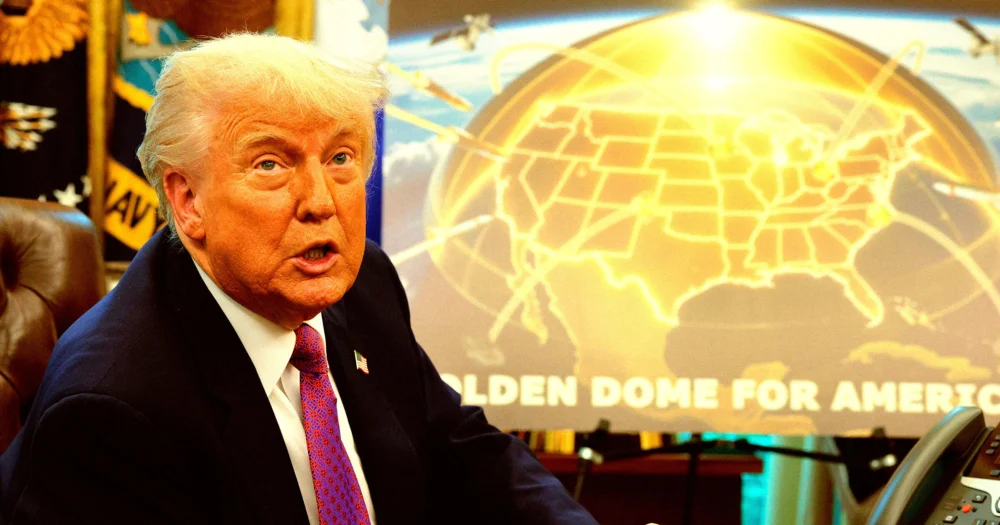
Donald Trump’s ambitious “Golden Dome” missile defense system, initially presented with an already staggering price tag of $175 billion, is now projected to incur costs so astronomical that experts warn it simply “will not work,” according to a new, comprehensive analysis by the watchdog group Taxpayers for Common Sense. This updated assessment fundamentally redefines the scope of the financial burden, shifting from a substantial investment to an unfeasible, nation-crippling expenditure that far exceeds the United States’ available physical currency. The initial $175 billion, once considered a monumental sum, now appears to be a mere rounding error in the face of trillions of dollars that could be siphoned into a project fraught with insurmountable technical and logistical challenges.
To arrive at their stark conclusion, Taxpayers for Common Sense meticulously synthesized various reports and expert analyses, painting a dire picture of the Golden Dome’s true economic footprint. One particularly sobering study, conducted by the conservative American Enterprise Institute (AEI), estimates that American taxpayers could be forced to shell out an astonishing $3.6 trillion over the next two decades for the system. When adjusted for anticipated inflation, this figure balloons further to an unimaginable $4.4 trillion. To put this into a stark and immediate perspective, if every physical dollar bill, coin, and piece of currency currently circulating within the United States were pooled together – including money held outside the US Treasury and Federal Reserve Banks – the total sum would still only amount to approximately $2.43 trillion. This staggering deficit highlights that even liquidating every tangible dollar in the nation would fall short of funding the Golden Dome, underscoring the sheer impossibility of its financial demands. The economic implications are profound, suggesting that such a venture would necessitate unprecedented borrowing, dramatic cuts to other vital federal programs, or a combination of both, fundamentally reshaping the American economy for generations.
The true financial abyss deepens further when considering the most complex and costly component of the Golden Dome concept: the space-based interceptors (SBIs). These orbital counter-ordinance systems are envisioned as a primary layer of defense, designed to neutralize adversarial rockets in the vacuum of space before they can deploy their warheads. Even without assuming a worst-case scenario for technical success, the AEI suggests that to achieve an interceptor success rate "very close to 100 percent," the space-based interceptors alone could cost as much as $6 trillion. This figure, dedicated solely to the orbital component, dwarfs even the total estimated cost for the entire Golden Dome system and underscores the immense engineering complexity and technological ambition inherent in the proposal. Under this $6 trillion scenario, the AEI projects that the US Space Force might need to field as many as 85,400 SBIs. This represents an astronomical amount of infrastructure to develop, launch, maintain, and operate in orbit, requiring a level of industrial capacity and technological innovation that arguably does not yet exist. Moreover, this estimate operates on a "generous ratio of real-world success," implying that only a handful of SBIs would be needed to effectively neutralize each incoming adversarial rocket.
However, the optimistic assumptions underpinning the AEI’s "generous ratio" are starkly contradicted by more rigorous scientific assessments. The American Physical Society Panel on Public Affairs, a highly respected body of scientific experts, published a February report that cast serious doubt on the efficacy and feasibility of such a system. Their findings indicate that the amount of SBIs required to reliably knock out even a single last-generation adversarial missile could realistically be in the hundreds, not just a handful. The challenge becomes exponentially more difficult when considering next-generation solid-state intercontinental ballistic missiles (ICBMs), which are designed with advanced countermeasures, maneuverability, and speed. For these advanced threats, the APS report chillingly suggests that "at least 1600 interceptors" could be required per missile.
This scientific reality transforms the already exorbitant cost projections into something truly unfathomable. Given that major geopolitical rivals like China and Russia collectively possess an estimated 750 ICBMs, the numbers quickly spiral out of control. To assure security against this threat using the APS’s more realistic figures, the US would need a staggering 1.2 million SBIs – solely to address the ICBM threat. This calculation doesn’t even begin to factor in the hundreds of cruise missiles, sophisticated hypersonic weapons, and other conventional and unconventional threats that would also need to be defended against, each presenting its own unique set of detection, tracking, and interception challenges. The sheer scale of such an undertaking, from manufacturing to deployment and command-and-control, pushes the boundaries of current human and technological capabilities to their breaking point.
Beyond the raw numbers, the engineering challenge of missile defense is a Gordian knot of physics, logistics, and real-time computation. Intercepting a ballistic missile traveling at thousands of miles per hour, often deploying decoys and maneuvering warheads, is akin to hitting a bullet with another bullet, but across intercontinental distances and with fractions of a second for decision-making. The system would need flawless, instantaneous detection, precise tracking across vast distances, discrimination between actual warheads and decoys, and the ability to launch and guide interceptors with pinpoint accuracy, all while under potential electronic attack and amidst the chaos of a global conflict. The physics involved in achieving such feats reliably against a sophisticated adversary are extraordinarily complex, making the "very close to 100 percent" success rate an aspiration rather than a realistic expectation based on current technology.
The history of missile defense research further reinforces the skepticism surrounding the Golden Dome. Despite over 40 years of intensive research, billions of dollars already spent, and countless hours of scientific and engineering effort, the track record of successful interceptions in controlled test environments remains abysmal. Shockingly, in all those decades, technicians have managed to successfully knock only one mock warhead out of the sky in a realistic test scenario. This solitary success, achieved under highly controlled conditions that do not replicate the complexities of a real-world attack, speaks volumes about the persistent and fundamental problems plaguing missile defense technology. Programs like the Strategic Defense Initiative (SDI), famously dubbed "Star Wars" in the 1980s, faced similar criticisms regarding feasibility and cost, ultimately never progressing beyond limited research. The current Ground-based Midcourse Defense (GMD) system, designed to protect against ICBMs, has itself been plagued by repeated test failures, cost overruns, and doubts about its operational effectiveness against a complex attack. These historical precedents serve as a stark warning: the allure of an impenetrable shield often collides with the harsh realities of physics and engineering.
The economic implications of pursuing the Golden Dome are equally catastrophic. A multi-trillion-dollar expenditure would inevitably trigger a cascade of negative effects on the US economy and society. Such massive spending would likely necessitate substantial cuts to crucial domestic programs, including healthcare, education, infrastructure development, scientific research, and social safety nets. It would exacerbate the national debt to unprecedented levels, potentially leading to increased interest rates, inflation, and a weakened dollar. The opportunity cost is immense: imagine the transformative potential of $4.4 to $6 trillion invested in renewable energy, universal healthcare, modernizing infrastructure, or pioneering new scientific fields. Instead, these resources would be diverted to a project that, by expert consensus, is unlikely to achieve its stated goals. This constitutes not just a misallocation of resources but a monumental "boondoggle" – a wasteful project offering little to no tangible benefit.
Geopolitically, the Golden Dome concept also presents significant risks. The deployment of such an expansive missile defense system, even if theoretically effective, could trigger a dangerous and destabilizing arms race. Adversarial nations, perceiving the Golden Dome as an attempt to negate their deterrent capabilities, would almost certainly respond by developing more ICBMs, designing more sophisticated countermeasures (such as advanced decoys, maneuvering warheads, or hypersonic gliders), or investing in other asymmetric threats to circumvent the system. This would lead to a perpetual cycle of escalation, undermining strategic stability and potentially increasing the risk of conflict rather than reducing it. Furthermore, the illusion of invulnerability created by a highly touted but ultimately ineffective shield could lead to reckless foreign policy decisions, creating a false sense of security that could have catastrophic consequences in a real crisis.
Ultimately, the consensus among independent experts and watchdog groups is clear: the Golden Dome, while perhaps appealing in its promise of absolute security, is an economically unviable and technically insurmountable fantasy. As Gabe Murphy, a policy analyst at Taxpayers for Common Sense, succinctly put it to the Federal News Network: “If Golden Dome could guarantee our security for nuclear weapons, one could argue that these astronomical costs would be worth it, but from all these viability problems and the history of failed attempts, it’s very clear that it won’t.” The allure of a technologically advanced defense against existential threats is powerful, but it must be tempered by scientific realism and fiscal responsibility. The evidence overwhelmingly suggests that the Golden Dome is not merely an expensive undertaking but an impossible dream, a colossal drain on national resources that promises little more than an empty, golden shell. To pursue it would be to squander trillions of dollars on a phantom shield, diverting critical funds from real challenges and leaving the nation no safer, but significantly poorer.