Faris Adani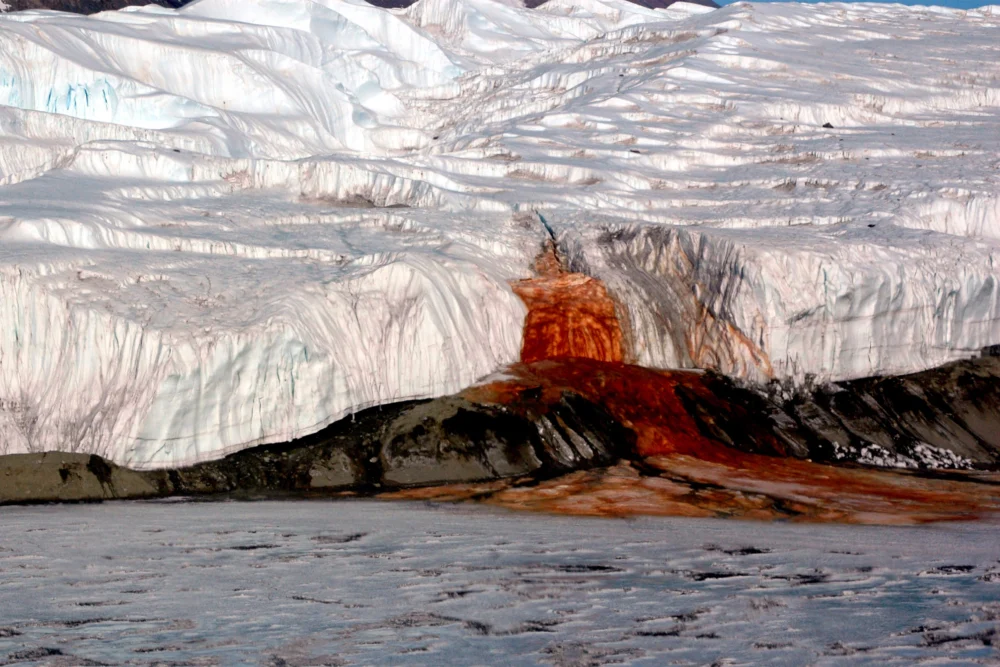
Antarctica, a continent synonymous with vast, pristine ice and extreme cold, harbors a truly bizarre natural phenomenon: a crimson waterfall that appears to bleed from the icy face of a glacier. Known dramatically as Blood Falls, this striking feature on the Taylor Glacier in the McMurdo Dry Valleys has long captivated explorers and scientists alike, its eerie scarlet flow conjuring images more akin to a gothic horror novel than a scientific expedition. For decades, the true nature and mechanics behind this chilling spectacle remained shrouded in mystery, fueling speculation and giving rise to various theories, some more fantastical than others. However, through persistent scientific inquiry and the application of cutting-edge technology, researchers have progressively peeled back the layers of this enigma, revealing a perfectly logical, albeit still extraordinary, explanation that ultimately "spoils the cosmic horror" in favor of fascinating geomicrobiology and glaciology.
The story of Blood Falls begins in 1911 with Australian geologist Thomas Griffith Taylor, part of Robert Falcon Scott’s ill-fated Terra Nova Expedition. Taylor was the first to document the peculiar crimson stain cascading from the snout of the glacier that would later bear his name. The sight must have been utterly perplexing to the early explorers, isolated in one of the planet’s most inhospitable environments. In an era before sophisticated analytical tools, the red coloration was a source of immediate wonder and, naturally, misinterpretation. Initial theories, rooted in observation rather than deep analysis, speculated on the presence of red algae as the cause, a common phenomenon in some polar and alpine environments. This idea persisted for some time, seemingly a plausible biological explanation for the vivid hue in a landscape otherwise dominated by whites and blues. The idea of "blood" was, of course, purely metaphorical, but the visual impact was undeniable, lending the site its enduring and evocative name.
However, as scientific exploration of Antarctica advanced, so did the tools and methodologies available to researchers. The microalgae theory, while initially appealing, began to lose ground. Scientists started to suspect that the color might be inorganic, specifically linked to iron. The hypothesis gained traction that the red could be attributed to iron-rich saltwater emerging from beneath the glacier, which would then rapidly oxidize upon exposure to the oxygen-rich air, much like rust forming on metal. This theory offered a more geologically sound explanation for the color, tracing its origins to subterranean reservoirs rather than surface-dwelling organisms. For many years, this iron oxidation hypothesis became the leading explanation for the Blood Falls’ macabre appearance. It provided a seemingly complete picture: a hidden source of iron-rich water, expelled from the glacier, and then reacting with the atmosphere to create the dramatic red flow.
Yet, as often happens in science, even widely accepted explanations can be refined or even overturned by new discoveries. Further investigation into the precise chemical composition of the Blood Falls’ water revealed a more intricate story than simple dissolved iron. A pivotal breakthrough came with research led by scientists from Johns Hopkins University, published in 2017. Using advanced analytical techniques, including transmission electron microscopy, they discovered that the iron in the water wasn’t present in a simple dissolved mineral form. Instead, it was trapped within tiny, iron-rich nanospheres. These nanoparticles, astonishingly, were found to be incredibly small—about 100 times smaller than a red blood cell—and were probably packaged in this unique way by ancient, metal-metabolizing bacteria.
This revelation transformed the understanding of Blood Falls from a purely geological phenomenon to a captivating example of extremophile biology. The nanospheres suggested that the iron originated not just from the bedrock of a subterranean lake, but was actively processed by a unique microbial ecosystem thriving deep beneath the ice. This subglacial lake, from which the Blood Falls emerges, is a truly alien environment—dark, anoxic (devoid of oxygen), and extremely cold, yet rich in iron and highly saline. The high salt content is crucial, as it lowers the freezing point of the water significantly, preventing it from solidifying even at sub-zero temperatures. This briny, iron-rich water provides the perfect conditions for these specialized microorganisms to survive and, indeed, flourish, metabolizing iron and sulfur compounds in the absence of sunlight, much like chemosynthetic life forms found around hydrothermal vents in the deep ocean. The discovery of nanospheres, therefore, didn’t just explain the color; it unveiled a hidden world of life sustained in one of Earth’s most extreme environments, hinting at the resilience and adaptability of life itself.
With the mystery of the "blood’s" composition and its biological origins largely solved, another crucial question remained: what mechanism was responsible for pumping this ancient, briny water out of its subglacial reservoir and through the glacier’s icy facade? This was the focus of a new study, published in the journal Antarctic Science, led by Peter Doran, a geoscientist at Louisiana State University, and his colleagues. Their research sought to unravel the hydrological dynamics that drive the intermittent, yet powerful, eruptions of Blood Falls.
To solve this final piece of the puzzle, Doran’s team employed a sophisticated array of instruments, combining GPS data, a visual time-lapse camera trained on the Blood Falls, and real-time temperature readings from within and around the glacier. This multi-faceted approach allowed them to monitor the glacier’s movements, the frequency of the falls’ discharge, and the environmental conditions with unprecedented precision. What they observed during a significant eruption in 2018 provided the definitive answer. They found a direct correlation between periods of increased discharge from Blood Falls and subtle but measurable changes in the overlying glacier. Specifically, their instruments detected that the glacier dropped by a mere fraction of an inch—less than an inch, in fact—during the eruption. This slight but significant subsidence created an immense amount of pressure on the hidden subglacial lake and its briny contents.
The mechanism is elegantly simple: the sheer weight and slow, inexorable movement of the massive Taylor Glacier act like a colossal, intermittent pump. When the glacier subtly shifts or settles, even by a tiny amount, it exerts immense hydrostatic pressure on the trapped, unfrozen brine beneath. This pressure then forces the highly saline water through existing cracks and fissures within the glacier, expelling it outwards in a sudden surge. As this ancient, iron-rich water emerges and makes contact with the oxygen in the atmosphere, the iron within the nanospheres rapidly oxidizes, creating the dramatic, rust-red cascade that gives Blood Falls its haunting name. The continuous flow is maintained by a dynamic equilibrium of glacial movement, pressure buildup, and the unique properties of the super-chilled brine.
The complete scientific explanation for Blood Falls is far more compelling than any supernatural or horrific tale. It represents a triumph of scientific inquiry, progressively dismantling a century-old mystery. From early guesses about algae to the refined understanding of iron nanospheres and microbial life, and finally to the mechanical pumping action of the glacier itself, each step has deepened our appreciation for the complex interplay of geology, chemistry, and biology in extreme environments.
Beyond merely solving a local enigma, the study of Blood Falls carries profound implications for several scientific disciplines. For astrobiology, this unique subglacial ecosystem serves as a potent analog for potential life forms on other icy worlds in our solar system, such as Jupiter’s moon Europa or Saturn’s moon Enceladus. These distant bodies are thought to harbor vast, subsurface oceans beneath thick ice shells, conditions that might mirror the dark, cold, and briny environment of Blood Falls. If life can thrive in such extreme conditions on Earth, it significantly bolsters the hypothesis that similar life could exist beyond our planet.
Furthermore, understanding the hydrological dynamics of Blood Falls contributes to the broader field of glaciology and our comprehension of subglacial systems. While the original article is careful to note that Blood Falls itself isn’t a direct "SOS signal about climate change," the research into how glaciers interact with underlying water bodies is critical for predicting glacial melt rates, sea-level rise, and the stability of ice sheets in a warming world. The intricate processes at play beneath the Taylor Glacier offer valuable insights into how water moves and is stored in these vast ice masses, influencing their flow and stability.
In conclusion, the Blood Falls of Antarctica, once a source of chilling wonder and cosmic dread, has been thoroughly demystified by the relentless pursuit of scientific understanding. What we are left with is not a monster from the deep, but a spectacular natural laboratory where extremophile life thrives in darkness, ancient waters are preserved by salt, and a colossal glacier acts as a silent, powerful pump. It is a testament to the fact that even in the most remote and seemingly barren corners of our planet, nature offers up extraordinary secrets, waiting to be unlocked by curiosity, perseverance, and the ever-evolving tools of scientific discovery. The "blood" is merely iron, but the story it tells of life’s tenacity and Earth’s dynamic processes is far more captivating than any fiction.