Imroatul Nasiyah
In a groundbreaking achievement that propels the realm of quantum networking from theoretical possibility to tangible reality, engineers at the University of Pennsylvania have successfully demonstrated the transmission of quantum signals over commercial fiber-optic infrastructure, utilizing the very same Internet Protocol (IP) that underpins the global internet. This pioneering experiment, detailed in the prestigious journal Science, unequivocally proves that the delicate and often elusive nature of quantum data can coexist and be managed alongside the everyday traffic of the classical internet. The research team meticulously tested their innovative approach on Verizon’s established campus fiber-optic network, marking a significant leap forward in the quest for a fully functional quantum internet.
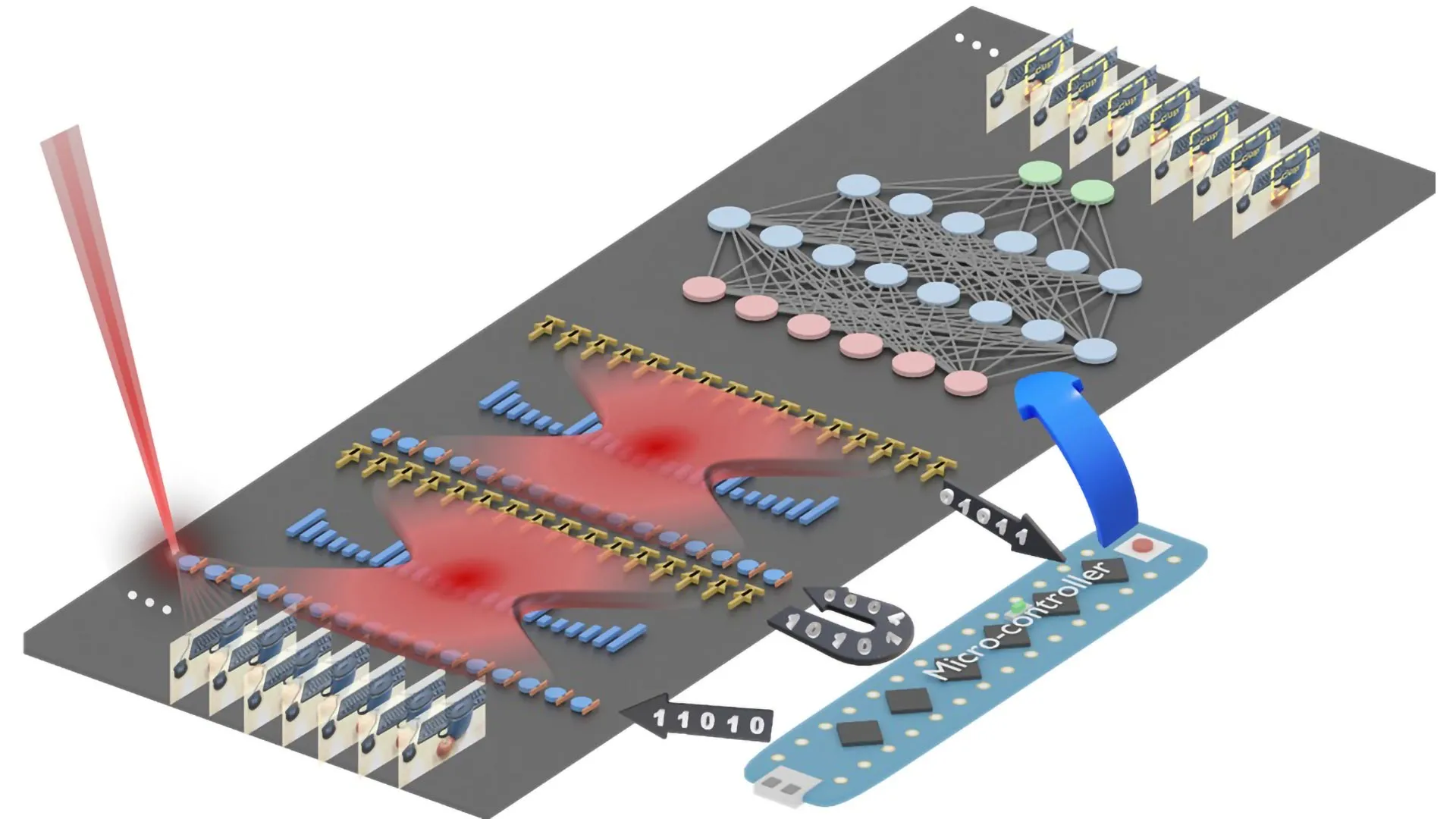
At the heart of this revolutionary development lies the University of Pennsylvania team’s ingenious creation: a compact "Q-chip." This sophisticated piece of technology is engineered to seamlessly coordinate both quantum and classical data streams, a feat previously considered immensely challenging. Crucially, the Q-chip "speaks the same language" as the modern web, adhering to established internet protocols. This compatibility is not merely an academic curiosity; it represents a vital pathway toward realizing the long-envisioned "quantum internet," a network that scientists predict could be as profoundly transformative to society as the advent of the initial online era.
The foundation of quantum communication lies in the phenomenon of "quantum entanglement." This perplexing principle describes a deep and instantaneous connection between pairs of quantum particles, where the state of one particle is intrinsically linked to the state of the other, regardless of the distance separating them. By harnessing this extraordinary property, quantum networks hold the potential to link vast arrays of quantum computers, enabling them to pool their immense processing power. The implications are staggering: faster, more energy-efficient artificial intelligence; the design of novel drugs and materials that are currently beyond the capabilities of even the most powerful supercomputers; and unprecedented levels of secure communication.
The Penn team’s achievement is significant because it demonstrates, for the first time on a live commercial fiber network, that a single chip can not only transmit quantum signals but also autonomously correct for errors and noise. Furthermore, it can intelligently bundle quantum and classical data into standard internet-style packets. This bundling is then routed using the identical addressing systems and management tools that currently connect billions of everyday devices to the internet. Liang Feng, a Professor in Materials Science and Engineering (MSE) and in Electrical and Systems Engineering (ESE) at the University of Pennsylvania, and the senior author of the Science paper, expressed his enthusiasm: "By showing an integrated chip can manage quantum signals on a live commercial network like Verizon’s, and do so using the same protocols that run the classical internet, we’ve taken a key step toward larger-scale experiments and a practical quantum internet."
Navigating the Labyrinth of Quantum Scaling Challenges
The inherent fragility of quantum states presents one of the most formidable obstacles in scaling quantum networks. Erwin Schrödinger, a pioneer in quantum mechanics who famously coined the term "quantum entanglement," illustrated its perplexing nature with his thought experiment involving a cat in a box. The paradox suggests that until the box is opened, the cat can be considered simultaneously alive and dead – a state of superposition. This analogy, while simplified, captures the essence of quantum particles: their peculiar properties are inherently tied to their unmeasured state. The moment a quantum particle is measured, it collapses into a definite state, losing the very quantum characteristics that make it valuable for computation and communication. This characteristic makes scaling quantum networks exceptionally difficult.
Robert Broberg, a doctoral student in ESE and a coauthor of the Science paper, elaborated on this challenge: "Normal networks measure data to guide it towards the ultimate destination. With purely quantum networks, you can’t do that, because measuring the particles destroys the quantum state." This fundamental limitation necessitates a paradigm shift in how quantum information is handled and routed.
The Art of Orchestrating Quantum and Classical Data Streams
To circumvent the measurement paradox, the Penn research team devised the "Q-Chip" (an acronym for "Quantum-Classical Hybrid Internet by Photonics"). This innovative chip serves as a sophisticated conductor, orchestrating the flow of both classical signals, which are composed of conventional light pulses, and the delicate quantum particles. "The classical signal travels just ahead of the quantum signal," explained Yichi Zhang, a doctoral student in MSE and the paper’s first author. "That allows us to measure the classical signal for routing, while leaving the quantum signal intact."
The operational analogy provided by Zhang is akin to a railway system. The classical signal acts as the engine of the train, guiding its journey, while the quantum information is carried securely within sealed cargo containers. "The classical ‘header’ acts like the train’s engine, while the quantum information rides behind in sealed containers," Zhang further elaborated. "You can’t open the containers without destroying what’s inside, but the engine ensures the whole train gets where it needs to go."
Because the classical header is amenable to measurement, the entire system can operate within the established framework of "IP" or "Internet Protocol," the very system that governs the routing of today’s internet traffic. Zhang emphasized the significance of this compatibility: "By embedding quantum information in the familiar IP framework, we showed that a quantum internet could literally speak the same language as the classical one. That compatibility is key to scaling using existing infrastructure."
Bridging the Gap: Adapting Quantum Technology for the Real World
The practical implementation of quantum particle transmission over commercial infrastructure faces a significant hurdle: the inherent variability and unpredictability of real-world transmission lines. Unlike the controlled environments of a laboratory, commercial networks are constantly subjected to a multitude of environmental factors. Fluctuations in temperature, driven by weather patterns; vibrations caused by human activities such as construction and transportation; and even subtle seismic activity can all introduce noise and instability that can easily disrupt and destroy delicate quantum signals.
To address this critical issue, the researchers developed a sophisticated error-correction mechanism. This method ingeniously leverages the relationship between the classical header and the quantum signal. The principle is straightforward: interference that affects the classical header will, in a predictable manner, also impact the quantum signal. "Because we can measure the classical signal without damaging the quantum one," Professor Feng stated, "we can infer what corrections need to be made to the quantum signal without ever measuring it, preserving the quantum state."
In rigorous testing, this innovative system demonstrated remarkable resilience, maintaining transmission fidelities exceeding 97%. This impressive performance indicates its capability to effectively counteract the noise and instability that typically plague quantum signals outside of carefully controlled laboratory settings. Moreover, the Q-chip is fabricated using silicon and established manufacturing techniques, making it amenable to mass production. This scalability is crucial for the widespread adoption of the new approach.
"Our network has just one server and one node, connecting two buildings, with about a kilometer of fiber-optic cable installed by Verizon between them," Feng noted. "But all you need to do to expand the network is fabricate more chips and connect them to Philadelphia’s existing fiber-optic cables." This statement underscores the practicality and scalability of their breakthrough.
Gazing into the Horizon: The Future of the Quantum Internet
Despite this monumental progress, a primary barrier to extending quantum networks beyond metropolitan areas remains the inability to amplify quantum signals without destroying their entangled state. Unlike classical signals, which can be readily boosted using repeaters, quantum signals lose their coherence and entanglement when amplified.
While some research groups have successfully demonstrated the long-distance transmission of "quantum keys" – specialized codes crucial for ultra-secure communication – over conventional fiber, these systems typically employ weak coherent light to generate random numbers. This technique is highly effective for security applications but is not sufficient to establish direct links between quantum processors.
Overcoming this amplification challenge will necessitate the development of novel devices. However, the University of Pennsylvania’s study represents a critical and foundational step. By proving that a single chip can manage quantum signals over existing commercial fiber, utilizing internet-style packet routing, dynamic switching, and on-chip error mitigation that align with current network protocols, they have laid the groundwork for future advancements.
Robert Broberg offered a compelling historical perspective: "This feels like the early days of the classical internet in the 1990s, when universities first connected their networks. That opened the door to transformations no one could have predicted. A quantum internet has the same potential." This sentiment encapsulates the profound implications of this research and the transformative future it promises.
This groundbreaking study was a collaborative effort undertaken at the University of Pennsylvania School of Engineering and Applied Science. It received crucial support from the Gordon and Betty Moore Foundation (grant numbers GBMF12960 and DOI 10.37807), the Office of Naval Research (grant number N00014-23-1-2882), the National Science Foundation (grant number DMR-2323468), the Olga and Alberico Pompa endowed professorship, and a PSC-CUNY award (grant number ENHC-54-93). Additional valuable contributions were made by co-authors Alan Zhu, Gushi Li, and Jonathan Smith from the University of Pennsylvania, and Li Ge from the City University of New York.