isnaini azizah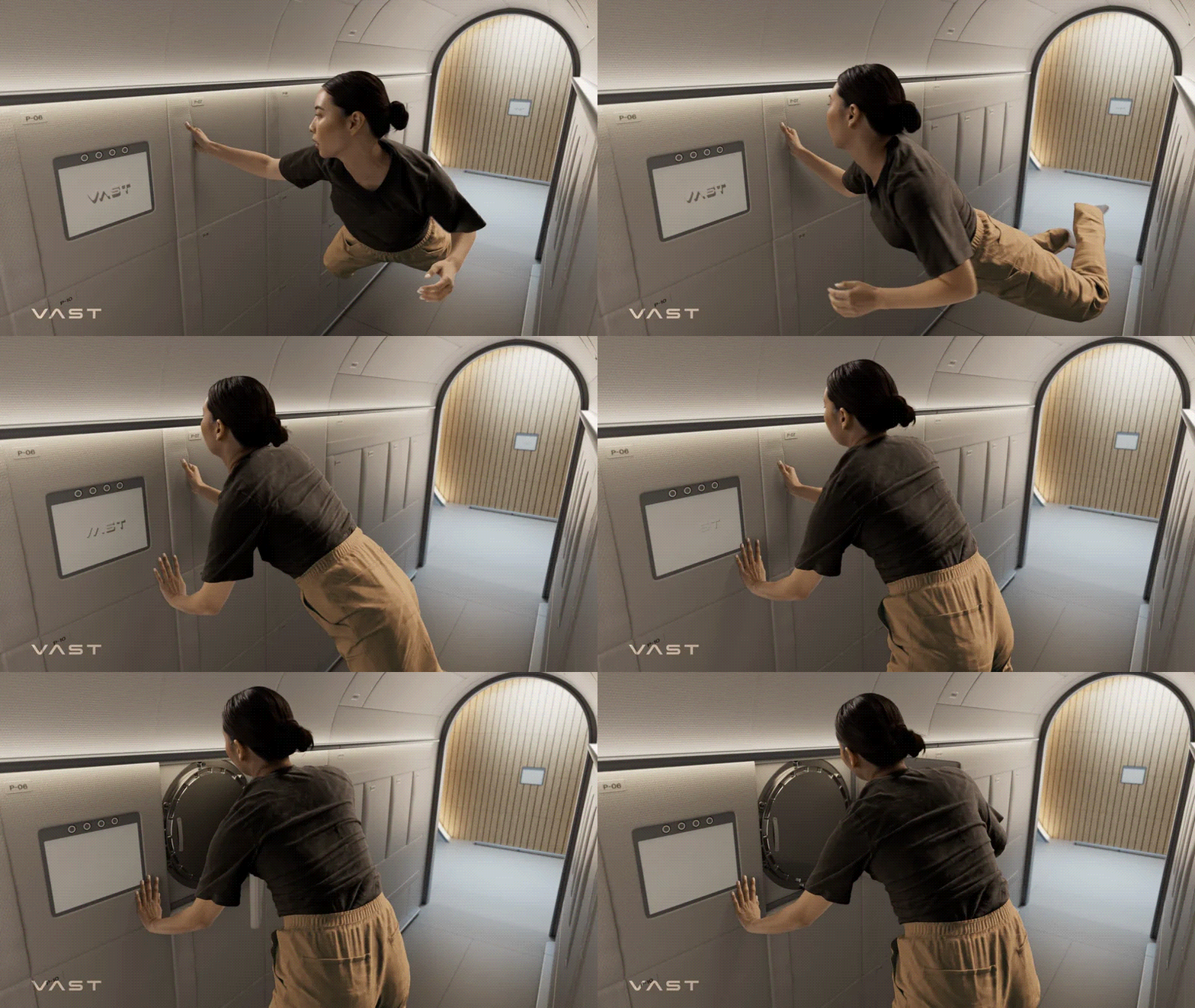
At the forefront of this revolution is Haven-1, a groundbreaking project by the California-based company Vast. This pioneering space station is slated for launch in May 2026, with its first paying visitors expected to embark on their historic journey approximately a month later. To ensure these civilian astronauts are fully prepared for their celestial adventure, Drew Feustel, a distinguished former NASA astronaut, has been enlisted to lead their training. Feustel brings an unparalleled depth of experience to this role, having accumulated 226 days in space across three missions to the International Space Station (ISS) and a pivotal trip to the Hubble Space Telescope.

Feustel now serves as Vast’s lead astronaut, a position that leverages his extensive knowledge. He was instrumental in advising the company on the interior design of Haven-1 and its future successor, Haven-2. His most significant contribution, however, is the meticulous development of a comprehensive, months-long training program designed to equip customers with the skills and knowledge necessary to live and work effectively in orbit. Up to four crew members will travel to Haven-1 aboard a state-of-the-art SpaceX Dragon spacecraft, which will remain docked throughout their 10-day sojourn. While Vast has yet to disclose the identities of its inaugural passengers or the exact cost of a ticket, industry benchmarks set by competing firms suggest prices in the tens of millions of dollars for comparable space tourism experiences.
Haven-1 is conceived as a precursor, a temporary facility paving the way for a larger, permanent orbital habitat named Haven-2. Vast plans to commence the deployment of Haven-2’s modules in 2028, with the ambitious goal of supporting a crew by 2030. This timeline coincides with NASA’s planned decommissioning of the ISS, an iconic orbital outpost that has served humanity for nearly three decades. Rather than seeking to replace the ISS, NASA and its international partners are shifting their focus towards conducting vital research aboard these burgeoning commercial space stations, including those being developed by Vast, Axiom, and Sierra Space.

The opportunity to engage with Feustel arose during his participation in the prestigious Web Summit tech conference in Lisbon. There, he shared insights into his pivotal role at Vast and articulated the company’s ambitious vision for the future of space exploration and habitation. His responses, thoughtfully edited and condensed for clarity, offer a compelling glimpse into this new era of commercial spaceflight.
When asked about the transformative potential of this new wave of commercial space stations, Feustel articulated a clear objective: creating unprecedented access. "Ideally, we’re creating access," he stated. He highlighted the limitations of the existing paradigm, which has been dominated by US-backed missions to the ISS and a restricted circle of approximately 16 to 17 primary partner nations. Vast’s ambition, he explained, is to evolve into a crucial service provider, not only for the US government but also for sovereign nations across the globe. This will empower those nations to establish their own human spaceflight programs and grant them greater access to a low-Earth-orbit platform.

Feustel’s journey with Vast began with his advisory role on the design of both Haven-1 and Haven-2, before transitioning to lead astronaut. He elaborated on specific design elements where his input has had a tangible impact. "Some of the things where I can see tangible evidence of my work is, for example, in the sleep cores and sleep system—trying to define a more comfortable way for astronauts to sleep," he revealed. The innovative solution involves an air bladder system designed to provide distributed pressure on the body, an attempt to replicate the comforting sensation of gravity felt when lying down in bed. He likened this to a "weighted blanket," but with the crucial distinction that the occupant is pressed against a wall by an inflatable bladder. Beyond comfort, Feustel’s influence extends to critical operational aspects, including the design of crew displays, interfaces, notification systems, and even the optimal size of viewing windows.
The question of window size prompted an enthusiastic response. "The bigger the better," Feustel declared. He then delved into the practical considerations, emphasizing that windows are not merely for aesthetics but serve functional purposes, particularly for photography. The quality of the window and its orientation are paramount to ensure unobstructed views of Earth, rather than perpetually facing the vastness of space.

Central to the success of commercial space tourism is the astronaut training program, which Feustel spearheads. He acknowledged the unique challenge of training private citizens with potentially no prior spaceflight experience for a typical two-week stay on their space station. The program, he detailed, is meticulously spread over an 11-month period, interspersed with gaps between training weeks. When compressed, this translates to approximately three to four months of intensive, day-to-day training.
A significant portion of this training, roughly half, is dedicated to mastering the operation of the SpaceX Dragon spacecraft, the designated mode of transportation. Feustel stressed that launch and landing represent the most critical phases of any space mission, and ensuring passengers understand the Dragon’s systems is paramount for their safety. While SpaceX provides its own comprehensive training, Vast’s program strategically "piggybacks" on these sessions. When crews are in California for SpaceX training, Vast seizes the opportunity to conduct crucial training at their own facility, focusing on the unique operational aspects of their spacecraft. A major emphasis is placed on emergency response protocols, ensuring crew members can safely manage any unforeseen circumstances and initiate an emergency return to Earth via the Dragon if necessary.

Beyond emergency preparedness, the training covers the fundamental aspects of daily life in orbit. "What we do is kind of piggyback on those weeks," Feustel explained. "If a crew shows up in California to train at SpaceX, we’ll grab them that same week and say, ‘Come down to our facility. We will train you to operate inside our spacecraft.’" This includes mastering essential tasks like eating, sleeping, and using the onboard facilities. Furthermore, the program addresses practicalities such as downloading captured imagery, accessing scientific payloads, and managing the data and telemetry generated by ongoing research. The goal is to instill these procedures into muscle memory through repeated practice, enabling astronauts to focus on their mission objectives rather than grappling with basic survival tasks.
The training facility includes a full-scale mock-up of the Haven-1 interior, allowing trainees to familiarize themselves with the environment. However, Feustel acknowledged the limitations of simulating microgravity on Earth. While zero-g airplanes offer brief periods of weightlessness, they are often nicknamed the "vomit comet" due to the discomfort they induce. Underwater training, while valuable for spacewalk simulations, is considered a more advanced technique. Consequently, much of the microgravity preparation relies on immersive video content, extensive discussions, and mental preparation to convey the unique sensations of living in space.

Regarding how individuals will spend their time aboard the station, Feustel anticipates a busy schedule. "If history is any indication, they will be quite busy and probably oversubscribed," he predicted. The primary activities will revolve around self-care, executing scientific experiments, and, of course, the profound experience of gazing out at Earth. Public relations and outreach activities, such as engaging with schools, hospitals, and corporations, will also form a significant part of their itinerary.
The advent of commercial space stations heralds an era where a broader spectrum of humanity, albeit initially those with considerable financial means, will have the opportunity to witness Earth from orbit. Feustel drew a parallel to the reactions of individuals who have experienced suborbital flights with companies like Blue Origin and Virgin Galactic. These brief glimpses of Earth from a lower altitude evoke a sense of "awe and wonder," mirroring the profound emotional responses of career astronauts. He expressed a hopeful sentiment: "And say if more humans could see Earth from space, we’d probably be a little bit better about being humans on Earth." This access, he believes, fosters a deeper understanding of our planet as a self-contained spacecraft, a fragile ecosystem dependent on its life-support systems.

Addressing the ambitious vision of humanity becoming a multiplanetary species, Feustel unequivocally shares this aspiration. "Yeah, I do," he affirmed. His conviction stems from the belief that humans possess the inherent capability to thrive beyond Earth, and the current advancements are actively creating the pathways to achieve this. "So why wouldn’t we explore space and go further and farther and learn to live in other areas?" he posed. He clarified that this does not imply abandoning Earth but rather diversifying humanity’s presence and potentially alleviating the strain on our home planet. Moreover, he underscored the imperative of establishing backup plans for humanity, acknowledging the inherent risks posed by cosmic events. "There’s not really a backup plan for no Earth," he stated, referencing historical events like the extinction of dinosaurs as a stark reminder of the potential threats from space. Extending our capabilities and creating such contingencies, he concluded, is a crucial endeavor.