anjir abdul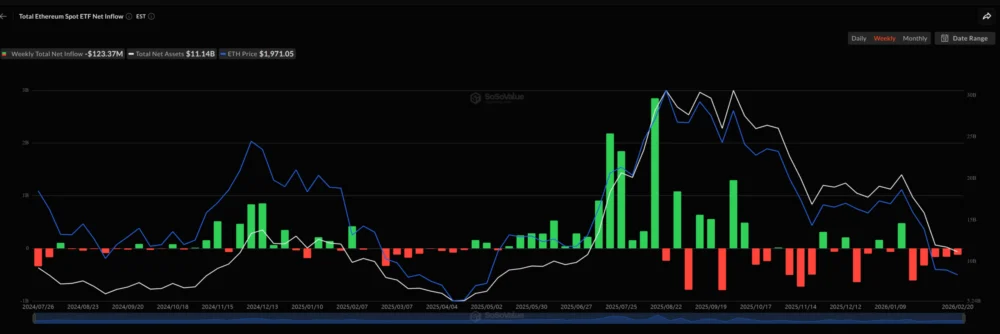
US spot Bitcoin exchange-traded funds (ETFs) have navigated a challenging period, recording five consecutive weeks of net outflows, with a substantial $3.8 billion withdrawn from these products over that timeframe. This sustained withdrawal marks a significant shift from the initial euphoria and record-breaking inflows observed immediately following their landmark approval and launch in January, signaling a period of cautious investor sentiment and strategic repositioning within the digital asset landscape. The recent data, predominantly from SoSoValue, paints a detailed picture of this evolving dynamic, highlighting both the scale of recent redemptions and the underlying factors driving institutional and retail investor behavior.
Delving into the specifics of these outflows, the most recent week saw approximately $315.9 million in net outflows. While this figure is considerable, it represents a moderation compared to the peak of the withdrawal streak. The largest weekly exodus during this five-week period was particularly stark, occurring in the week ending January 30, when spot Bitcoin (BTC) ETFs witnessed a staggering $1.49 billion in net outflows. This period coincided with early profit-taking following Bitcoin’s initial price surge post-ETF launch and a broader market re-evaluation, as investors digested the immediate impact of these new investment vehicles. Such a concentrated withdrawal suggests a significant, possibly institutionally-driven, rebalancing of portfolios.
Despite the prevailing trend of net outflows, the market experienced intermittent periods of positive activity. For instance, on a recent Friday, Bitcoin ETFs managed to record about $88 million in inflows. However, these sporadic positive sessions were consistently overshadowed by larger redemption days earlier in the week, reinforcing the overall negative trajectory. Notable withdrawals included more than $410 million on February 12, followed by additional negative sessions from February 17 through February 19, cumulatively leaving the weekly total firmly in the red. This seesaw pattern underscores the ongoing tug-of-war between new capital entering the market and existing investors cashing out, or reallocating their positions. A significant contributor to these outflows has often been identified as the Grayscale Bitcoin Trust (GBTC), which converted into a spot ETF and has seen consistent redemptions as investors rotate into lower-fee alternatives or simply exit their positions.

Despite the recent string of negative flows, the overall picture for spot Bitcoin ETFs since their inception remains robust. As of the recent Friday, these funds have accumulated roughly $54.01 billion in net inflows, a testament to the initial overwhelming demand and the long-term conviction of a significant portion of the investor base. Total net assets under management for these products stood near $85.31 billion, representing approximately 6.3% of Bitcoin’s overall market capitalization. This substantial cumulative figure underscores the transformative impact these ETFs have had on legitimizing Bitcoin as a mainstream asset class and providing regulated, accessible avenues for investment that were previously unavailable. The presence of major financial institutions like BlackRock, Fidelity, and Ark Invest in the spot ETF arena continues to lend credibility and attract diverse investor pools.
The underlying reasons for this prolonged period of outflows appear to be multifaceted, but expert analysis points predominantly towards institutional positioning rather than a fundamental loss of long-term interest in the asset. Vincent Liu, chief investment officer at Kronos Research, articulated that the outflows reflect a broader strategy of portfolio de-risking. This defensive stance is largely a response to escalating geopolitical tensions across various regions, including ongoing conflicts in Eastern Europe and the Middle East, coupled with broader macro uncertainty influencing global financial markets. Such uncertainties often compel institutional investors to trim exposure to more volatile assets like cryptocurrencies and reallocate capital into safer, less correlated holdings.
Liu further elaborated that market flows are likely to remain unstable in the near term, heavily influenced by prevailing macro headlines. The current economic environment, characterized by persistent inflation concerns, evolving interest rate outlooks from central banks like the Federal Reserve, and ongoing trade disputes and tariff developments, has reinforced a risk-off sentiment across traditional financial markets. Digital assets, despite their unique characteristics, are not immune to these broader economic forces and remain sensitive to shifts in global risk appetite. He highlighted that "market inflows will be dependent on macro events like incoming Thursday’s initial jobless claims, as weaker data could revive expectations for future rate cuts and help support sentiment currently at 14 extreme fear on the crypto fear and greed index." Weaker jobless claims data could signal a cooling labor market, potentially increasing the likelihood of interest rate cuts by the Fed, which historically tends to be bullish for risk assets like Bitcoin. The "14 extreme fear" reading on the Crypto Fear and Greed Index further corroborates the prevailing cautious, if not pessimistic, sentiment among crypto investors, suggesting that many are operating from a position of anxiety rather than confidence.
The impact of these outflows on Bitcoin’s price has been noticeable, though not catastrophic. While the outflows certainly contributed to downward pressure, Bitcoin has demonstrated a degree of resilience, often finding support above key psychological levels. The correlation between ETF flows and BTC price movements remains a critical metric for analysts, as these funds represent a significant new demand vector for the cryptocurrency. Furthermore, the anticipation of Bitcoin’s halving event, which reduces the supply of new Bitcoin entering the market, continues to act as a long-term bullish catalyst that could counteract short-term selling pressure from ETFs once the macro environment stabilizes. However, as one related report indicated, Bitcoin ETFs shed $166 million as BTC headed for its "worst yearly start" in some time, underscoring the immediate pain felt by the market.

The selling pressure has not been confined solely to Bitcoin ETFs. Spot Ether (ETH) ETFs, though not yet approved in the US, have also faced sustained selling pressure in other markets, with flows turning negative across the past five weeks as investors trimmed exposure to the second-largest cryptocurrency. This parallel trend suggests a broader re-evaluation of risk across the cryptocurrency market. During the most recent week, Ether ETFs recorded approximately $123.4 million in net outflows, according to SoSoValue data. Similar to Bitcoin ETFs, these weekly losses occurred despite occasional positive sessions. Ether ETFs posted inflows on several days, including about $48.6 million on February 17 and $10.3 million on February 13. However, these positive movements were ultimately outweighed by heavier selling earlier in the week, leading to a net negative outcome. The outflows from Ether ETFs might also reflect uncertainty surrounding the regulatory approval of spot Ether ETFs in the United States, a decision that is still pending and could significantly impact ETH’s price trajectory. Recent upgrades to the Ethereum network, such as the Dencun upgrade, aim to improve efficiency and scalability, potentially bolstering long-term investor confidence, but short-term market dynamics are currently dominated by macro concerns.
Looking ahead, the trajectory of spot Bitcoin and Ether ETFs will heavily depend on a confluence of factors. A potential pivot by the Federal Reserve towards interest rate cuts could inject renewed liquidity and risk appetite into financial markets, likely benefiting cryptocurrencies. Easing geopolitical tensions, while unpredictable, would also contribute to a more stable investment climate. Renewed institutional interest, perhaps fueled by clearer regulatory guidance or a significant rally in Bitcoin’s price post-halving, could reverse the outflow trend. However, the market remains susceptible to continued macro uncertainty and further regulatory scrutiny, which could prolong the current period of instability.
In conclusion, the five consecutive weeks of outflows totaling $3.8 billion from US spot Bitcoin ETFs represent a notable cooling-off period after an explosive launch. While these figures highlight a cautious stance from investors, largely driven by institutional de-risking amid geopolitical tensions and macro uncertainty, the cumulative net inflows since launch remain overwhelmingly positive. The parallel outflows from spot Ether ETFs underscore a broader market recalibration. As the nascent spot ETF market continues to mature, its sensitivity to global economic indicators and geopolitical events will likely persist. Nevertheless, the long-term narrative for digital assets, bolstered by increasing institutional adoption and a growing understanding of their unique value propositions, remains intact, with many experts anticipating a rebound once the broader economic landscape stabilizes and a clearer path for monetary policy emerges.