anjir abdul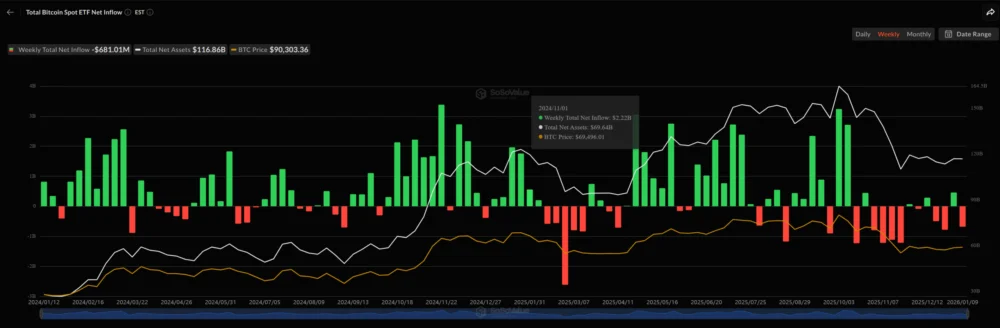
According to comprehensive data compiled by SoSoValue, the week saw Spot Bitcoin (BTC) ETFs register four consecutive days of net redemptions, spanning from Tuesday through Friday. This prolonged period of outflows decisively overshadowed the initial optimism and inflows observed earlier in the week. The most severe daily redemption event occurred on Wednesday, January 7th, when these investment vehicles collectively shed a staggering $486 million. This was followed by considerable outflows of $398.9 million on Thursday and an additional $249.9 million on Friday, painting a clear picture of receding confidence and widespread profit-taking or repositioning among institutional and sophisticated retail investors. The consistent negative flow underscored a broader reevaluation of risk in a market segment that had, until recently, enjoyed sustained enthusiasm since its landmark approvals in 2024.
This sharp reversal came after what appeared to be a promising start to 2026, echoing the "in like a lion" adage for the new year. On January 2nd, Spot Bitcoin ETFs attracted a robust $471.1 million in fresh capital, suggesting a continuation of the bullish momentum that characterized parts of 2025. This initial strength was further amplified on January 5th, with another substantial inflow of $697.2 million. Market analysts had interpreted these early movements as a validation of Bitcoin’s growing institutional acceptance and an expectation that the crypto bull run would extend into the new year, potentially driven by further corporate adoption and increasing mainstream integration. The swift pivot from substantial inflows to persistent outflows within a single week highlighted the inherent volatility and sensitivity of the crypto market to external macroeconomic forces and shifting investor sentiment.
The ripple effect of this dampened risk appetite was not confined solely to Bitcoin. Spot Ether (ETH) ETFs, which have steadily gained traction since their own regulatory approvals, followed a remarkably similar trajectory, indicating a correlated response across major digital assets. On a weekly basis, Spot Ether ETFs recorded net outflows of approximately $68.6 million, bringing their total net assets to around $18.7 billion by the week’s end. While the absolute figures were smaller than those for Bitcoin ETFs, the mirrored trend suggested a systemic shift rather than an isolated event impacting a single cryptocurrency. The synchronized downturn in both Bitcoin and Ether ETF flows underscored the broader market’s susceptibility to overarching macroeconomic narratives and the interconnectedness of the digital asset ecosystem. Investors, it appeared, were de-risking across the board, pulling capital from both established and emerging crypto-backed investment products.
Vincent Liu, the astute chief investment officer at the prominent trading firm Kronos Research, offered critical insights into the underlying causes of this market pullback, unequivocally pointing to escalating macro uncertainty as the primary catalyst. In an exclusive statement to Cointelegraph, Liu elaborated that evolving expectations regarding global monetary policy and a general uptick in geopolitical risks were significantly weighing on investor positioning. The prevailing narrative, he explained, had shifted from one of potential monetary easing to one of prolonged hawkishness, fundamentally altering the calculus for risk assets.
"With Q1 rate cuts looking increasingly less likely and geopolitical risks rising across several key regions, macro conditions have decisively turned risk-off," Liu stated, encapsulating the market’s prevailing mood. He further elaborated, "As traders and institutional funds await clearer positive signals regarding economic stability and policy direction, this reduced risk appetite is inevitably spilling into the crypto market, which is often viewed as a higher-beta asset class." The implication was clear: in an environment of uncertainty, capital flows away from speculative investments towards perceived safer havens, a dynamic that profoundly impacts volatile assets like cryptocurrencies.
Liu added that market participants were now intently scrutinizing upcoming US Consumer Price Index (CPI) data, a crucial inflation gauge, and any subsequent guidance from the Federal Reserve. These indicators would provide vital clues on the potential timing and pace of future monetary easing. "Until clearer signals emerge from these critical economic data points and central bank communications, positioning is likely to remain cautious, characterized by lower leverage and a preference for liquidity," he concluded, reinforcing the expectation of continued circumspection from investors in the near term. This cautious stance reflects a broader macroeconomic environment where inflation, interest rates, and global stability are paramount concerns for capital allocators.

Despite these challenging market conditions and the immediate headwinds faced by existing Spot Bitcoin and Ether ETFs, the long-term institutional march into the digital asset space showed no signs of abating. In a significant development that underscored the enduring appeal and future potential of cryptocurrencies, Morgan Stanley, one of the largest and most influential financial services firms in the United States, officially filed with the US Securities and Exchange Commission (SEC) to launch two new spot crypto ETFs. These proposed offerings included one tracking Bitcoin and another focused on Solana (SOL), a rapidly growing alternative blockchain platform.
Morgan Stanley’s move is particularly noteworthy given its stature as a financial behemoth and its traditional cautious approach to emerging asset classes. Their decision to pursue spot ETFs for both Bitcoin and Solana signals a profound belief in the long-term viability and institutional demand for digital assets, even amidst short-term market volatility. The inclusion of Solana, a leading smart contract platform renowned for its high throughput and low transaction costs, alongside Bitcoin, further highlights the increasing diversification of institutional interest beyond just the flagship cryptocurrency. This development suggests that major players are not merely dipping their toes into the crypto waters but are strategically positioning themselves to offer a broader suite of digital asset investment products to their vast client base.
This filing by Morgan Stanley came just a day after another major financial institution, Bank of America, the second-largest US bank by assets, made its own groundbreaking announcement. Bank of America began allowing financial advisors within its extensive wealth management businesses to recommend exposure to four existing Spot Bitcoin ETFs to their eligible clients. This decision by Bank of America represents a crucial step in mainstreaming Bitcoin investments, effectively opening the floodgates for a significant portion of traditional wealth to access crypto exposure through regulated and familiar investment vehicles. The combined actions of Morgan Stanley and Bank of America within such a short timeframe, despite the immediate market downturn, illustrate a powerful underlying current of institutional adoption that transcends daily price fluctuations and temporary shifts in risk appetite. These moves solidify the trajectory of digital assets becoming an increasingly integral part of diversified investment portfolios offered by leading financial institutions.
The initial launch of Spot Bitcoin ETFs in early 2024 had been hailed as a watershed moment, democratizing access to Bitcoin for millions of investors and ushering in an era of institutional participation. The first week of 2026, while marked by outflows, should be viewed in this broader context. The market structure for Bitcoin has fundamentally changed, moving from being predominantly retail-driven and speculative to one where sophisticated institutional capital plays an increasingly dominant role. These institutions, unlike many retail investors, often operate with longer investment horizons and are more attuned to macroeconomic cycles, leading to periods of de-risking when global conditions turn adverse.
The impact of these outflows on Bitcoin’s price was immediately felt, with BTC experiencing a notable correction throughout the week, erasing some of the gains accumulated in late 2025 and early 2026. This price volatility is a natural consequence of significant capital movements in and out of the ecosystem. However, the concurrent institutional advancements, such as Morgan Stanley’s filings and Bank of America’s advisory recommendations, suggest that these short-term market reactions are distinct from the long-term strategic positioning of major financial players. Investor behavior during such periods is bifurcated: some institutional investors might rebalance their portfolios to reduce risk, while others, particularly those with a long-term bullish outlook, might view price dips as accumulation opportunities.
Looking ahead, the digital asset market remains at a crucial juncture. While the immediate headwinds of macro uncertainty and receding risk appetite are undeniable, the structural growth in institutional interest, exemplified by the actions of Morgan Stanley and Bank of America, provides a robust counter-narrative. The market will continue to closely monitor economic data, central bank policies, and geopolitical developments for clearer signals of stability. Until then, caution is likely to prevail, but the underlying trend of traditional finance embracing digital assets appears to be an irreversible force, setting the stage for future growth even through periods of temporary retraction. The initial week of 2026 served as a stark reminder of the crypto market’s sensitivity to global economic forces, yet it simultaneously underscored the unwavering commitment of major financial institutions to integrate digital assets into the mainstream financial landscape.