anjir abdul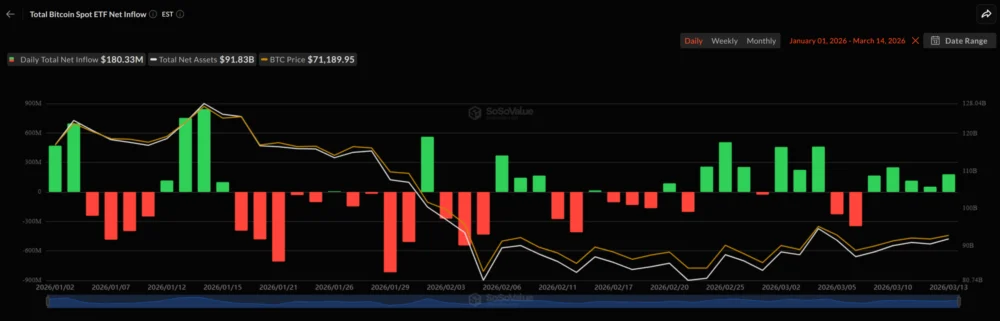
US spot Bitcoin exchange-traded funds (ETFs) have marked a significant milestone, logging their first five-day inflow streak of 2026 and attracting a robust $767.32 million in capital this week. This sustained period of positive sentiment follows a tumultuous start to the year, signaling a potential shift in investor confidence and a renewed appetite for digital asset exposure through regulated financial products. The consistent influx of funds underscores a growing maturity in the cryptocurrency market, as institutional and retail investors increasingly leverage ETFs for diversified portfolio strategies.
The week culminated with a strong performance on Friday, as the funds recorded an impressive $180.33 million in net inflows, extending the positive run that commenced earlier in the week. The momentum built steadily, with Tuesday emerging as the strongest day of the streak, drawing a substantial $250.92 million into spot Bitcoin (BTC) ETFs, according to detailed data compiled by SoSoValue. This recent surge far surpasses previous benchmarks, highlighting a burgeoning institutional interest and a broader acceptance of Bitcoin as a legitimate asset class. The last comparable streak observed by these funds was in late November 2025, when spot Bitcoin ETFs experienced five consecutive days of net inflows from November 25 to December 2, bringing in a combined total of $284.61 million. The current streak’s total is more than double that previous high, indicating a significant acceleration in capital allocation towards Bitcoin ETFs.
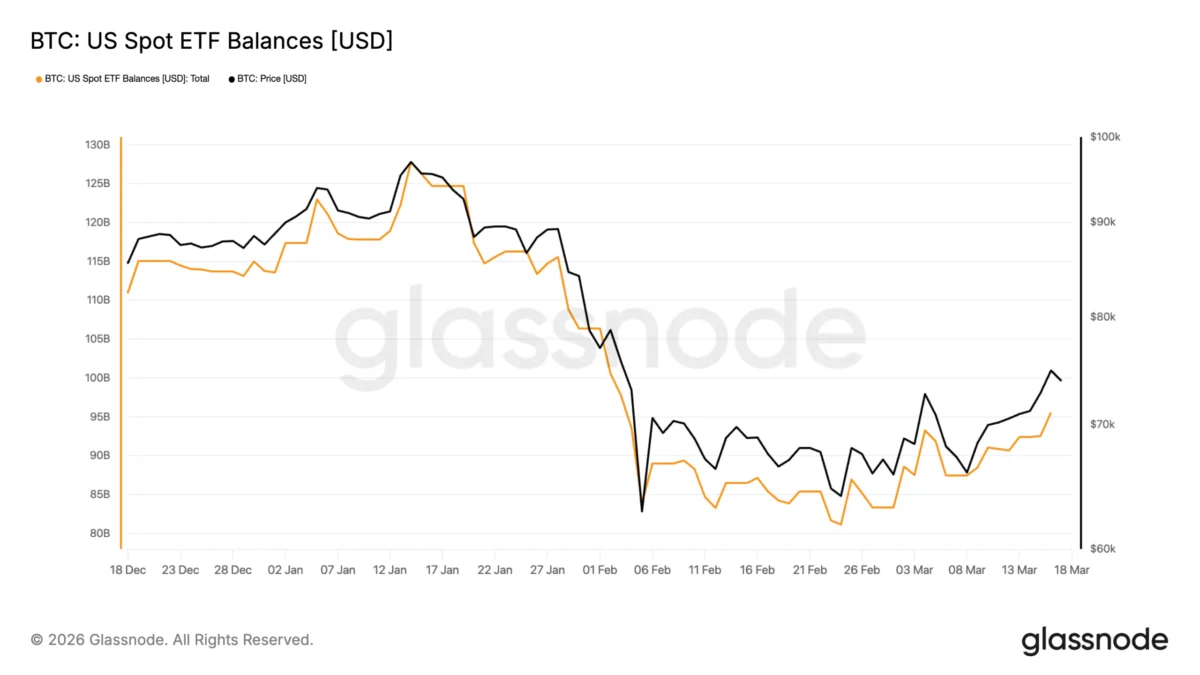
The implications of this consistent inflow are profound. For the first time in 2026, the market has witnessed a prolonged period where buying pressure through these regulated vehicles has outweighed selling, suggesting a strong underlying demand. This trend is critical not only for Bitcoin’s price stability but also for its continued integration into mainstream finance. The cumulative net inflows into these ETFs have now reached an astounding $56.14 billion, pushing the total net assets held by these products to an impressive $91.83 billion. Furthermore, the total value traded on the day reached approximately $4.93 billion, demonstrating robust liquidity and active participation within the spot Bitcoin ETF ecosystem. These figures reflect not just a fleeting interest but a foundational shift, positioning Bitcoin as a credible component within diverse investment portfolios, from hedge funds and asset managers to individual wealth managers. The ease of access, regulatory oversight, and liquidity offered by spot Bitcoin ETFs have proven to be powerful drivers for this institutional adoption, circumventing many of the complexities associated with direct cryptocurrency ownership.
Meanwhile, the enthusiasm for digital asset ETFs extended beyond Bitcoin, with US spot Ether (ETH) ETFs also experiencing a significant upturn. These funds recorded $26.69 million in net inflows on Friday, marking a commendable four-day run of positive flows. This streak commenced on Tuesday with $12.59 million, followed by an accelerated $57.01 million on Wednesday, and a particularly strong $115.85 million on Thursday, which represented the largest single-day inflow during this period. The total for this four-day stretch brought approximately $212.14 million into spot Ether ETFs, effectively reversing the outflows that characterized the earlier part of March. This performance is a strong indicator of growing institutional confidence in Ethereum, the second-largest cryptocurrency by market capitalization, and its underlying blockchain’s robust ecosystem and utility.

The success of Ether ETFs mirrors the broader acceptance witnessed by Bitcoin ETFs, albeit on a slightly smaller scale. As of today, cumulative net inflows into US spot Ether ETFs stand at $11.79 billion, with total net assets across the funds reaching $12.26 billion. The daily trading value for these Ether ETFs was approximately $1.30 billion, showcasing healthy market activity. The approval and subsequent performance of spot Ether ETFs represent a crucial step in diversifying institutional exposure to the crypto market beyond just Bitcoin. It signifies a recognition of Ethereum’s unique value proposition, including its role in decentralized finance (DeFi), NFTs, and smart contract innovation. This dual success for both Bitcoin and Ether ETFs marks the first sustained inflow run for both products this year, following a volatile start to 2026 that saw several days of heavy outflows across the products. This synchronized recovery suggests a broader positive sentiment returning to the digital asset space, potentially driven by a confluence of factors including improving market conditions and increasing clarity in the regulatory landscape.
However, the broader macroeconomic landscape continues to present a complex backdrop for these digital asset triumphs. Rising tensions in the Middle East, particularly concerning potential disruptions around the Strait of Hormuz, and subsequent volatility in global energy markets, are weighing heavily on overall global risk sentiment. According to analysts at Bitunix, escalating conflicts and elevated oil prices have amplified macro uncertainty, consequently reducing expectations for aggressive Federal Reserve rate cuts. This scenario typically prompts investors to prioritize short-term liquidity and capital preservation over long-term risk exposure, which can often dampen enthusiasm for more volatile assets like cryptocurrencies.
Against this backdrop of geopolitical unease and monetary policy speculation, Bitcoin’s price has remained largely range-bound despite the strong ETF inflows. Bitunix analysis, utilizing derivatives liquidation heatmaps, points to a key short-liquidity cluster near $71,300, which is currently acting as a significant near-term resistance level. A larger concentration of selling pressure and potential liquidations is observed between $72,000 and $73,500, indicating a formidable barrier that Bitcoin needs to overcome to achieve a sustained upward breakout. On the downside, liquidity support is identified around $69,000, with deeper long liquidation levels near $68,800. These technical indicators suggest that Bitcoin may continue its consolidation pattern, oscillating within these defined boundaries, unless a powerful macro catalyst emerges to trigger a decisive breakout in either direction. The interplay between strong institutional demand via ETFs and broader macroeconomic headwinds creates a fascinating, yet challenging, environment for Bitcoin’s price action.
Looking ahead, the sustained inflow streaks for both Bitcoin and Ether ETFs in 2026 could herald a new phase of institutional adoption for the crypto market. The increasing comfort level of traditional finance with these products, coupled with the sheer volume of capital being deployed, suggests a long-term commitment rather than speculative short-term plays. The diversification into Ether ETFs, in particular, opens doors for further exploration of other altcoin-focused investment vehicles, signaling a broader acceptance of the entire digital asset ecosystem. While geopolitical tensions and monetary policy uncertainty will continue to influence market dynamics, the consistent growth in ETF assets under management and trading volumes reinforces the growing legitimacy and integration of cryptocurrencies into the global financial fabric. The challenge for Bitcoin and Ether will be to leverage this institutional momentum to overcome macroeconomic hurdles and achieve new price discovery, solidifying their roles as integral components of future investment landscapes.