Faris Adani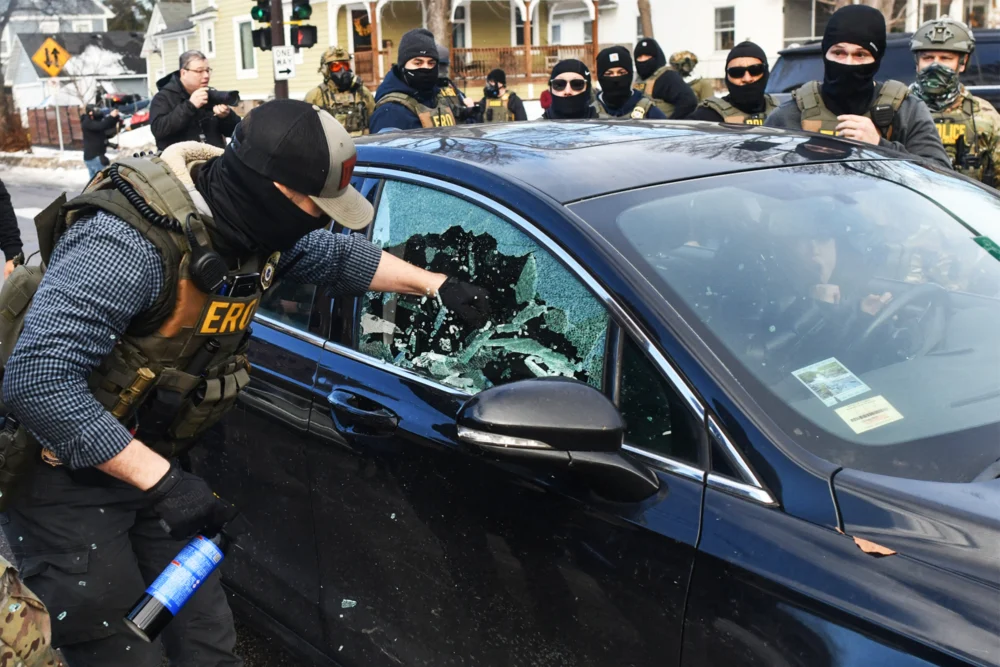
A chilling simulation conducted by researchers at the University of Pennsylvania’s Center for Ethics and the Rule of Law (CERL) has unveiled a deeply unsettling pathway to a potential Civil War 2.0 in the United States, eerily mirroring the escalating tensions and federal law enforcement operations currently unfolding in cities like Minneapolis. The findings from this "war gaming" exercise, which involved high-level government officials and former senior military leaders, paint a grim picture of how a breakdown in federal-state relations could precipitate violent conflict on American soil, a scenario none of the participants deemed unrealistic.
The experiment, meticulously orchestrated in October 2024, centered on a hypothetical but highly plausible scenario set in Philadelphia, the "City of Brotherly Love." In this simulation, a sitting president issued an executive order for a federal law enforcement operation within the city, an action that was widely condemned across political spectra. To enforce this contentious directive, the fictional president attempted to federalize the Pennsylvania National Guard. This move, however, met with staunch resistance from the state’s governor, who refused to cede control. Consequently, a significant portion of the National Guard troops sided with the state, setting the stage for a dramatic escalation. The simulated president, facing defiance, then took the unprecedented step of ordering acting U.S. military troops to march on Philadelphia, intending to enforce federal will through force.
Claire Finkelstein, the director of CERL, recently detailed the harrowing culmination of this experiment in a newly published piece in The Guardian. She described how the simulation ultimately devolved into a "violent confrontation" between state and federal forces in a major U.S. metropolis. What lends particular weight to these findings is the caliber of the participants. The war gaming exercise was not merely an academic exercise among theorists; it included actual government officials and former senior military leaders, individuals intimately familiar with the intricacies of command, constitutional law, and potential crises. Their unanimous agreement that the scenario was "not unrealistic" underscores the profound fragility of the current political and constitutional framework, particularly when faced with executive overreach and state defiance. A critical underlying assumption in the simulation, which informed its dire outcome, was that during such a rapidly evolving civil emergency, the courts would be largely ineffective at intervening or stopping federal actions, thereby removing a crucial institutional check on power.
The disquieting aspect of this simulation is its striking resonance with the contemporary situation in Minneapolis. While the full-scale armed conflict predicted by the simulation has not yet materialized, the early stages of the Philadelphia experiment bear an uncanny resemblance to the "brutal events" that citizens in Minneapolis have experienced at the hands of U.S. Immigration and Customs Enforcement (ICE) agents. The presence of federal agents operating with perceived impunity, often in ways that local authorities and communities condemn, mirrors the initial catalyst for the simulated conflict. ICE operations, particularly those involving broad sweeps or aggressive tactics, frequently ignite debates over federal jurisdiction, state sovereignty, and human rights, leading to widespread protests and calls for local non-cooperation.
However, a significant and crucial divergence exists between the simulated outcome and current reality in Minnesota. While Minneapolis municipal and state officials have expressed strong opposition to ICE activities and implemented measures to limit cooperation, they have not, to date, shown any interest in directly attacking or forcibly expelling federal agents. This distinction highlights the critical "gulf" between non-cooperation and armed resistance.
Minneapolis has indeed taken concrete steps to delineate its stance. Under a 2025 municipal ordinance, for instance, Minneapolis police are explicitly prohibited from cooperating with ICE agents in certain capacities. This ordinance reflects a growing trend among "sanctuary" jurisdictions to limit local law enforcement’s involvement in federal immigration enforcement, often citing concerns about community trust and resource allocation. Yet, this same ordinance, in a testament to the delicate balance of federalism, also explicitly states that local police are not authorized to interfere in federal enforcement activities. This legal nuance is pivotal; it allows for a principled non-cooperation without descending into open conflict.
Similarly, Minnesota Governor Tim Walz has navigated this treacherous terrain with caution. While he has urged protestors not to engage in acts of civil disobedience that could escalate tensions, he also moved to mobilize the Minnesota National Guard. This action, initially viewed by some as a potential precursor to forcibly expelling ICE from Minneapolis, was quickly clarified. As a National Guard official explicitly stated to a local news channel, the deployment, if it occurs, would be for purposes entirely distinct from confronting federal agents. The stated objectives were to direct traffic, help keep protests peaceful, and protect private property – functions typical of Guard deployments during civil unrest, not inter-agency warfare. This careful positioning by state leadership demonstrates an acute awareness of the constitutional boundaries and the catastrophic implications of an armed confrontation.
The broader implications of the CERL simulation extend beyond the immediate context of Minneapolis and ICE. It underscores the inherent tensions within the U.S. federal system, where the balance of power between the federal government and individual states is constantly being tested. Scenarios like the one simulated highlight the potential for a crisis of constitutional order, particularly when political polarization is at an all-time high, and trust in institutions is eroding. The simulation’s assumption about the ineffectiveness of courts in a rapid-onset crisis is particularly alarming, suggesting that in moments of extreme executive action and state defiance, the judicial branch, traditionally the arbiter of such disputes, might be sidelined, leaving direct confrontation as the only recourse. This raises profound questions about the resilience of the rule of law in a deeply divided nation.
Furthermore, the events in Minneapolis and similar federal operations in other cities illuminate the human cost of these escalating tensions. Communities are often caught in the crossfire, experiencing fear, uncertainty, and a sense of alienation from governmental authority. The dilemma faced by state and local law enforcement — balancing their oath to their state constitution and local laws with the demands of federal agencies — creates an environment ripe for mistrust and potential fracturing.
In conclusion, while the prospect of official armed resistance from state or municipal forces against federal agents currently remains "the stuff of simulations," the CERL experiment serves as a stark warning. The uncanny parallels between the simulation’s initial conditions and the current reality in Minneapolis underscore the precariousness of the present moment. State power, despite strong rhetoric and non-cooperation ordinances, largely remains directed at managing public order and protecting property during protests, rather than confronting federal agents directly. The ultimate takeaway is a sobering one: the path to an unthinkable civil conflict, though currently avoided, is not entirely hypothetical. It is a possibility that leading experts and officials have seriously contemplated, driven by the very types of federal-state confrontations playing out in America’s cities today. The need for de-escalation, adherence to constitutional principles, and robust dialogue between federal and state entities has never been more critical to prevent the simulation from becoming a grim reality.
More on ICE: ICE’s AI Tool Has Been a Complete Disaster