Imroatul Nasiyah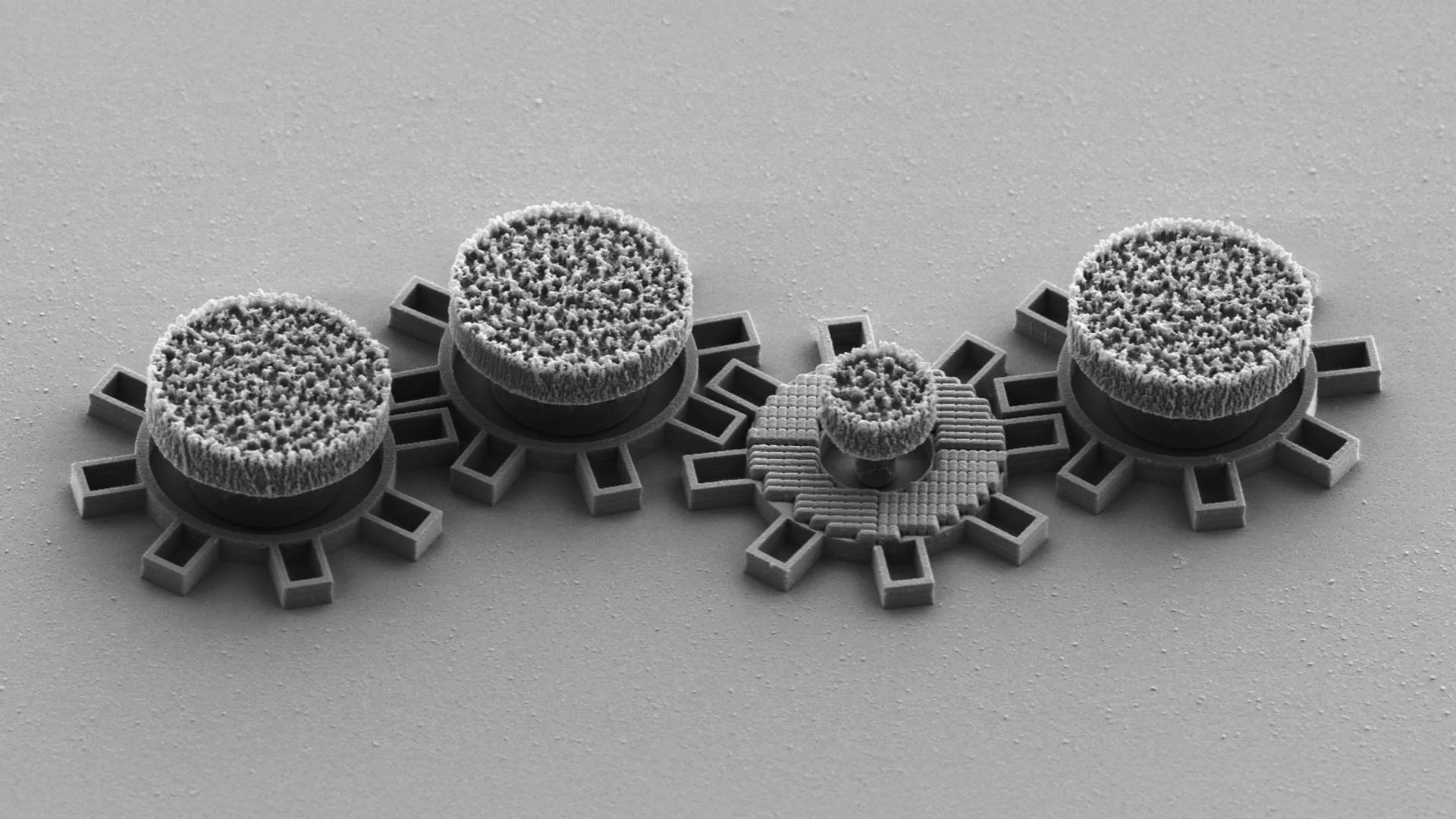
Researchers at the University of Gothenburg have achieved a groundbreaking feat in nanotechnology, successfully developing light-powered gears on a micrometer scale. This innovation shatters previous limitations in micro-engineering, paving the way for the creation of the smallest on-chip motors ever conceived, capable of fitting within the confines of a single strand of human hair. This development represents a paradigm shift in the field of micro-robotics and micro-mechanics, moving beyond the constraints of traditional mechanical drive trains and embracing the precision and control offered by light.
For decades, the dream of miniaturized mechanical systems has captivated scientists. Gears, ubiquitous in everything from intricate timepieces to colossal wind turbines, have been a focal point of this pursuit. The aspiration to construct micro-engines, powered by minuscule gears, has been a persistent goal for over thirty years. However, progress in this domain had reached an apparent plateau, with the smallest functional gears topping out at a mere 0.1 millimeters. The insurmountable challenge lay in fabricating the intricate drive trains necessary to impart motion at such an infinitesimal scale. The delicate nature of these components and the inherent difficulties in their assembly and activation proved to be formidable obstacles.
The breakthrough by the research team at the University of Gothenburg, in collaboration with other institutions, signifies a monumental leap forward. Their ingenious approach bypasses the need for conventional mechanical linkages altogether. Instead, they have harnessed the power of laser light to directly set the gears in motion. This fundamental departure from established methodologies has unlocked unprecedented possibilities for miniaturization and functionality.
Gears Powered by Light: A New Frontier in Micro-Mechanics
The core of this revolutionary technology lies in the sophisticated integration of optical metamaterials. In their seminal study, the researchers demonstrate that microscopic machines can be propelled by these specially engineered materials. Optical metamaterials are not merely microscopic; they are intricately patterned structures designed at the nanoscale to interact with light in highly specific and controlled ways. These structures possess the remarkable ability to capture and manipulate light, effectively acting as intermediaries between the light source and the mechanical component.
The fabrication process leverages established techniques such as traditional lithography. This allows for the precise manufacturing of gears directly onto a microchip, utilizing silicon as the substrate. The resulting gears, imbued with the optical metamaterial, boast a diameter typically ranging from a few tens of micrometers. When a laser beam is directed onto the metamaterial integrated into the gear, a remarkable transformation occurs: the gear wheel begins to spin. The intensity of the laser light directly dictates the speed of rotation, offering a precise level of control. Furthermore, the direction of the gear’s spin can be elegantly manipulated by altering the polarization of the incident light, adding another layer of dynamic control.
This ability to achieve controlled rotational motion with light marks a critical milestone, bringing researchers to the cusp of creating truly functional micromotors. These aren’t just passive components; they are active machines capable of performing work at the microscopic level.
A New Way of Thinking: Rethinking Microscale Mechanics
The implications of this light-driven approach are profound, necessitating a fundamental re-evaluation of how we conceive of mechanics at the microscale. "We have built a gear train in which a light-driven gear sets the entire chain in motion," explains Gan Wang, the study’s first author and a researcher in soft matter physics at the University of Gothenburg. "The gears can also convert rotation into linear motion, perform periodic movements and control microscopic mirrors to deflect light." This versatility underscores the potential of these micromotors to perform a wide array of complex tasks.
The ability to seamlessly integrate these light-powered machines directly onto a microchip and activate them with laser light unlocks entirely new avenues for technological advancement. Unlike traditional micro-mechanical systems that often require physical connections or bulky actuators, laser light offers a non-contact and highly controllable means of actuation. This inherent advantage allows for the scaling up of these micromotors into highly sophisticated and complex microsystems.
"This is a fundamentally new way of thinking about mechanics on a microscale," emphasizes Gan Wang. "By replacing bulky couplings with light, we can finally overcome the size barrier that has long plagued micro-engineering. The elegance of using light as the driving force lies in its ability to be precisely focused, directed, and modulated without any physical contact, which is crucial for working with such delicate structures."
Cell Size: Opening Doors to Biomedical Innovations
The implications of this breakthrough extend far beyond the realm of pure engineering, holding immense promise for fields such as medicine. With these advances, scientists are now envisioning micro- and nanomachines capable of sophisticated tasks like controlling light, precisely manipulating microscopic particles, and being seamlessly integrated into future lab-on-a-chip systems. The dimensions of these gear wheels, as small as 16-20 micrometers, are comparable to the size of human cells. This remarkable congruence opens up a vast landscape of possibilities within the medical domain.
"We can use the new micromotors as pumps inside the human body, for example to regulate various flows," Gan Wang elaborates, highlighting the potential for revolutionary medical applications. "I am also looking at how they function as valves that open and close." Imagine microscopic pumps precisely delivering medication to specific sites within the body, or tiny valves controlling the flow of bodily fluids with unparalleled accuracy. These are no longer futuristic fantasies but tangible possibilities brought closer by this research.
The potential applications in medicine are extensive and varied. Beyond pumps and valves, these light-powered micromotors could be employed for targeted drug delivery, micro-surgery, diagnostics, and even as components in advanced biosensors. The ability to precisely control these microscopic machines within the intricate environment of the human body represents a significant leap towards personalized and minimally invasive medical treatments.
Furthermore, the integration of these micromotors into lab-on-a-chip systems could revolutionize diagnostic capabilities. These miniature laboratories, capable of performing complex biological analyses on tiny samples, could be enhanced by the precise manipulation of fluids and particles afforded by these new motors. This could lead to faster, more accurate, and more accessible diagnostic tools for a wide range of diseases.
The research team’s success in overcoming the size barrier in micro-gear fabrication, coupled with the innovative use of light as a power source, signifies a pivotal moment in scientific discovery. The development of these light-powered micromotors is not merely an incremental improvement; it represents a fundamental paradigm shift that promises to redefine the boundaries of what is possible in micro-engineering and unlock a wave of transformative technologies across numerous disciplines, particularly in the critical field of medicine. The era of microscopic machines, intricately controlled by light, has officially begun.