Faris Adani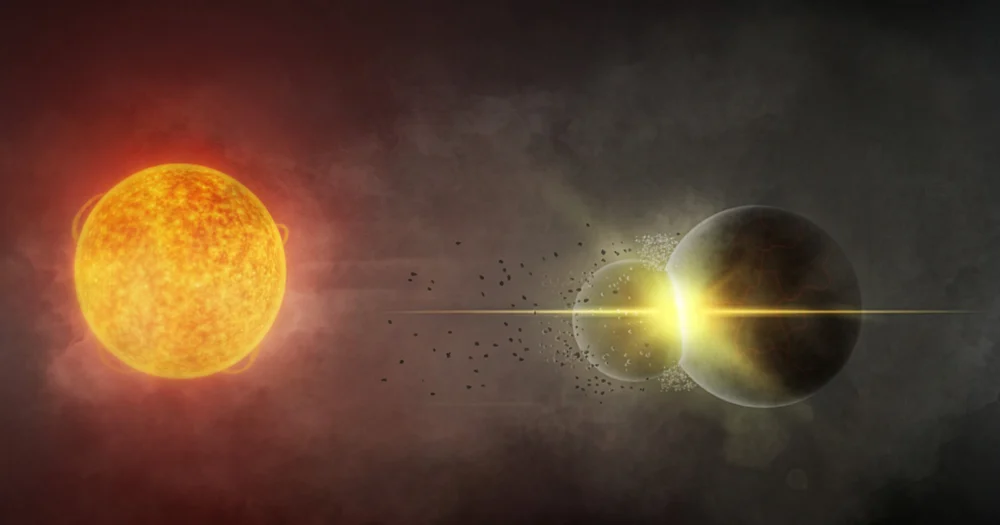
Scientists Spot Two Planets That Collided, Resulting in Carnage That Will Send Prickles Through Your Scalp
Astronomers have recently unveiled compelling evidence of a cataclysmic collision between two distant exoplanets, an event of cosmic carnage that offers a rare glimpse into the violent birth and evolution of planetary systems. This dramatic discovery, detailed in a study published in *The Astrophysical Journal Letters*, is more than just an awe-inspiring spectacle; it provides unprecedented insight into the dynamic processes that shape worlds, potentially shedding new light on the formation of our own solar system and even the enigmatic origins of Earth’s Moon.
The story of this cosmic tragedy unfolds around a seemingly ordinary main sequence star, designated Gaia20ehk. Like our Sun, Gaia20ehk had for millennia burned with a steady, predictable brightness. However, a closer look revealed a profound and inexplicable shift in its behavior. Beginning in 2016, the star’s light output started to flicker with peculiar dips in brightness, a phenomenon that escalated dramatically around 2021 when its variability became truly erratic.
“The star’s light output was nice and flat, but starting in 2016 it had these three dips in brightness. And then, right around 2021, it went completely bonkers,” explained lead author Anastasios Tzanidakis, an astronomer at the University of Washington, in a statement accompanying the research. He emphasized the extraordinary nature of this observation: “I can’t emphasize enough that stars like our Sun don’t do that. So when we saw this one, we were like ‘Hello, what’s going on here?'”
This erratic flickering was not indicative of a dying star or internal stellar instability. Instead, astronomers deduced that the periodic dimming was caused by colossal streams of rock and dust obscuring the star’s light as they passed in front of it. The sheer quantity of material required to partially blot out a star’s luminosity pointed to an event of immense scale – a planetary collision.
Further observational evidence solidified this theory. Data collected in the infrared spectrum revealed a crucial correlation: as the star’s visible light dimmed due to the obscuring debris, its infrared light simultaneously spiked. This critical detail suggested that the material blocking the star was incredibly hot, radiating its own intense heat as infrared energy. A collision between two massive celestial bodies would generate precisely these levels of extreme heat, validating the hypothesis of a planetary impact.
Before this brutal “bodyslam,” the planets would have been locked in a “morbid dance,” their gravitational interactions drawing them inexorably closer. “That could be caused by the two planets spiraling closer and closer to each other,” Tzanidakis speculated. This orbital decay would have likely led to a series of grazing impacts, minor brushes that wouldn’t produce a significant infrared signature. However, these initial encounters would have destabilized their orbits further, setting the stage for the main event. “Then, they had their big catastrophic collision, and the infrared really ramped up,” he added, describing the crescendo of this cosmic drama.
The ability of various telescopes to capture this event in “real time” is a testament to modern astronomical capabilities and sheer serendipity. Direct observations of planetary collisions are exceedingly rare, making this discovery a treasure trove for scientists. “It’s incredible that various telescopes caught this impact in real time,” Tzanidakis remarked. “There are only a few other planetary collisions of any kind on record, and none that bear so many similarities to the impact that created the Earth and Moon. If we can observe more moments like this elsewhere in the galaxy, it will teach us lots about the formation of our world.”
Indeed, the latest findings bear striking parallels to one of the most significant and ancient catastrophes in our own cosmic backyard: the formation of Earth’s Moon. Around 4.5 billion years ago, astronomers theorize that a Mars-sized protoplanet, dubbed Theia, collided with the nascent Earth. This titanic impact, known as the Giant Impact Hypothesis, obliterated Theia and ejected a vast amount of molten rock and debris into Earth’s orbit. Over time, this material gradually coalesced under its own gravity to form the Moon, a celestial body that is unusually large relative to its host planet.
Encouragingly, the astronomers observed that the immense dust cloud around Gaia20ehk orbits at roughly the same distance as Earth does from the Sun – approximately one astronomical unit. This orbital sweet spot is crucial, as it suggests that the debris cloud could similarly cool and coalesce over eons, potentially forming a new rocky satellite around one of the surviving planetary cores, or even a new planet altogether from the combined remnants. The similarities between the Gaia20ehk event and the hypothetical Theia impact offer a powerful observational anchor for understanding our own planetary history.
The implications of this discovery extend far beyond merely understanding planetary mechanics; they touch upon the profound field of astrobiology and the prevalence of life in the universe. Earth’s unusually large Moon is often considered one of the “magical ingredients” that makes our planet a habitable haven. Its gravitational influence is immense, stabilizing Earth’s axial tilt, which prevents extreme climatic swings and maintains a relatively stable environment for life to flourish. The Moon also generates powerful ocean tides, which are thought to have played a crucial role in the development of early life, facilitating the transition from marine to terrestrial ecosystems. Furthermore, our Moon acts as a cosmic shield, deflecting or absorbing a significant number of asteroids and comets that might otherwise impact Earth.
If collisions that lead to the formation of such an outsized and beneficial moon are rare events, then the conditions necessary for life, particularly complex life, might also be far rarer than previously imagined. “Right now, we don’t know how common these dynamics are,” Tzanidakis acknowledged. “But if we catch more of these collisions, we’ll start to figure it out.” Each new observation of a planetary collision, whether it’s the aftermath of two ice giants smashing together – as reported in a 2023 study that revealed a red-hot, torus-shaped debris cloud – or the dramatic events around Gaia20ehk, adds a vital piece to the cosmic puzzle. These events are not just destructive; they are profoundly creative, forging new worlds and potentially seeding the conditions for life in the vast, dynamic tapestry of the cosmos.
This research underscores the dynamic and often violent nature of planet formation and evolution. Far from being static, planetary systems are constantly undergoing dramatic transformations driven by gravitational interactions and high-energy impacts. By observing these “real-time” cosmic crashes, astronomers gain invaluable empirical data to refine their models of planet formation, understand the diversity of exoplanetary systems, and ultimately, piece together the intricate story of how worlds like our own came to be. The lingering debris around Gaia20ehk serves as a poignant reminder of the chaotic yet ultimately creative forces at play across the universe, offering a window into the past and future of planets, moons, and perhaps, life itself.