Imroatul Nasiyah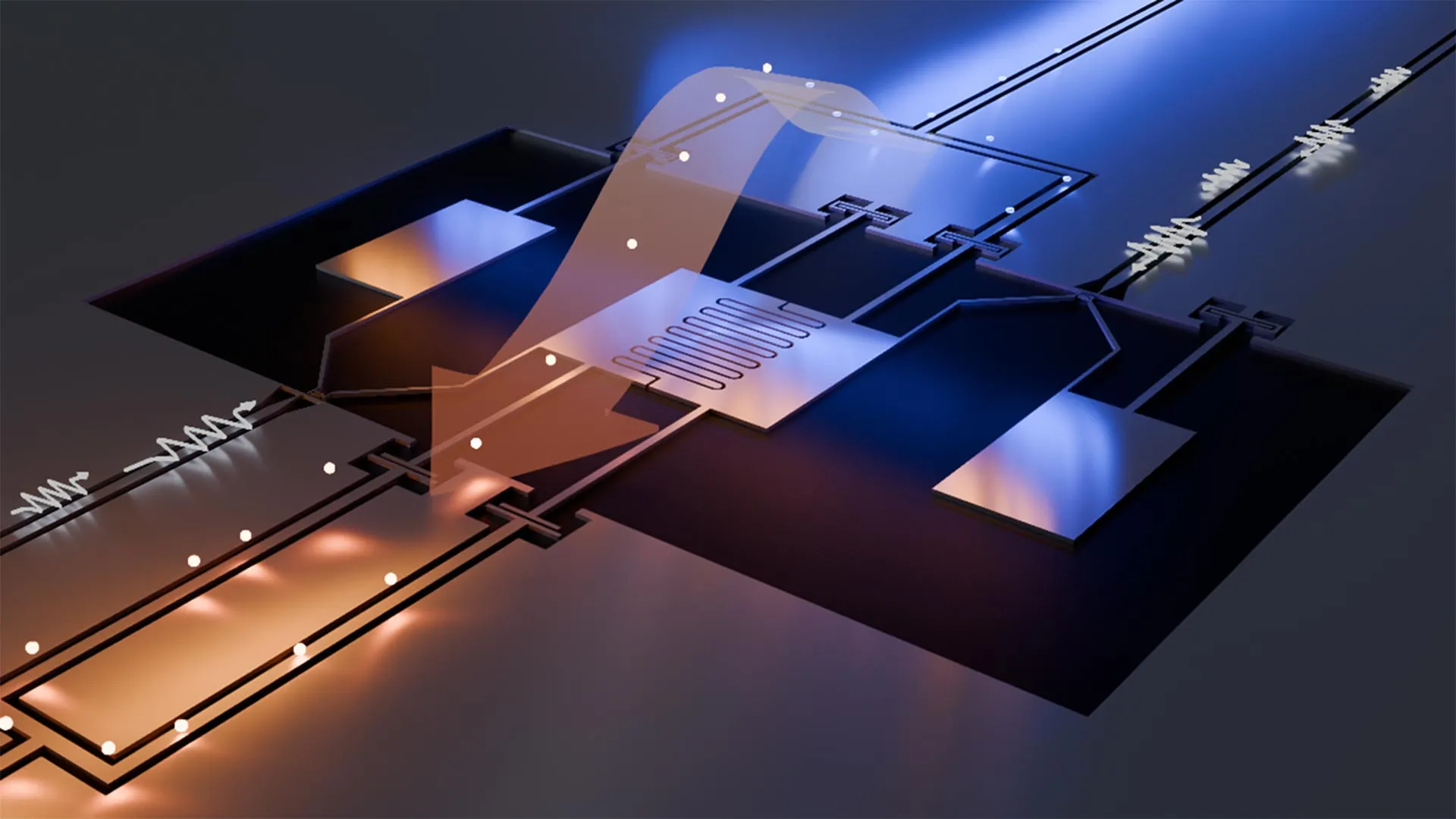
Traditionally, the approach to managing this delicate quantum environment has been to meticulously shield quantum systems from external noise and meticulously design cooling systems to minimize their own thermal footprint. However, this conventional strategy presents a paradox: the very cooling systems required to protect quantum information often generate the very noise that can disrupt it. This inherent conflict has spurred researchers to explore novel approaches, and a team at Chalmers University of Technology in Sweden has taken a radical departure from conventional wisdom. They have developed a pioneering quantum refrigerator that not only tolerates noise but actively leverages it as a fundamental component of its cooling mechanism. This innovative device, detailed in a recent publication in the prestigious journal Nature Communications, represents a significant leap forward in our ability to control and manipulate thermal energy at the quantum level.
The core innovation lies in the device’s ability to harness what physicists have theorized for years as "Brownian refrigeration." This concept suggests that the random thermal fluctuations inherent in any physical system, often perceived as detrimental noise, could, in principle, be manipulated to achieve a cooling effect. "Physicists have long speculated about a phenomenon called Brownian refrigeration; the idea that random thermal fluctuations could be harnessed to produce a cooling effect," explains Simone Gasparinetti, an associate professor at Chalmers and the senior author of the study. "Our work represents the closest realization of this concept to date."
At the heart of this novel quantum refrigerator is a meticulously engineered superconducting artificial molecule. This synthetic construct, fabricated in Chalmers’ state-of-the-art nanofabrication laboratory, mimics the behavior of natural molecules but is composed not of atoms, but of exquisitely designed tiny superconducting electrical circuits. This artificial molecule is then intricately connected to a network of microwave channels. The magic happens when carefully controlled microwave noise – essentially random signal fluctuations confined to a specific frequency range – is introduced into the system through a third port. This precisely engineered noise acts as a catalyst, enabling the researchers to guide the flow of heat and energy through the system with unprecedented precision.
"The two microwave channels serve as hot and cold reservoirs, but the key point is that they are only effectively connected when we inject controlled noise through a third port," elaborates Sundelin. "This injected noise enables and drives heat transport between the reservoirs via the artificial molecule. We were able to measure extremely small heat currents, down to powers in the order of attowatts, or 10⁻¹⁸ watt. If such a small heat flow were used to warm a drop of water, it would take the age of the universe to see its temperature rise one degree Celsius." This ability to control and measure heat flows at such infinitesimal scales is a testament to the device’s remarkable precision.
The implications of this noise-driven cooling mechanism are profound. By subtly adjusting the temperatures of the reservoirs and meticulously tracking these minuscule heat flows, the quantum refrigerator can be made to operate in multiple modes. Depending on the specific conditions and control parameters, it can function as a refrigerator, actively cooling a target, or it can even act as a heat engine, converting thermal energy into useful work. Furthermore, it can amplify thermal transport, a capability that opens up new avenues for energy management in quantum systems.
This exceptional level of control is particularly crucial for the advancement of larger, more complex quantum systems. In these advanced architectures, heat is inevitably generated locally during the operation and measurement of qubits. The ability to manage this heat directly within the quantum circuits, at the nanoscale, offers a significant advantage over conventional cooling systems, which often struggle to dissipate heat effectively from such confined spaces. "We see this as an important step towards controlling heat directly inside quantum circuits, at a scale that conventional cooling systems can’t reach," states Aamir Ali, a researcher in quantum technology at Chalmers and a co-author of the study. "Being able to remove or redirect heat at this tiny scale opens the door to more reliable and robust quantum technologies."
The research, titled "Quantum refrigeration powered by noise in a superconducting circuit," has been published in Nature Communications. The study’s authors include Simon Sundelin, Mohammed Ali Aamir, Vyom Manish Kulkarni, Claudia Castillo-Moreno, and Simone Gasparinetti, all from the Department of Microtechnology and Nanoscience at Chalmers University of Technology. The quantum refrigerator itself was fabricated at the Nanofabrication Laboratory, Myfab, also at Chalmers. This groundbreaking work was supported by funding from the Swedish Research Council, the Knut and Alice Wallenberg Foundation through the Wallenberg Centre for Quantum Technology (WACQT), the European Research Council, and the European Union, underscoring the international recognition of its significance. The development of this noise-harnessing quantum refrigerator represents a paradigm shift in quantum technology, potentially paving the way for more stable, scalable, and ultimately, more powerful quantum computers and other quantum devices. By transforming a fundamental challenge into an enabling feature, scientists at Chalmers have opened a new frontier in the quest for practical quantum technologies.