Imroatul Nasiyah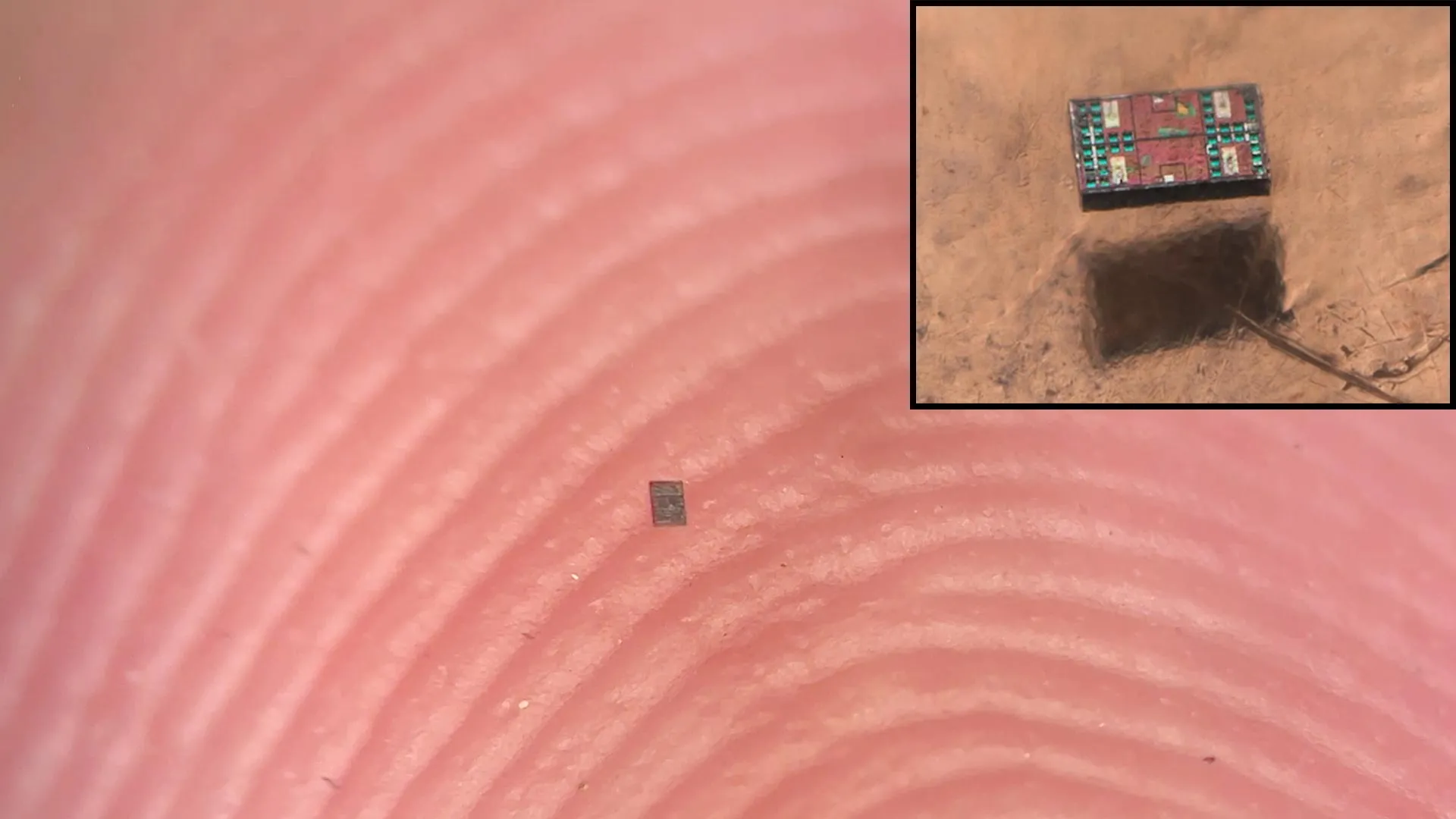
A groundbreaking achievement in miniaturization has been unveiled by researchers at the University of Pennsylvania and the University of Michigan: the creation of the smallest fully programmable autonomous robots ever conceived. These microscopic marvels, barely visible to the naked eye, are poised to revolutionize fields ranging from targeted drug delivery to intricate micro-assembly. Each robot measures a mere 200 by 300 by 50 micrometers, making them substantially smaller than a single grain of salt. Their minuscule size allows them to operate at the same scale as many living microorganisms, opening up unprecedented possibilities for medical diagnostics and advanced manufacturing. Imagine doctors monitoring individual cells within the human body or engineers assembling incredibly tiny components for next-generation devices – these robots could make such futuristic scenarios a reality.
The brilliance of these robots lies in their complete autonomy and programmability, powered entirely by light. Integrated microscopic computers within each unit enable them to execute programmed paths, detect subtle changes in their environment, and independently adjust their behavior in response. This is a significant leap from previous generations of microscopic machines, which often relied on cumbersome external controls like wires, magnetic fields, or constant human intervention. The research, meticulously detailed in prestigious journals like Science Robotics and the Proceedings of the National Academy of Sciences (PNAS), marks a pivotal moment in robotics.
"We’ve made autonomous robots 10,000 times smaller," exclaims Marc Miskin, Assistant Professor in Electrical and Systems Engineering at Penn Engineering and the senior author of the groundbreaking papers. "That opens up an entirely new scale for programmable robots." This dramatic reduction in size represents a paradigm shift, tackling a challenge that has stymied roboticists for decades.
The Herculean Task of Shrinking Robots
While electronics have experienced relentless miniaturization for decades, robotics has lagged behind. The critical hurdle has been achieving true independence at scales below one millimeter. "Building robots that operate independently at sizes below one millimeter is incredibly difficult," Miskin elaborates. "The field has essentially been stuck on this problem for 40 years."
The fundamental challenge stems from a dramatic shift in physics as objects shrink. At macroscopic scales, forces like gravity and inertia, which are dependent on volume, play a dominant role in motion. However, at the microscopic level, surface-related forces, such as drag and viscosity, become overwhelmingly significant. This means that movement, which we perceive as effortless at our scale, becomes akin to navigating through a viscous fluid. "If you’re small enough, pushing on water is like pushing through tar," Miskin illustrates, highlighting the immense resistance these tiny machines face.
Conventional robotic designs, with their delicate arms and legs, are ill-suited for this microscopic realm. These minute appendages are not only prone to breaking but are also extraordinarily difficult to manufacture. "Very tiny legs and arms are easy to break," Miskin explains. "They’re also very hard to build." To surmount these inherent limitations, the research team devised an entirely novel approach to locomotion that works in harmony with, rather than against, the physics of the microscopic world.
The Art of Microscopic Swimming
Unlike larger aquatic creatures that propel themselves by pushing water backward, leveraging Newton’s Third Law, these tiny robots employ a unique strategy. Instead of relying on physical articulation, they generate an electrical field. This field gently nudges charged particles, or ions, within the surrounding liquid. As these ions move, they, in turn, drag nearby water molecules, effectively creating a localized current around the robot. "It’s as if the robot is in a moving river," Miskin analogizes, "but the robot is also causing the river to move."
By precisely controlling this electrical field, the robots gain remarkable maneuverability. They can alter their direction, navigate complex predetermined paths, and even synchronize their movements to form coordinated groups, reminiscent of schools of fish. These microscopic swimmers can achieve impressive speeds, reaching up to one body length per second.
A significant advantage of this light-powered, electrokinetic propulsion system is its inherent durability. With no moving parts, the robots are remarkably robust and can withstand repeated transfers between samples using a micropipette without sustaining damage. Furthermore, powered by light from an LED, these tireless machines can operate for months on end, a testament to their energy efficiency and longevity.
Intelligence Packed into a Microscopic Frame
True autonomy, however, extends beyond mere locomotion. For a robot to be considered truly autonomous, it must possess the ability to perceive its surroundings, make independent decisions, and manage its own power. The monumental task of integrating these essential components onto a chip mere fractions of a millimeter across fell to David Blaauw’s team at the University of Michigan.
Blaauw’s lab has a distinguished history in miniaturization, holding the record for the world’s smallest computer. The serendipitous meeting between Blaauw and Miskin at a Defense Advanced Research Projects Agency (DARPA) presentation five years prior proved to be a pivotal moment. They recognized the symbiotic potential of their respective technologies: Penn Engineering’s innovative propulsion system and Michigan’s minuscule yet powerful electronic computers. "We saw that Penn Engineering’s propulsion system and our tiny electronic computers were just made for each other," Blaauw remarks. Despite this immediate synergy, translating this vision into a functional robot required an arduous five years of dedicated development.
One of the most formidable obstacles was power management. "The key challenge for the electronics," Blaauw states, "is that the solar panels are tiny and produce only 75 nanowatts of power. That is over 100,000 times less power than what a smart watch consumes." To overcome this severe power constraint, the team engineered specialized circuits capable of operating at extremely low voltages, achieving a staggering reduction in power consumption by over 1,000 times.
Space, or rather the extreme lack thereof, presented another significant hurdle. The solar panels, crucial for power, occupied a substantial portion of the robot’s limited surface area, leaving minimal room for essential computing hardware. The solution involved a radical rethinking of the robot’s software architecture. "We had to totally rethink the computer program instructions," Blaauw explains, "condensing what conventionally would require many instructions for propulsion control into a single, special instruction to shrink the program’s length to fit in the robot’s tiny memory space." This ingenious condensation of code was vital for fitting the necessary intelligence into such a confined space.
Sensing and Communicating at the Microscopic Scale
These combined advancements have culminated in what the researchers believe to be the first sub-millimeter robot capable of genuine decision-making. To their knowledge, no previous endeavor has succeeded in integrating a complete computer – encompassing a processor, memory, and sensors – into a robot of this minuscule dimension. This remarkable achievement empowers the robots to not only sense their environment but also to react and operate independently.
The robots are equipped with sophisticated electronic temperature sensors, capable of detecting minute temperature variations as small as one-third of a degree Celsius. This sensitivity allows them to navigate towards warmer regions or to report temperature data that can serve as indicators of cellular activity, providing a novel method for monitoring individual cells with unprecedented precision.
Communicating these vital measurements required an equally inventive approach. "To report out their temperature measurements, we designed a special computer instruction that encodes a value, such as the measured temperature, in the wiggles of a little dance the robot performs," says Blaauw. "We then look at this dance through a microscope with a camera and decode from the wiggles what the robots are saying to us. It’s very similar to how honey bees communicate with each other." This bio-inspired communication method offers a unique way for these microscopic agents to convey information about their surroundings.
The same light that powers the robots also serves as the medium for programming them. Each robot possesses a unique address, enabling researchers to upload distinct instructions to individual units. "This opens up a host of possibilities," Blaauw adds, "with each robot potentially performing a different role in a larger, joint task." This programmability allows for complex coordinated behaviors and specialized functions, paving the way for sophisticated swarm robotics at the microscale.
A Foundation for Future Microscopic Machines
The current iteration of these robots represents just the nascent stage of a transformative technology. Future versions are envisioned to incorporate more advanced programming capabilities, achieve greater speeds, integrate a wider array of sensors, and even operate effectively in more challenging environments. The researchers deliberately designed the system as a flexible and adaptable platform, combining a robust and efficient propulsion method with electronics that can be manufactured cost-effectively and evolve over time.
"This is really just the first chapter," Miskin concludes with optimism. "We’ve shown that you can put a brain, a sensor and a motor into something almost too small to see, and have it survive and work for months. Once you have that foundation, you can layer on all kinds of intelligence and functionality. It opens the door to a whole new future for robotics at the microscale." This pioneering work promises to unlock a universe of possibilities, driving innovation across numerous scientific and technological frontiers.
The research was a collaborative effort undertaken at the University of Pennsylvania (Penn) School of Engineering and Applied Science, Penn School of Arts & Sciences, and the University of Michigan Department of Electrical Engineering and Computer Science. Funding for this groundbreaking research was generously provided by the National Science Foundation (NSF 2221576), the University of Pennsylvania Office of the President, the Air Force Office of Scientific Research (AFOSR FA9550-21-1-0313), the Army Research Office (ARO YIP W911NF-17-S-0002), the Packard Foundation, the Sloan Foundation, and the NSF National Nanotechnology Coordinated Infrastructure Program (NNCI-2025608), which supports the Singh Center for Nanotechnology, alongside contributions from Fujitsu Semiconductors.
Key contributors to this monumental achievement include Maya M. Lassiter, Kyle Skelil, Lucas C. Hanson, Scott Shrager, William H. Reinhardt, Tarunyaa Sivakumar, and Mark Yim from the University of Pennsylvania, and Dennis Sylvester, Li Xu, and Jungho Lee from the University of Michigan, all of whom played integral roles in bringing these microscopic robots to life.