Imroatul Nasiyah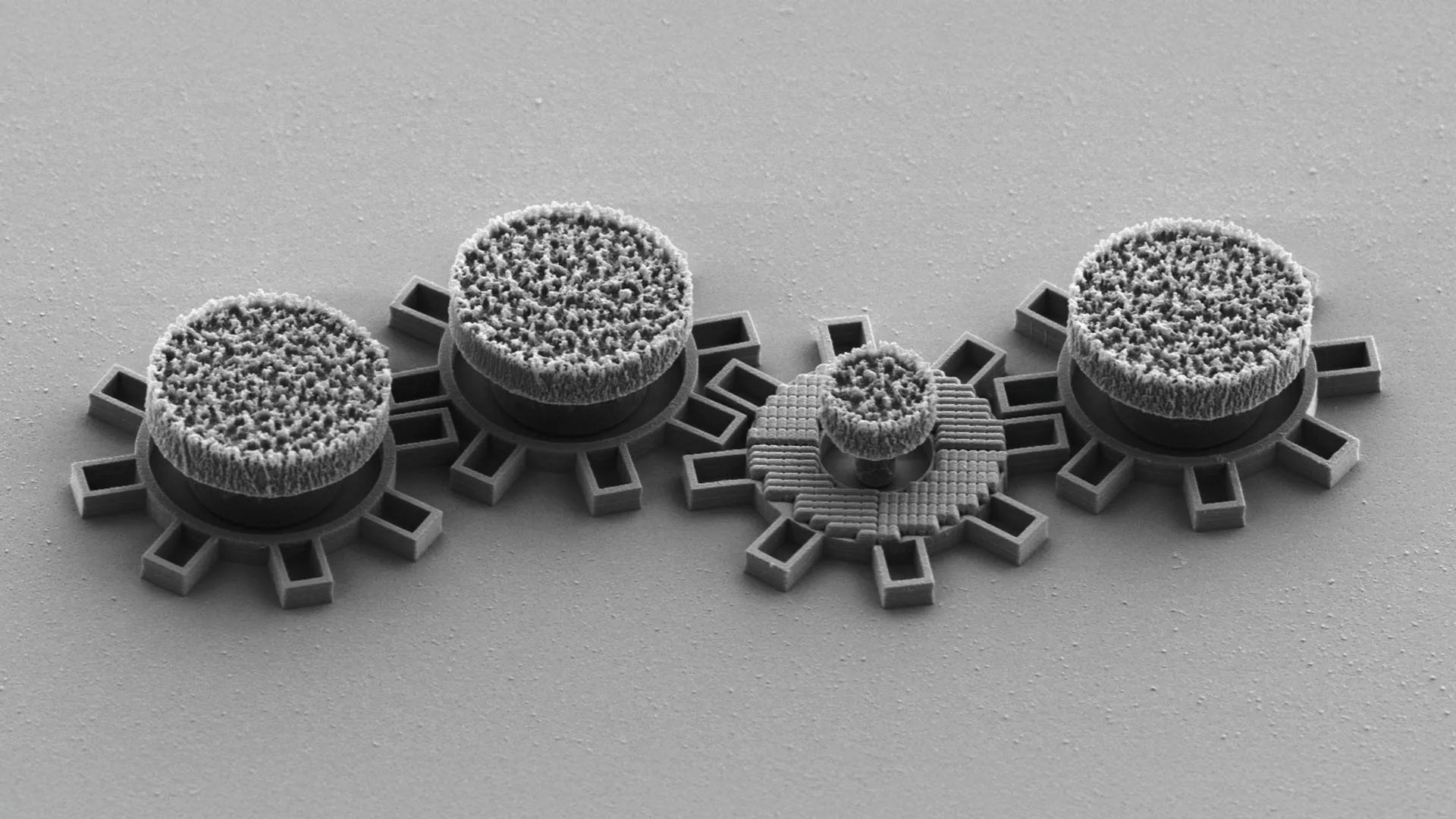
Researchers at the University of Gothenburg have achieved a groundbreaking feat in micro-engineering, successfully fabricating light-powered gears on a micrometer scale that are smaller than a human hair. This remarkable innovation paves the way for the development of the smallest on-chip motors ever created, holding immense potential to transform various scientific and technological fields, particularly in medicine and advanced computing. The breakthrough, detailed in a recent study, overcomes long-standing limitations in miniaturization by leveraging the power of light to drive intricate mechanical components.
For decades, the concept of micro-engines, powered by minuscule gears, has been a tantalizing prospect for scientists. Gears, ubiquitous in macroscopic machinery from timepieces to industrial robots, have been a persistent challenge at the micro- and nanoscale. While progress had been made, the development of functional gears and their associated drive trains had stalled at approximately 0.1 millimeters, due to the inherent difficulties in constructing the mechanical linkages necessary for movement at such diminutive scales. Traditional methods of transmitting power mechanically become increasingly problematic as components shrink, leading to friction, wear, and a lack of precision.
The team at the University of Gothenburg, in collaboration with other institutions, has shattered this long-standing barrier by reimagining the fundamental principles of micro-mechanical actuation. Instead of relying on conventional mechanical drive trains, they have ingeniously employed laser light as the direct force to set their microscopic gears in motion. This paradigm shift fundamentally alters the approach to micro-engineering, moving away from physical connections and towards contactless, optical control.
The core of this innovation lies in the utilization of optical metamaterials. These are not merely small structures but highly engineered, patterned surfaces designed to interact with light in unprecedented ways. Specifically, these metamaterials possess the remarkable ability to capture and precisely control light at the nanoscale. By employing standard lithography techniques, the researchers were able to manufacture gears directly onto a microchip, integrating these sophisticated optical metamaterials with silicon. The resulting gears, with diameters measuring just a few tens of micrometers, are minuscule enough to fit within the width of a human hair.
The activation mechanism is as elegant as it is effective. When a laser beam is directed at the optical metamaterial integrated into the gear, the gear wheel begins to spin. The intensity of the laser light serves as a direct control knob for the rotational speed, allowing for precise adjustments. Furthermore, the researchers have demonstrated the ability to manipulate the direction of the gear’s rotation by altering the polarization of the incident light. This level of control over both speed and direction is crucial for the development of functional micromotors.
This breakthrough brings the realization of true micromotors within reach. The study’s first author, Gan Wang, a researcher in soft matter physics at the University of Gothenburg, highlights the significance of this achievement: "We have built a gear train in which a light-driven gear sets the entire chain in motion." This statement underscores the cascaded effect of their innovation, where a single light-activated gear can drive an entire system of interconnected micro-components. Beyond simple rotation, these light-powered gears exhibit a versatility that expands their potential applications. They can convert rotational motion into linear motion, execute periodic movements, and even control microscopic mirrors to deflect light beams. This multifaceted functionality opens up a wide array of possibilities for complex micro-assembly and manipulation.
The ability to integrate these microscopic machines directly onto a microchip and actuate them with light presents a fundamentally new pathway for micro-engineering. Laser light offers distinct advantages over traditional mechanical couplings. It does not require any fixed physical contact with the machine, thus minimizing wear and tear and simplifying design. Moreover, laser light is inherently easy to control and direct, making it an ideal candidate for scaling up to highly complex microsystems.
Gan Wang elaborates on this transformative aspect: "This is a fundamentally new way of thinking about mechanics on a microscale. By replacing bulky couplings with light, we can finally overcome the size barrier." This sentiment captures the essence of their scientific leap – a departure from the constraints of physical mechanics towards the precision and control offered by optics. The "size barrier" that had plagued micro-gear development for decades is now being dismantled by this innovative light-driven approach.
The implications of these advances are far-reaching, extending to the development of micro- and nanomachines capable of sophisticated tasks. These could include controlling light with unprecedented precision, manipulating minute particles for scientific experimentation or manufacturing, or being seamlessly integrated into future lab-on-a-chip systems, which promise to revolutionize diagnostics and drug discovery. The size of these gear wheels, as small as 16-20 micrometers, is particularly noteworthy. This dimension is comparable to the size of many human cells, placing the field of medicine firmly within the realm of achievable applications for these new micromotors.
Gan Wang expresses optimism about the medical applications: "We can use the new micromotors as pumps inside the human body, for example to regulate various flows. I am also looking at how they function as valves that open and close." The prospect of tiny, implantable pumps and valves controlled by external light sources could lead to novel treatments for a range of conditions, from circulatory issues to targeted drug delivery. Imagine microscopic devices navigating the bloodstream, precisely dispensing medication or regulating fluid levels within the body, all powered and controlled wirelessly by external light.
Beyond their function as pumps and valves, these light-powered micromotors could also serve as microscopic manipulators, capable of grasping and moving individual cells or molecules. In diagnostics, they could be employed to sort and analyze biological samples with unparalleled speed and accuracy. The development of lab-on-a-chip systems, which miniaturize complex laboratory processes onto a single chip, would be significantly enhanced by the integration of these controllable micromotors, enabling sophisticated analysis and experimentation at the point of care.
The fundamental innovation lies in the optical metamaterial’s ability to convert light energy into mechanical motion with high efficiency and precision. The specific patterns etched into the metamaterial are crucial for this energy conversion, designed to resonate with the wavelength and polarization of the incident laser light. This resonant interaction amplifies the effect of the light, causing the gear to rotate. The choice of materials, such as silicon, ensures biocompatibility and ease of integration with existing microelectronic fabrication processes.
The potential for miniaturization is further amplified by the fact that these components are fabricated using lithography, a process already well-established for producing intricate patterns on microchips. This means that the production of these light-powered micromotors can potentially be scaled up significantly, moving from laboratory prototypes to mass production. The cost-effectiveness of such mass production would further accelerate their adoption across various industries.
The research also opens avenues for exploring the use of different wavelengths of light, potentially in the infrared or ultraviolet spectrum, to achieve different effects or to penetrate tissues more effectively for medical applications. The ability to precisely control the light source, perhaps using focused laser arrays, could enable the coordinated movement of multiple micromotors simultaneously, creating complex microscopic robotic systems.
In conclusion, the development of light-powered micromotors smaller than a human hair by researchers at the University of Gothenburg represents a monumental leap forward in micro-engineering. By circumventing the limitations of traditional mechanical drive trains and harnessing the power of light and optical metamaterials, they have unlocked the potential for the smallest on-chip motors ever conceived. This breakthrough promises to revolutionize fields ranging from advanced computing and sensing to the burgeoning area of nanomedicine, offering unprecedented control and functionality at the microscopic level and heralding a new era of miniaturized technologies. The implications for future medical treatments, scientific research, and technological innovation are profound and continue to unfold.