Faris Adani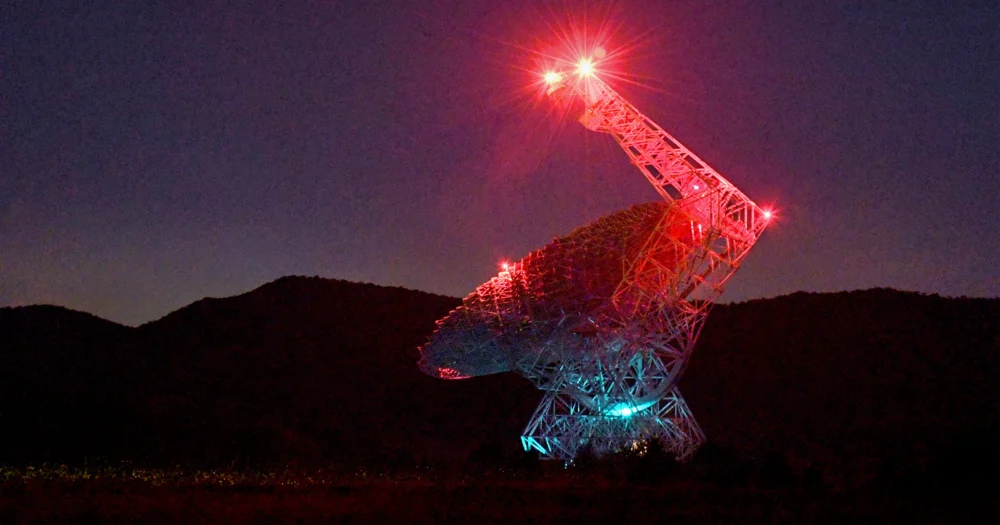
An international team of researchers, leveraging the immense power of the world’s largest single-dish radio telescope, has delivered its initial findings after meticulously scanning the enigmatic interstellar object 3I/ATLAS for any signs of extraterrestrial technology, with results that, while expected, nonetheless contribute significantly to humanity’s ongoing search for life beyond Earth. The celestial visitor, initially discovered in July by the NASA-funded Asteroid Terrestrial-impact Last Alert System (ATLAS) survey telescope in Chile, captivated the astronomy community due to its unprecedented velocity, indicating it was not gravitationally bound to our Sun and originated from another star system – making it only the third such interstellar interloper ever observed.
Dubbed 3I/ATLAS, this object swiftly garnered attention not only for its rarity but also for the intriguing possibility, championed by Harvard astronomer Avi Loeb, that it might be an alien artifact. Despite a preponderance of data aligning with the characteristics of a natural comet – featuring an icy core, or nucleus, enveloped by a bright, diffuse cloud of gas and dust known as a coma – Loeb has consistently argued for the scientific imperative to explore all hypotheses, even the most extraordinary. He has maintained that there remains a non-zero chance that 3I/ATLAS could represent a technological relic from an advanced extraterrestrial civilization, an interstellar probe sent perhaps to explore new star systems.
While Loeb himself has candidly acknowledged that the probability of 3I/ATLAS being technological in nature diminishes with each new piece of observational evidence, the scientific community, driven by the profound implications of such a discovery, pressed forward with investigations. The object’s closest approach to Earth, a mere 167 million miles on December 19, presented a unique and invaluable window for observation. This critical juncture prompted the alien-hunting astronomy project Breakthrough Listen to spring into action. An international consortium of researchers associated with the project directed the colossal Green Bank Telescope (GBT) in West Virginia – renowned as the largest fully steerable single-dish radio telescope globally – toward 3I/ATLAS.
Their efforts culminated in a comprehensive search for artificial radio emissions, the hallmark of technological civilizations. The preliminary findings, detailed in a yet-to-be-peer-reviewed paper, present a sobering, though largely anticipated, conclusion: the Green Bank Telescope detected no "candidate signals" emanating from 3I/ATLAS during its intense observational period, specifically on the day prior to its closest terrestrial proximity. As succinctly noted by the Search for Extraterrestrial Intelligence (SETI) Institute on its official website, "No artificial radio emission localized to 3I/ATLAS was detected" by the powerful instrument.
The SETI statement further elaborated, affirming that "In summary, 3I/ATLAS continues to behave as expected from natural astrophysical processes." This assessment reinforces the prevailing scientific consensus, which leans heavily towards a natural, cometary origin. Nonetheless, the institute stressed the object’s enduring scientific value: "That said, it remains an extremely interesting target for observation given the overall rarity of interstellar objects." The Breakthrough Listen researchers, in their paper, concurred, stating unequivocally that "3I/ATLAS exhibits mostly typical cometary characteristics, including a coma and an unelongated nucleus." This observation is particularly significant, as the previous interstellar visitor, ‘Oumuamua, showed no discernible coma and exhibited an elongated, cigar-like shape, fueling speculation about its potentially artificial nature. The presence of a clear coma and a standard, unelongated nucleus for 3I/ATLAS strongly supports the natural comet hypothesis.
The paper’s authors concluded with a foundational statement for the nascent field of interstellar object study: "There is currently no evidence to suggest that [interstellar objects] are anything other than natural astrophysical objects." However, they wisely appended a crucial caveat: "However, given the small number of such objects known (only three to date), and the plausibility of interstellar probes as a technosignature, thorough study is warranted." This highlights the meticulous balance between scientific skepticism and the open-minded pursuit of groundbreaking discoveries that defines the search for extraterrestrial intelligence. Even if 3I/ATLAS turns out to be a natural phenomenon, the established protocol for its investigation sets a vital precedent for future interstellar encounters.
Despite these findings, Avi Loeb maintains his dedicated scrutiny of 3I/ATLAS, continuing to meticulously document what he perceives as "anomalies" in its behavior. He points to its unusually large suspected size, which, if confirmed, would make it a particularly massive comet. Furthermore, Loeb highlights what he describes as its "strangely fine-tuned trajectory," a path that brought it and will continue to bring it within tens of millions of miles of several inner and outer solar system planets, including Mars, Venus, and Jupiter. From Loeb’s perspective, such a precise celestial dance, especially if combined with other unusual characteristics, could hint at a deliberate, directed course rather than a purely random gravitational slingshot. This line of reasoning echoes his earlier arguments regarding ‘Oumuamua’s non-gravitational acceleration, which he proposed could have been due to radiation pressure on a thin, light-sail-like object.
The scientific community’s efforts to characterize 3I/ATLAS have predominantly painted a picture of a gargantuan snowball, primarily composed of carbon dioxide and water ice, exhibiting all the hallmarks of a typical comet. With the absence of any detectable artificial radio signals during its closest approach to Earth, the chances of this object being an alien probe sent from a distant star system appear to be dwindling significantly. One might reasonably ponder: if an extraterrestrial civilization intended for its probe to make contact, wouldn’t it be in its best interest to transmit signals during its closest encounter with a habitable planet known to emit its own radio transmissions? Earth, after all, broadcasts a constant symphony of electromagnetic waves, making it an unmistakable beacon in the cosmic void.
Loeb, in his characteristic fashion, developed a "Loeb scale" to quantify the likelihood of an interstellar object being alien in nature, with zero representing a natural icy rock and ten denoting a confirmed piece of alien technology. Shortly after its initial discovery, he tentatively ranked 3I/ATLAS as a "four" on this scale. He has since opted to defer an update to this ranking, stating he will wait "until new data from the period bracketing its closest approach to Earth is publicly released and analyzed." This rigorous, albeit potentially protracted, process underscores the scientific commitment to data-driven conclusions, regardless of the tantalizing nature of the initial hypothesis.
The ongoing saga of 3I/ATLAS serves as a powerful testament to humanity’s enduring fascination with the cosmos and the persistent hope of discovering life beyond our planet. While the Breakthrough Listen project’s initial sweep for technosignatures has yielded no definitive proof of alien technology, the exhaustive investigation of 3I/ATLAS exemplifies the scientific method in action – rigorously testing even the most speculative hypotheses. The rarity of interstellar objects, and the profound questions they raise about the prevalence of life and intelligence in the universe, ensure that objects like 3I/ATLAS will continue to be targets of intense scrutiny, pushing the boundaries of observational astronomy and the relentless quest to answer one of humanity’s most fundamental questions: Are we alone? The journey of 3I/ATLAS through our solar system, whether as a silent cosmic iceball or something more, has undoubtedly enriched our understanding of the vast interstellar medium and refined our techniques for searching for the ultimate discovery.