Imroatul Nasiyah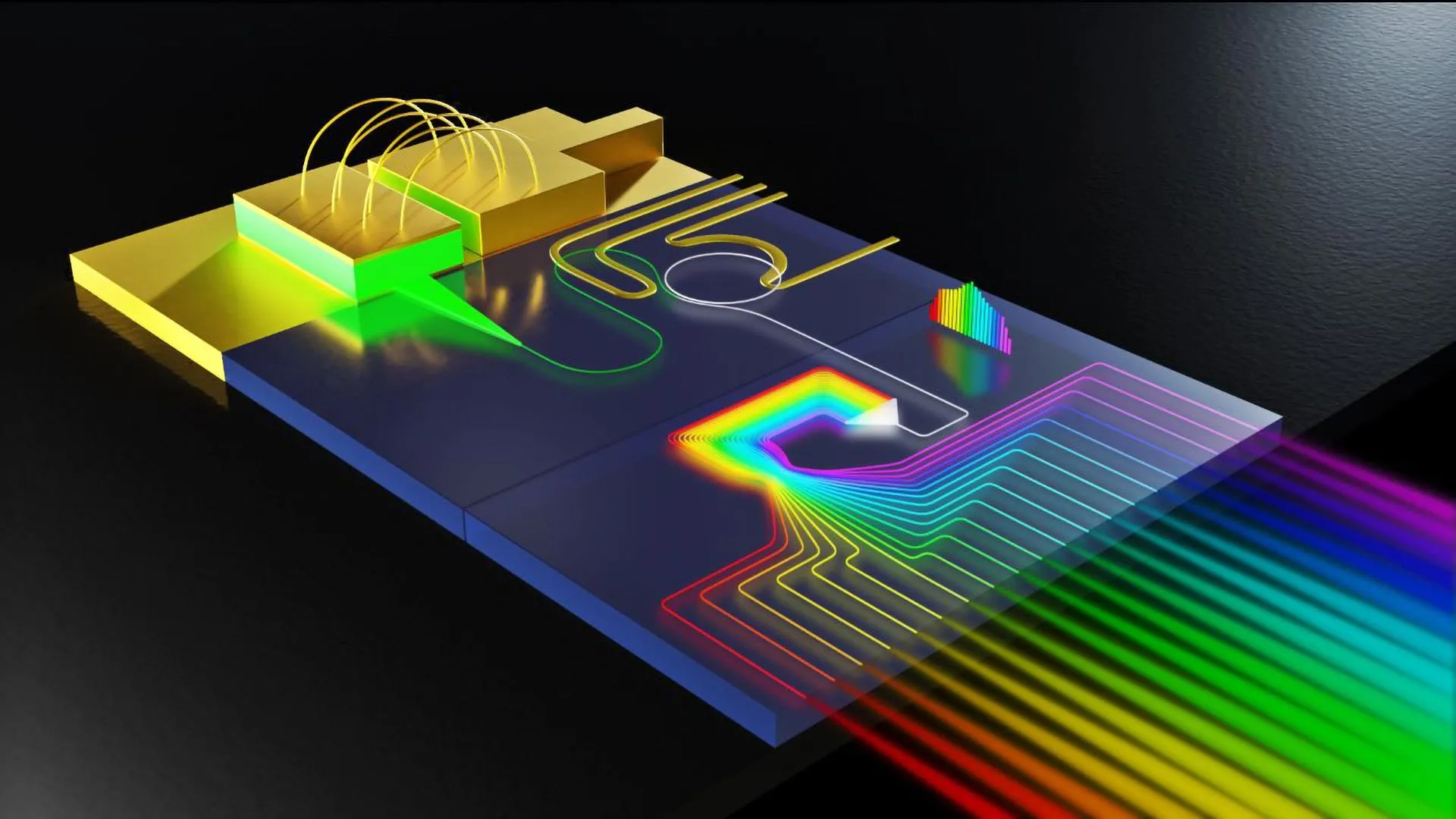
In a groundbreaking development that promises to revolutionize data transmission and unlock new frontiers in technology, scientists have stumbled upon a method to create a miniaturized "rainbow chip" capable of generating a powerful and highly organized spectrum of light. This accidental discovery, born from research aimed at enhancing LiDAR (Light Detection and Ranging) technology, holds immense potential to dramatically increase internet speeds, boost the efficiency of data centers, and pave the way for a new generation of advanced devices. The breakthrough, spearheaded by researchers in Michal Lipson’s lab at Columbia University, demonstrates how a single microchip can replace bulky, expensive equipment, leading to significant cost savings, space reduction, and a leap forward in energy efficiency.
The genesis of this remarkable innovation lies in an unexpected observation made by the research team. While focused on developing high-power chips to amplify LiDAR’s light beams, they noticed a peculiar phenomenon occurring as they pushed the power limits of their experimental chips. "As we sent more and more power through the chip, we noticed that it was creating what we call a frequency comb," explains Andres Gil-Molina, a former postdoctoral researcher in Lipson’s lab and now a principal engineer at Xscape Photonics. This frequency comb is not just any light; it is a highly structured form of light composed of numerous distinct colors, or frequencies, arranged in an orderly sequence. Imagine the vibrant bands of a rainbow, each shining intensely while the intervals between them remain dark. When visualized on a spectrogram, these luminous frequencies manifest as evenly spaced spikes, remarkably resembling the teeth of a comb. This unique characteristic is the key to its revolutionary potential: each individual color within the comb can serve as a separate channel for carrying data, allowing for a massive increase in information transfer without interference.
Traditionally, generating such a potent and finely tuned frequency comb has been a complex and costly endeavor, requiring large, expensive lasers and specialized amplifiers. However, the recent study, published in the prestigious journal Nature Photonics, showcases a paradigm shift. Lipson, the Eugene Higgins Professor of Electrical Engineering and professor of Applied Physics, and her colleagues have successfully engineered a solution that achieves the same remarkable output using a single, compact microchip. "Data centers have created tremendous demand for powerful and efficient sources of light that contain many wavelengths," Gil-Molina elaborates. "The technology we’ve developed takes a very powerful laser and turns it into dozens of clean, high-power channels on a chip. That means you can replace racks of individual lasers with one compact device, cutting cost, saving space, and opening the door to much faster, more energy-efficient systems." This advancement directly addresses the growing strain on existing data infrastructure, particularly in light of the explosive growth of artificial intelligence.
Professor Lipson emphasized the significance of this research within the broader context of silicon photonics. "This research marks another milestone in our mission to advance silicon photonics," she stated. "As this technology becomes increasingly central to critical infrastructure and our daily lives, this type of progress is essential to ensuring that data centers are as efficient as possible." The team’s journey to this breakthrough began with a fundamental question: how much power could they reliably integrate onto a chip using a laser? Their investigation led them to a multimode laser diode, a type of laser known for its considerable light output, commonly employed in industrial applications such as medicine and cutting tools. While these lasers are undeniably powerful, their light beams are typically characterized by a degree of chaos, or "messiness," making them unsuitable for precise applications.
The challenge then became integrating such a powerful, yet unruly, laser into the intricate world of silicon photonics. This field relies on guiding light through microscopic pathways, often only a few microns or even hundreds of nanometers wide. The engineering required to achieve this integration was substantial. "We used something called a locking mechanism to purify this powerful but very noisy source of light," Gil-Molina explains. This sophisticated method leverages the properties of silicon photonics to meticulously reshape and refine the laser’s output, transforming its chaotic beam into a significantly cleaner, more stable, and highly coherent stream of light. Coherence is a crucial scientific property that signifies the uniformity and predictability of a light wave.
Once the light was successfully purified, the inherent nonlinear optical properties of the chip were activated. These properties allowed the single, powerful beam of purified light to be effectively split into dozens of evenly spaced colors, thus creating the coveted frequency comb. The outcome is a compact, highly efficient light source that ingeniously combines the raw power of an industrial laser with the refined precision and stability essential for cutting-edge communication and sensing technologies.
The timing of this breakthrough is particularly prescient. The unprecedented surge in artificial intelligence has placed immense pressure on the infrastructure within data centers, which are struggling to keep pace with the demands of moving vast amounts of information, especially between processors and memory. While current state-of-the-art data centers extensively utilize fiber optic links for data transport, the majority of these still rely on single-wavelength lasers, limiting their capacity.
Frequency combs offer a transformative solution. Instead of a single beam carrying a single data stream, the rainbow chip enables dozens of data streams to travel in parallel through the same fiber. This concept is the foundational principle behind wavelength-division multiplexing (WDM), the very technology that propelled the internet into a global high-speed network during the late 1990s. By miniaturizing the creation of high-power, multi-wavelength frequency combs to fit directly onto a chip, Professor Lipson’s team has made this powerful capability accessible to the most compact and cost-sensitive components of modern computing systems.
The implications of this discovery extend far beyond the confines of data centers. The same versatile chips hold the promise of enabling a wide array of advanced technologies. Imagine portable spectrometers for on-site analysis, ultra-precise optical clocks for enhanced navigation and scientific research, compact quantum devices for revolutionary computing, and even significantly improved LiDAR systems for autonomous vehicles and advanced mapping. "This is about bringing lab-grade light sources into real-world devices," Gil-Molina concludes with evident enthusiasm. "If you can make them powerful, efficient, and small enough, you can put them almost anywhere." This accidental discovery, born from a pursuit of better distance measurement, has serendipitously opened a door to a future of faster, more efficient, and more capable technologies across a multitude of sectors.