Imroatul Nasiyah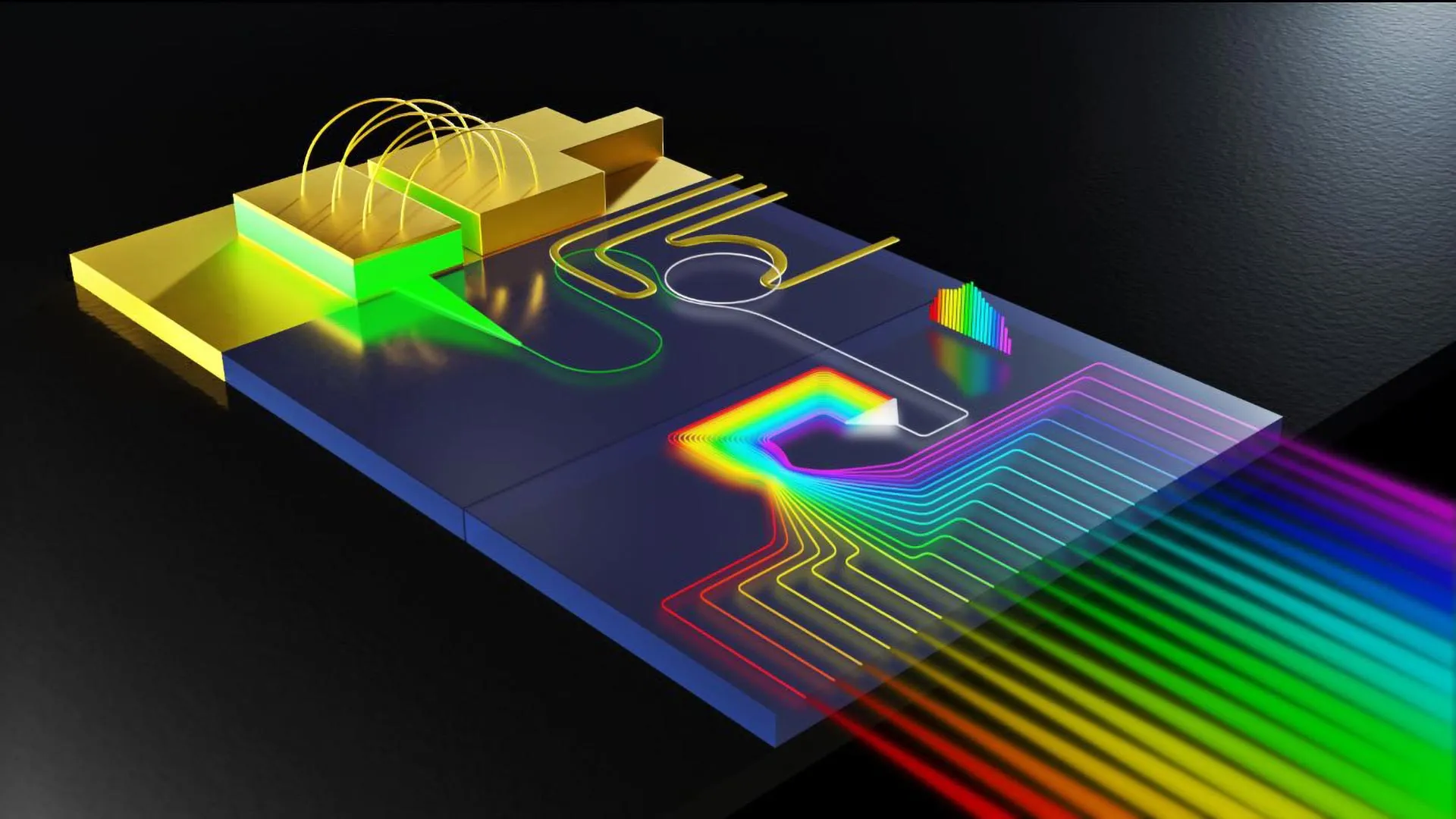
In a discovery that could fundamentally reshape the digital landscape, scientists have inadvertently engineered a groundbreaking microchip capable of generating a vibrant spectrum of light, akin to a miniature rainbow. This "rainbow chip," born from research aimed at enhancing LiDAR technology, promises to significantly supercharge the internet and unlock new frontiers in data processing and transmission. The unexpected breakthrough occurred in the lab of Michal Lipson, a distinguished Eugene Higgins Professor of Electrical Engineering and professor of Applied Physics at Columbia University, where researchers were striving to create high-power chips for more intense LiDAR light beams.
During their experiments, as they pushed increasing amounts of power through a specialized chip, researchers observed the spontaneous emergence of what they termed a "frequency comb." Andres Gil-Molina, a former postdoctoral researcher in Lipson’s lab and now a principal engineer at Xscape Photonics, explained the phenomenon: "As we sent more and more power through the chip, we noticed that it was creating what we call a frequency comb." A frequency comb is an extraordinary form of light characterized by a series of distinct, equally spaced colors, or frequencies, that appear side-by-side, much like the bands of a rainbow. Crucially, each of these individual colors shines brightly, while the intervals between them remain dark. When visualized on a spectrogram, these bright frequencies manifest as evenly spaced spikes, resembling the teeth of a comb. This inherent structure is precisely what makes it so valuable: each color can independently carry a stream of data without interfering with the others, effectively multiplying the data-carrying capacity.
Traditionally, producing such a powerful and organized frequency comb has necessitated the use of bulky, expensive lasers and associated amplification equipment. However, the recent study, published in the prestigious journal Nature Photonics, details how Lipson and her colleagues have achieved the same remarkable outcome using a single, compact microchip. This miniaturization represents a paradigm shift in the field. "Data centers have created tremendous demand for powerful and efficient sources of light that contain many wavelengths," Gil-Molina elaborated, highlighting the critical need for such technology. "The technology we’ve developed takes a very powerful laser and turns it into dozens of clean, high-power channels on a chip. That means you can replace racks of individual lasers with one compact device, cutting cost, saving space, and opening the door to much faster, more energy-efficient systems."
Professor Lipson emphasized the broader implications of this research, stating, "This research marks another milestone in our mission to advance silicon photonics. As this technology becomes increasingly central to critical infrastructure and our daily lives, this type of progress is essential to ensuring that data centers are as efficient as possible." The quest for this breakthrough began with a fundamental question: how powerful a laser could be integrated onto a chip?
The team’s innovative approach involved working with a multimode laser diode, a type of laser commonly found in demanding applications such as medicine and industrial cutting tools. While these lasers are known for their ability to generate substantial amounts of light, their output is typically characterized by a chaotic, or "messy," beam, which limits their utility in precision-oriented applications. Integrating such a potent yet unruly laser into a silicon photonics chip, which guides light through microscopic pathways mere microns or even hundreds of nanometers wide, presented a significant engineering challenge.
To overcome this hurdle, Gil-Molina explained, "We used something called a locking mechanism to purify this powerful but very noisy source of light." This sophisticated method leverages the principles of silicon photonics to meticulously reshape and cleanse the laser’s raw output. The result is a significantly cleaner, more stable beam – a characteristic scientists refer to as high coherence. Once the light’s coherence is established, the chip’s inherent nonlinear optical properties come into play. These properties enable the single, purified beam to be effectively split into dozens of precisely spaced colors, thereby generating the defining characteristic of a frequency comb. The culmination of this intricate process is a compact, highly efficient light source that merges the raw power of an industrial laser with the exceptional precision and stability vital for advanced communications, sensing, and computational tasks.
The timing of this scientific leap is particularly opportune. The exponential growth of artificial intelligence (AI) is placing immense strain on the infrastructure within data centers, particularly in the rapid movement of information between processors and memory. While state-of-the-art data centers currently utilize fiber optic links for data transport, the majority of these still rely on single-wavelength lasers, which inherently limit data throughput.
Frequency combs offer a transformative solution to this bottleneck. Instead of a single beam carrying a single data stream, the rainbow chip enables dozens of data streams to travel in parallel through the same fiber optic cable. This principle is the foundation of wavelength-division multiplexing (WDM), the technology that propelled the internet into a global high-speed network in the late 1990s. By successfully miniaturizing high-power, multi-wavelength frequency comb generation to fit directly onto a chip, Lipson’s team has made this advanced capability accessible for integration into the most compact and cost-sensitive components of modern computing systems.
The potential applications extend far beyond data centers. The same revolutionary chips could pave the way for a new generation of portable spectrometers, ultra-precise optical clocks, compact quantum computing devices, and even more sophisticated LiDAR systems. "This is about bringing lab-grade light sources into real-world devices," Gil-Molina emphasized. "If you can make them powerful, efficient, and small enough, you can put them almost anywhere." This breakthrough represents a significant stride towards a future where data can be processed and transmitted with unprecedented speed, efficiency, and cost-effectiveness, impacting everything from scientific research to everyday digital experiences. The "rainbow chip" is not just a scientific curiosity; it is a tangible step towards a more connected and capable digital world.