Faris Adani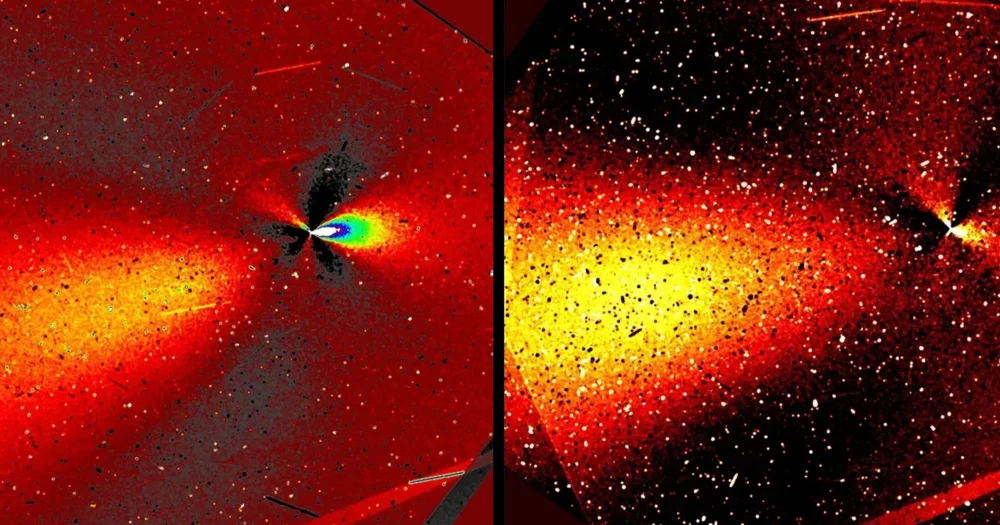
The enigmatic interstellar visitor, 3I/ATLAS, continues to captivate and challenge astronomers, even as it gracefully recedes from our solar system after its closest approach last month. This celestial transient, only the third confirmed interstellar object ever observed, has presented a new mystery in the form of an "intriguing configuration" of three evolving, symmetrical jets, sparking renewed debate and speculation, particularly from Harvard astronomer Avi Loeb.
Discovered in July, 3I/ATLAS immediately drew attention due to its unprecedented trajectory, confirming its origin beyond our Sun’s gravitational influence. Its fleeting visit offered a rare window into material from another star system, prompting intense observation campaigns from ground-based telescopes and space observatories alike. Among the most crucial insights have come from NASA’s venerable Hubble Space Telescope, whose observations in November and December revealed the perplexing multi-jet structure that has now become a focal point of discussion.
While 3I/ATLAS largely conforms to the characteristics of a typical comet – a celestial body composed primarily of ice, dust, and rock – these new Hubble images introduce a layer of complexity. The object’s most prominent feature remains a massive "anti-tail," a broad plume of material extending directly towards the Sun. This phenomenon is well-understood in cometary physics: as the comet approaches the Sun, solar radiation warms its surface, causing volatile ices like water and carbon dioxide to sublimate directly into gas. This outgassing forms a vast, diffuse atmosphere known as a coma, and the solar wind then pushes dust and gas away, forming tails. An "anti-tail" typically appears when the comet’s nucleus is facing the Sun, and the ejected material forms a broader, sunward-pointing stream due to perspective or the specific geometry of outgassing and solar radiation pressure. This aligns perfectly with the prevailing scientific consensus that 3I/ATLAS is indeed a natural comet, albeit one from a distant star.
However, beneath this macro-level understanding, the Hubble observations have unveiled a more intricate detail: three additional, mysteriously symmetrical jets emanating from the object. These jets, described by Loeb as "evolving," jut out at regular angles from each other. In a recent blog post, Loeb suggested these could be linked to "major pockets of ice on the surface of a rotating nucleus" and "triggered by heat conduction through the body of the nucleus." While localized outgassing from ice pockets is a known phenomenon on comets, the striking symmetry of these three jets has piqued Loeb’s curiosity, leading him to question whether they might be more than just natural phenomena.
Loeb, a figure well-known for his provocative theories regarding extraterrestrial intelligence, particularly concerning the first interstellar object ‘Oumuamua, finds the symmetry and alignment of these jets particularly puzzling. He argues that it is "highly unlikely" for the rotation axis of these three jets to be perfectly aligned with the direction of the Sun, especially given the presence of the much larger anti-tail that "requires stability over longer periods." He posited, "how could it be that these three jets are perfectly rotating around a much larger anti-tail jet that acts ‘like the beam of a lighthouse’?" For Loeb, this geometric precision, coupled with the overall behavior of 3I/ATLAS, once again raises the possibility that the object could be an alien remnant – a piece of technology from an advanced extraterrestrial civilization. This hypothesis, though largely dismissed by the broader scientific community for lack of direct evidence, remains a persistent theme in Loeb’s interpretations of interstellar objects.
The scientific mainstream, including NASA scientists, has largely maintained that 3I/ATLAS, despite its interstellar origin, closely resembles a solar system comet. They point to the wealth of observational data that supports a natural explanation for its features. The presence of a coma, the clear evidence of outgassing, and the chemical signatures observed are all consistent with a cometary composition of water ice and other volatiles. The "anti-tail," for instance, while visually striking, is not entirely unprecedented and can be explained by the physics of cometary activity and viewing geometry.
In an effort to definitively test the technosignature hypothesis, the alien-hunting astronomy project Breakthrough Listen initiated a comprehensive search. Using the Green Bank Telescope, the world’s largest fully steerable single-dish radio telescope, researchers meticulously scanned for any "candidate signals" emanating from 3I/ATLAS as it made its closest approach to Earth on December 19. Their findings, detailed in a yet-to-be-peer-reviewed paper, reported no detection of artificial radio emissions. This absence of signals further strengthens the argument for a natural origin.
The Breakthrough Listen team also drew a crucial comparison between 3I/ATLAS and its predecessor, 1I/‘Oumuamua. ‘Oumuamua, detected in 2017, was the first confirmed interstellar object and famously sparked widespread speculation, including from Loeb, about its potential artificial nature. Its unusual characteristics – a highly elongated shape, a lack of a discernible coma, and unexplained non-gravitational acceleration – made it truly anomalous. Scientists struggled to explain its behavior with conventional cometary or asteroidal models, leading some to consider exotic explanations. However, for 3I/ATLAS, the situation is different. "Unlike 1I/‘Oumuamua, 3I/ATLAS exhibits mostly typical cometary characteristics, including a coma and an unelongated nucleus," the Breakthrough Listen researchers stated. They concluded, "There is currently no evidence to suggest that [interstellar objects] are anything other than natural astrophysical objects."
Despite the strong evidence pointing towards a natural cometary origin for 3I/ATLAS, the scientific community acknowledges the immense value in its continued study. The rarity of interstellar objects – only three have been confirmed to date, including the more recently identified C/2019 Q4 (Borisov) – makes each one a precious sample. These objects offer direct insights into the composition and processes of protoplanetary disks around other stars, providing a unique opportunity to understand the diversity of planetary systems beyond our own. Studying their volatile content, isotopic ratios, and physical characteristics can reveal clues about the conditions under which they formed in their home systems and how they were subsequently ejected into interstellar space.
The "symmetric jet structure" on 3I/ATLAS, while prompting fascinating questions, ultimately serves as a reminder of the intricate and often surprising dynamics at play within even seemingly familiar celestial bodies. Whether these jets are merely complex manifestations of natural gas dynamics under specific rotational and thermal conditions, or something more, they underscore the profound importance of continuous observation and rigorous scientific inquiry. As 3I/ATLAS drifts away into the cosmic void, carrying its secrets with it, the data gathered from its brief visit will undoubtedly continue to be analyzed, refined, and debated, enriching our understanding of the universe one enigmatic interstellar wanderer at a time. The search for technosignatures remains a vital, albeit challenging, endeavor, and every interstellar object, natural or not, warrants our thorough attention.