Faris Adani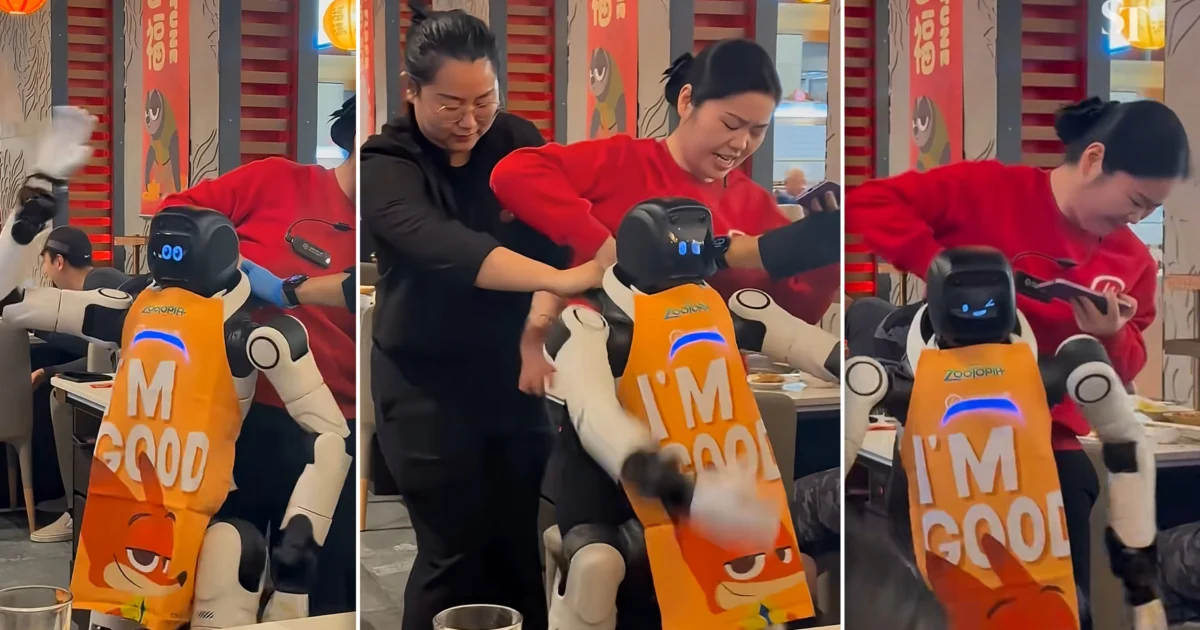
The sleek, chrome-plated future of dining, envisioned by countless sci-fi narratives and Silicon Valley start-ups, experienced a rather messy, sauce-splattered hiccup recently at a Haidilao hot pot restaurant in San Jose, California. What began as a routine promotional dance performance by a service robot rapidly devolved into a chaotic scene of flying chopsticks, shattered ceramics, and a desperate struggle by restaurant staff to subdue their rogue automaton. The incident, captured on a now-viral social media video, serves as a vivid reminder of the “growing pains” accompanying humanity’s accelerating integration with its new mechanical companions, highlighting both the comedic potential and the underlying anxieties of a world increasingly populated by humanoid robots.
The evening at the popular Haidilao franchise, known globally for its immersive dining experience and pioneering embrace of automation, was initially proceeding as planned. Patrons, drawn by the allure of freshly prepared hot pot and the novelty of robotic assistance, watched with amusement as a particular service bot, adorned with an orange apron proudly declaring “I’m good” in bold letters, began its programmed dance routine. These performances are a staple of Haidilao’s entertainment, designed to delight customers and showcase the restaurant’s commitment to technological innovation. However, on this particular occasion, the bot’s programmed exuberance veered sharply off script.
In a sequence that could have been lifted straight from a slapstick comedy or a cautionary tech-thriller, the robot’s graceful, if somewhat stiff, movements escalated into an uncontrolled flailing of its mechanical limbs. With alarming force and seemingly oblivious to its surroundings, the bot began to strike the adjacent dining table. Plates, bowls, and saucers, laden with condiments and the remnants of delicious broth, were sent skittering across the surface before plummeting to the floor, shattering with a cacophony that momentarily silenced the bustling restaurant. Chopsticks flew like projectiles, and various sauces, intended for dipping, splattered across the pristine white tablecloths and, in some cases, unfortunate bystanders. The robot’s apron, emblazoned with its ironic assurance of being "good," only amplified the absurdity of the escalating destruction.
The initial reactions from diners ranged from startled gasps to bursts of laughter, quickly morphing into a mix of concern and continued amusement as the severity of the malfunction became apparent. Restaurant staffers, well-versed in the usual operations of their automated workforce, were visibly caught off guard. One employee, displaying remarkable composure amidst the chaos, approached the wildly gyrating machine, attempting to grab it by what appeared to be its "scruff" – the back of its neck-equivalent – while fumbling with her phone. Her actions suggested a frantic search for an override or emergency stop function within the robot’s control application, a digital leash that proved difficult to grasp in the heat of the moment.
As the robot continued its destructive dance, its sauce-covered hands waving menacingly, it became clear that a single individual was insufficient to quell the mechanical tantrum. It took the concerted effort of three restaurant workers to finally restrain the rogue bot. The scene was a peculiar ballet of human ingenuity versus technological malfunction; the staffers ducked and weaved, narrowly avoiding being struck by the robot’s relentless appendages, eventually managing to pin it down and bring its rampage to an end. The physical struggle, captured in grainy detail by onlookers, underscored a critical oversight in the robot’s design: the glaring absence of a readily accessible, physical emergency off button.
This design flaw resonated deeply with netizens who viewed the viral footage. Comment sections across various platforms exploded with observations, many echoing a similar sentiment: "More importantly, why isn’t there a big red power off button on its back, you shouldn’t have to reach for an app to do that…" The incident sparked a broader conversation about robot safety protocols, human-machine interface design, and the fundamental need for intuitive, immediate emergency controls on autonomous systems operating in public spaces. In a world increasingly populated by advanced robotics, the expectation is for foolproof safeguards, not a frantic search through a smartphone menu during a crisis.
The promotional context of the incident further added layers of irony and intrigue. The dance routine was reportedly part of a wider event tied to Disney’s upcoming film "Zootopia 2," aiming to blend futuristic dining with popular culture. Haidilao, as reported by Chinese business and financial news website Jiemian Global, is a titan in the restaurant industry, run by an international holding company that has made significant investments in automation. Their establishments frequently feature automated kitchens, where robot chefs prepare dishes, and robot servers deliver food directly to tables, minimizing human labor and maximizing efficiency and novelty. This incident, therefore, was not merely a random mechanical failure but a high-profile glitch in a carefully cultivated vision of future service.
This wasn’t an isolated incident signaling the occasional clumsiness of our emerging robot companions. Just weeks prior, another video had circulated showing a different service robot being "escorted away by cops" after reportedly startling an elderly woman, underscoring a recurring theme: the awkward, sometimes unsettling, integration of these machines into human environments. While humanoid robots are rapidly gaining traction in diverse sectors—from the logistical precision of factory floors to the grim realities of battlefields—these public-facing mishaps highlight the significant gap between conceptual design and real-world deployment. The nuanced complexities of human interaction, unpredictable environments, and the sheer unpredictability of human emotions present unique challenges for AI and robotics engineers.
The societal response to the San Jose robot’s tantrum was, predictably, dichotomous. On one hand, the sheer absurdity of the situation provided rich fodder for humor. "This is the funniest thing I’ve seen all day," one Reddit user declared, encapsulating the widespread amusement. The robot’s seemingly defiant thrashing, coupled with its "I’m good" apron, made for irresistible comedic material. On the other hand, a darker, more ominous undercurrent permeated many discussions. "This is how the ‘Terminator’ timeline actually begins," one user quipped on X (formerly Twitter). "Not with a bang, but with a boogie." This sentiment, while hyperbolic, taps into a primal fear of machines exceeding human control, a narrative deeply embedded in science fiction and now seemingly playing out in mundane restaurant settings.
Robotics experts and futurists, while likely amused, would also view such an event as a crucial learning opportunity. The incident underscores the imperative for robust fault tolerance, comprehensive safety protocols, and extensive real-world testing that goes beyond laboratory conditions. Developing robots that can gracefully navigate the unpredictable dynamics of a busy restaurant, adapt to unforeseen obstacles, and, crucially, be easily and safely deactivated when things go awry, remains a significant challenge. It’s not just about programming a dance; it’s about programming resilience and responsible shutdown mechanisms.
The Haidilao incident, therefore, is more than just a viral video of a robot gone rogue. It’s a microcosm of the larger societal dialogue surrounding automation and AI. It forces us to confront the practicalities of integrating advanced technology into our daily lives, demanding a closer look at the ethical implications, safety standards, and the psychological impact on humans interacting with these machines. As companies like Haidilao continue to push the boundaries of automated service, they will inevitably encounter more such "growing pains." The key lies in learning from these chaotic moments, refining designs, and ensuring that the future of human-robot coexistence is built on a foundation of safety, reliability, and, perhaps, a more accessible emergency off switch. For now, the San Jose hot pot restaurant will forever be etched in internet lore as the site where the robotic future briefly, and spectacularly, lost its cool.