Faris Adani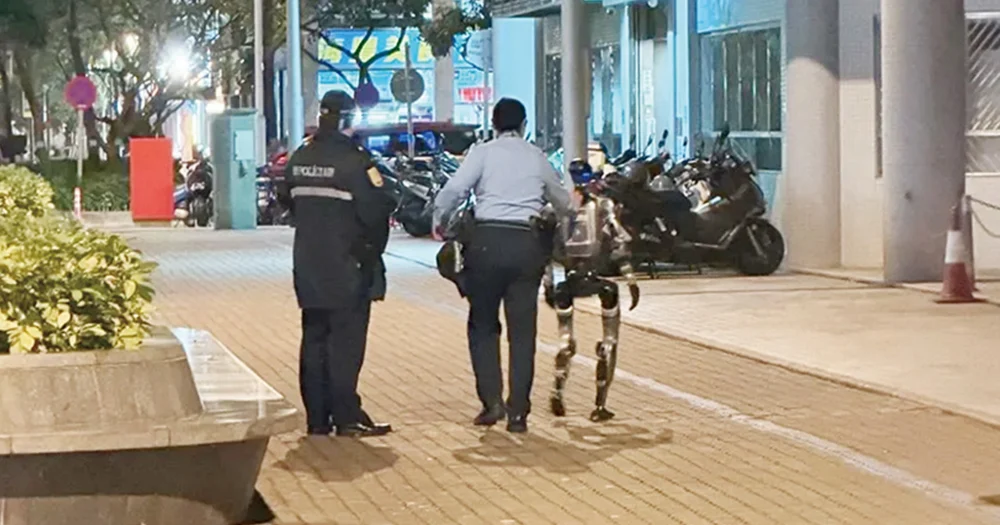
A bizarre incident unfolded recently in Macau, sparking both amusement and serious discussion across Chinese-speaking social media, when a humanoid robot was dramatically escorted away by police after allegedly startling a 70-year-old woman, leading to her hospitalization. The event, widely reported by outlets such as the Macau Post, the South China Morning Post, and public broadcaster TDM, highlights the burgeoning challenges and unexpected interactions arising as advanced robotics increasingly integrate into public spaces.
The peculiar encounter occurred last Thursday evening, around 9:00 PM, near a bustling residential complex in Patane. According to police reports, the elderly woman was engrossed in her phone, walking along the street, when she suddenly became aware of a presence directly behind her. To her profound shock, it wasn’t another pedestrian, but a metallic, bipedal humanoid robot – specifically, a Unitree G1 model – its sensors and lights undoubtedly active in the dim evening light.
The woman’s reaction was immediate and visceral. Far from being intrigued or amused by the technological marvel, she was reportedly overcome with fright. A video of the aftermath, which quickly went viral across platforms like X (formerly Twitter) and Chinese social media, captures her in a heated exchange with the silent automaton, a small crowd of curious onlookers gathering around. Reports quoted her exclaiming, “You’re making my heart race!” and further questioning, “You’ve got plenty to do, so what’s the point of messing around with this? Are you freaking crazy?” Her words paint a vivid picture of distress, suggesting a profound sense of violation or threat from the unexpected robotic presence.
In a moment that added an almost comedic layer to the unfolding drama, the Unitree G1 robot, designed with a degree of expressive capability, was observed raising both its arms. Whether this gesture was an automated attempt at an apology, a programmed response to confusion, or merely a mechanical movement interpreted as exasperation, it did little to de-escalate the woman’s agitation. The image of the robot, seemingly attempting to communicate or respond to the human’s emotional outburst, underscored the nascent and often awkward nature of human-robot interaction in uncontrolled environments.
Shortly thereafter, two police officers arrived on the scene, responding to calls about the disturbance. What followed was a spectacle that many netizens dubbed a "robot arrest" or the "silliest perp walk" ever witnessed. The officers were seen escorting the diminutive android away, one even placing a hand on its metallic shoulder – a distinctly human gesture of guidance or even apprehension applied to a machine. This visual served as a powerful metaphor for society’s initial attempts to categorize and regulate the behavior of autonomous entities.
Further investigation revealed that the robot belonged to an education center located in Macau and was being utilized for “promotional activities” in the vicinity. Police confirmed that the robot was subsequently returned to its 50-year-old operator, who was cautioned and reminded about the critical importance of exercising greater discretion and caution when deploying such advanced technology in public spaces. The incident prompted a re-evaluation of public safety protocols surrounding autonomous devices.
Towin Mak, a representative from the education center, offered an explanation to TDM, attempting to clarify the sequence of events. He stated that the incident occurred as the robot was in the process of leaving the area. According to Mak, the woman had unexpectedly paused in the middle of the walkway to check her phone. The Unitree G1, programmed perhaps for direct traversal and lacking the nuanced situational awareness of a human, simply stopped behind her, unable to navigate around the obstruction without potentially bumping into her or other obstacles. It was in this static, waiting position, with its operational lights illuminated in the late evening, that the woman first noticed it, leading to her intense fright.
While the operator’s explanation points to an accidental confluence of circumstances rather than deliberate intimidation, the impact on the elderly woman was undeniable. Following the arrival of the police, she reported feeling unwell and requested medical attention. She was transported to a local hospital for examination and treatment. Thankfully, she was discharged after a thorough assessment, with police confirming no physical contact or injuries had occurred. Despite the significant distress, she ultimately decided not to file a formal complaint, perhaps viewing the incident as an unfortunate misunderstanding rather than a malicious act.
The incident quickly became a sensation among Chinese-speaking netizens, who found the entire scenario both amusing and thought-provoking. The image of police "arresting" a robot became a source of widespread humor, leading to numerous memes and jokes. However, beneath the surface of laughter, a more serious debate began to unfold regarding the ethics and safety implications of robots operating alongside humans in shared public environments. Many users raised pertinent questions about the necessary regulatory frameworks, safety standards, and public awareness campaigns required as these technologies become more commonplace.
The Unitree G1 model, a product of Chinese robotics company Unitree Robotics, is known for its agility and advanced balancing capabilities. It’s a versatile bipedal robot designed for various tasks, from industrial inspections to research and, increasingly, public demonstrations and entertainment. Its relatively compact size and human-like gait make it less imposing than larger industrial robots, yet its sudden, silent appearance can still be jarring to the uninitiated, especially in an unexpected context. The model has indeed gained popularity for social media stunts, where its advanced movements and interactions are showcased, often blurring the lines between controlled demonstrations and public encounters. This growing trend underscores the urgent need for clear guidelines on where and how such robots can operate without causing undue alarm or potential harm.
The psychological impact of encountering a sophisticated robot unexpectedly, particularly for an elderly individual, cannot be overstated. For many older adults, technology, especially in its advanced autonomous forms, can be a source of anxiety rather than wonder. The sudden appearance of a silent, walking machine, even one designed to be non-threatening, can trigger primal fear responses, especially in low-light conditions. This incident serves as a stark reminder that the integration of robotics must not only consider technical capabilities but also human psychology, cultural perceptions, and varying levels of technological literacy across different demographics.
This incident in Macau is not isolated; it’s part of a global trend where robots are gradually moving out of factories and labs and into homes, workplaces, and public spaces. From delivery robots navigating sidewalks to security robots patrolling parks, human-robot interaction is becoming an everyday reality. However, the regulatory landscape is still playing catch-up. Most jurisdictions lack comprehensive laws specifically addressing the deployment and liability of autonomous robots in public. This incident highlights the gaps: Who is responsible when a robot causes distress? What kind of training should operators undergo? What are the requirements for public notification or visual identification of operational robots?
The police response, while somewhat unorthodox, also offers insights into how law enforcement might adapt to such novel situations. Their decision to escort the robot, even without a formal "arrest" or charges, demonstrates an attempt to de-escalate a public disturbance and manage an unusual technical-social challenge. The human touch – a hand on the robot’s shoulder – was perhaps an intuitive way to assert control and communicate to the public that the situation was being handled, albeit in a remarkably futuristic manner.
Looking ahead, this Macau incident could serve as a valuable case study for urban planners, robotics manufacturers, and policymakers. As AI and robotics continue to advance, creating machines that are increasingly sophisticated and capable of independent action, such encounters will undoubtedly become more frequent. The challenge lies in designing robots that are not only efficient and intelligent but also context-aware, socially intelligent, and capable of gracefully navigating the complexities of human society. Furthermore, public education and transparent communication about robot deployment will be crucial in fostering acceptance and minimizing unforeseen incidents. The future of human-robot coexistence hinges not just on technological prowess, but on thoughtful integration and a deep understanding of human factors.
More on robots: Body Horror Robot Turns Human Into Centaur