isnaini azizah
The trajectory of Artificial Intelligence remains a subject of intense debate, oscillating between dismissive skepticism, labeling it a fleeting fad fueled by hype and misallocated capital, and a dystopian vision of widespread job displacement and economic destabilization. Markets swing precariously between these extremes, while the technology itself hurtles forward at an unprecedented pace, attracting investment dollars not seen in decades. Amidst this volatility, a prevailing consensus among many financial and economic leaders suggests a continuation of the current economic landscape. However, a deeper dive into history and data, undertaken by Joseph Davis, global chief economist at Vanguard, and his team, offers a more nuanced perspective. Their proprietary data set, spanning 130 years, has birthed "The Vanguard Megatrends Model," a framework that posits AI as a general-purpose technology poised to significantly boost productivity, revolutionize industries, and, crucially, augment human work rather than replace it. The future, according to this research, is neither marginal nor dystopian.
"Our findings suggest that the continuation of the status quo, the basic expectation of most economists, is actually the least likely outcome," Davis asserts. "We project that AI will have an even greater effect on productivity than the personal computer did. And we project that a scenario where AI transforms the economy is far more likely than one where AI disappoints and fiscal deficits dominate. The latter would likely lead to slower economic growth, higher inflation, and increased interest rates."
Implications for Business Leaders and Workers: The Dawn of the AI Copilot
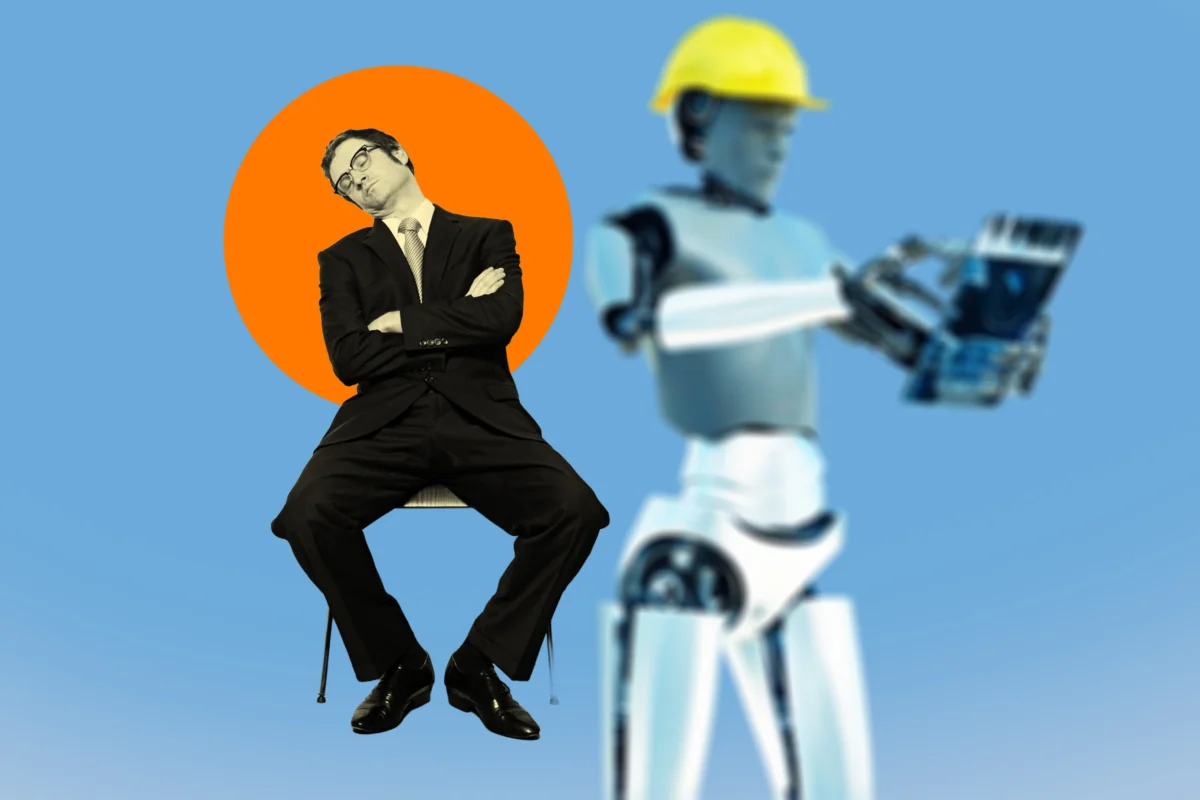
While the overarching economic outlook is positive, Davis does not shy away from the disruptive potential of AI, particularly for business leaders and knowledge workers. "AI is likely to be the most disruptive technology to alter the nature of our work since the personal computer," he states. He draws a parallel to the advent of personal computers, recalling how they didn’t eliminate jobs but rather empowered individuals to focus on higher-value activities.
The Vanguard Megatrends Model meticulously analyzed the automation risks across over 800 occupations. The research indicates that while approximately 20% of occupations face potential job loss due to AI-driven automation, the vast majority—an estimated four out of five—will experience a blend of innovation and automation. This shift will see workers increasingly dedicating their time to tasks that are more complex, strategic, and uniquely human. This heralds the rise of AI as a "copilot," adept at handling repetitive tasks and offering assistance across a spectrum of responsibilities. Davis critiques traditional economic models for their failure to adequately capture the profound structural impacts of technological change. "Most approaches for thinking about future growth, such as GDP, don’t adequately account for AI," he explains. "They fail to link short-term variations in productivity with the three dimensions of technological change: automation, augmentation, and the emergence of new industries." Automation streamlines processes, augmentation empowers human capabilities through technological partnership, and the birth of new industries generates novel avenues for economic expansion.
Economic Ripples: Addressing Productivity Lag and Demographic Headwinds
Paradoxically, Davis’s research suggests that the recent stagnation in productivity growth might stem from a deficit in automation, rather than an overabundance of it. Despite a decade of rapid advancements in digital and automation technologies, productivity growth has faltered, reaching fifty-year lows since the 2008 financial crisis. While this might seem to support the notion of AI’s marginal impact, Davis argues that automation has been misapplied. "What surprised me most was how little automation there has been in services like finance, health care, and education," he reveals. "Outside of manufacturing, automation has been very limited. That’s been holding back growth for at least two decades." The services sector, which constitutes over 60% of U.S. GDP and 80% of its workforce, has historically exhibited some of the lowest productivity growth rates. It is precisely in this sector, Davis contends, that AI is poised to make its most significant contributions.
Demographic shifts present a formidable challenge to the global economy. As the Baby Boomer generation retires, immigration slows, and birth rates decline, economies face a shrinking workforce. These demographic headwinds underscore the imperative for technological acceleration. "There are concerns about AI being dystopian and causing massive job loss, but we’ll soon have too few workers, not too many," Davis observes. "Economies like the U.S., Japan, China, and those across Europe will need to step up function in automation as their populations age."
Consider the nursing profession, where empathy and human connection are paramount. AI is already demonstrating its capacity to augment, not automate, in this field. By streamlining data entry in electronic health records, AI frees up nurses to dedicate more time to patient care. Davis estimates that such tools could boost nursing productivity by as much as 20% by 2035, a critical advancement as healthcare systems grapple with aging populations and escalating demand. "In our most likely scenario, AI will offset demographic pressures. Within five to seven years, AI’s ability to automate portions of work will be roughly equivalent to adding 16 million to 17 million workers to the U.S. labor force," Davis projects. "That’s essentially the same as if everyone turning 65 over the next five years decided not to retire." He anticipates that over 60% of occupations, including nurses, family physicians, high school teachers, pharmacists, human resource managers, and insurance sales agents, will benefit from AI as an augmentation tool.
Investor Outlook: The Rise of the AI User
As AI technology permeates the economic landscape, the most successful companies in the stock market are likely to be not its creators, but its adopters. "That makes sense, because general-purpose technologies enhance productivity, efficiency, and profitability across entire sectors," Davis explains. This widespread adoption of AI is fostering greater flexibility in investment strategies, suggesting that diversification beyond pure technology stocks may prove prudent, as highlighted in Vanguard’s Economic and Market Outlook for 2026. "As that happens, the benefits move beyond places like Silicon Valley or Boston and into industries that apply the technology in transformative ways." Historical precedent demonstrates that early adopters of new technologies reap the most substantial productivity gains. "We’re clearly in the experimentation phase of learning by doing," Davis notes. "Those companies that encourage and reward experimentation will capture the most value from AI."
Globally, Davis identifies the United States and China as frontrunners in the AI race, describing their positions as a "virtual dead heat," indicative of sustained intense competition. However, other economies, particularly those with low automation rates and substantial service sectors like Japan, Europe, and Canada, stand to gain significantly. "If AI is truly going to be transformative, three sectors stand out: health care, education, and finance," Davis emphasizes. "For AI to live up to its potential, it must fundamentally reshape these industries, which face high costs and rising demand for better, faster, more personalized services."
Vanguard’s outlook on AI’s transformative economic potential has grown more optimistic over the past year, especially as the realization dawns that true transformation hinges on its application beyond the confines of Silicon Valley. "When I speak to business leaders, I remind them that this transformation hasn’t happened yet," Davis concludes. "It’s their investment and innovation that will determine whether it does."