Imroatul Nasiyah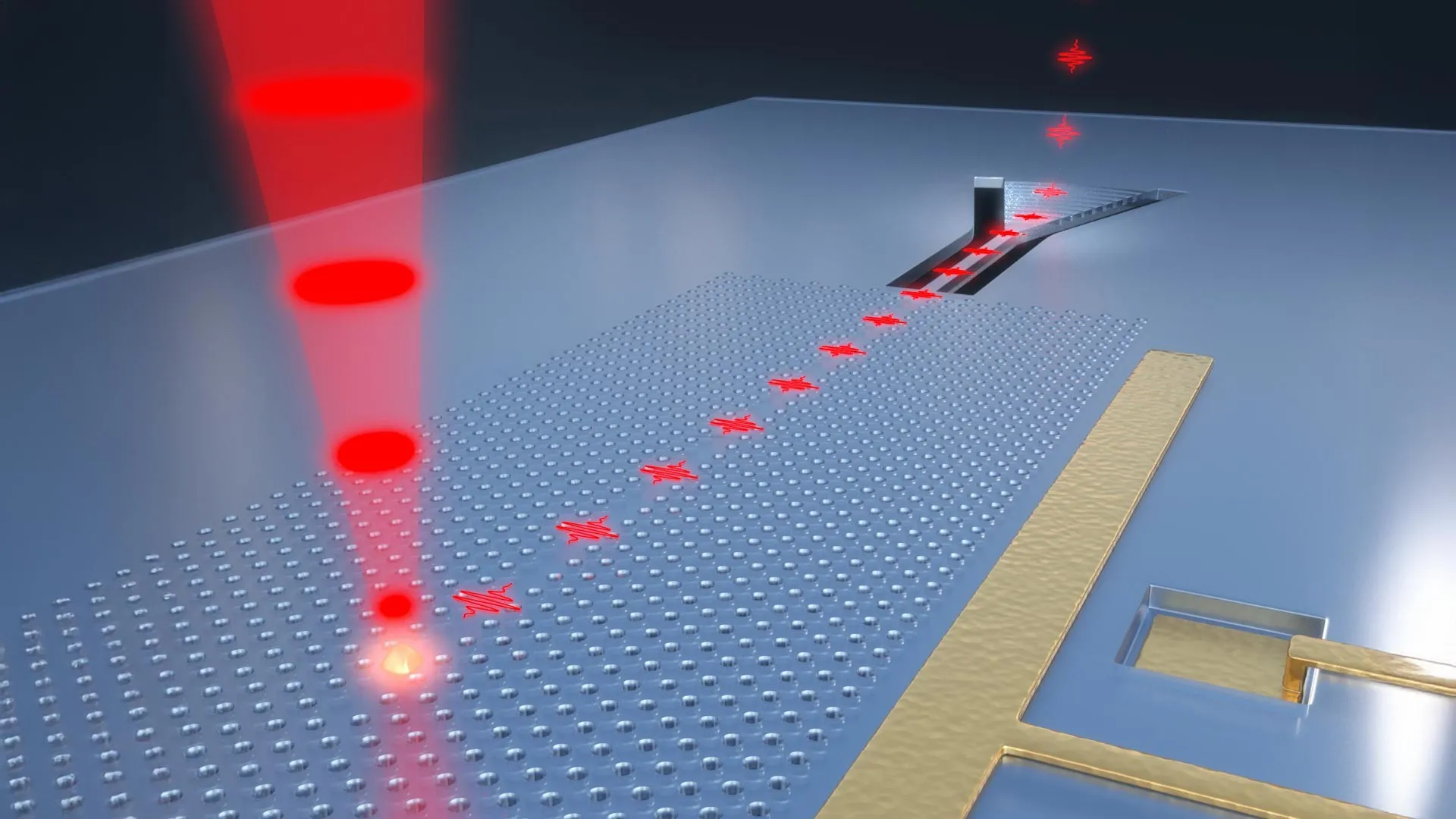
Researchers at the University of Iowa have achieved a significant breakthrough in the field of quantum optics, developing a novel technique to "purify" photons. This innovation holds immense promise for dramatically improving both the performance and security of light-based quantum technologies, addressing long-standing limitations that have hindered the advancement of optical quantum systems. By refining the very process by which single particles of light are produced, this pioneering approach aims to overcome critical obstacles that have previously impeded the reliable generation of a consistent stream of single photons, which are the fundamental building blocks for photonic quantum computers and advanced secure communication networks.
The University of Iowa team, led by Assistant Professor Ravitej Uppu and graduate student Matthew Nelson, meticulously investigated two principal impediments to generating a reliable stream of single photons. The first, known as laser scatter, presents a persistent challenge. When a laser is employed to stimulate an atom into releasing a photon, the process is not always perfectly precise. Instead, it can inadvertently produce a cascade of additional, unwanted photons. These extraneous particles act as disruptive noise within an optical circuit, analogous to how stray electrical currents can degrade the performance of conventional electronic circuits. This interference significantly diminishes the efficiency and reliability of quantum operations.
The second major hurdle arises from the inherent behavior of atoms when interacting with laser light. In certain instances, an atom can be excited to emit not just one, but multiple photons simultaneously. This multi-photon emission is problematic because quantum operations, particularly those underpinning quantum computing and secure communication, rely on the precise, sequential arrival of individual photons. When multiple photons are emitted at once, the carefully orchestrated order required for quantum computations is disrupted, as the extra photons interfere with the intended one-by-one flow of information. This breakdown in precision compromises the integrity of quantum states and the fidelity of quantum protocols.
In a remarkable turn of events, the new study by Nelson and Uppu uncovered an unexpected and powerful synergy between these two seemingly disparate problems. They discovered a deep, previously unappreciated connection: when an atom emits multiple photons, the resulting wavelength spectrum and waveform of these unwanted photons bear a striking resemblance to the characteristics of the stimulating laser light itself. This close alignment between the unwanted emissions and the laser light is the key to the purification process.
According to the researchers, this fundamental similarity provides an avenue for precise manipulation. By carefully adjusting the parameters of the laser light, it is possible to engineer a situation where the unwanted photons and the laser light are precisely out of phase with each other. This delicate balance allows for destructive interference, where the unwanted photons effectively cancel each other out. In essence, the very phenomenon that has been a persistent nuisance – laser scatter – can be ingeniously harnessed to actively suppress the emission of unwanted multi-photon events, leading to a much cleaner and purer photon stream.
"We have shown that stray laser scatter, typically considered a nuisance, can be harnessed to cancel out unwanted, multi-photon emission," states Ravitej Uppu, the study’s corresponding author. "This theoretical breakthrough could turn a long-standing problem into a powerful new tool for advancing quantum technologies." This sentiment underscores the transformative potential of their discovery, shifting the paradigm from viewing laser scatter as an unavoidable impediment to recognizing it as a controllable asset in the pursuit of pristine photon sources.
The significance of single photons for quantum computing cannot be overstated. Photonic computing, which leverages light instead of electricity to perform calculations, offers the tantalizing prospect of systems that are orders of magnitude faster and more energy-efficient than their classical counterparts. While conventional computers rely on bits – electrical or optical pulses representing binary states of one or zero – quantum computers employ qubits. These qubits can be realized by subatomic particles, with photons being a particularly promising candidate due to their speed, low interaction with the environment, and ease of manipulation.
Many leading technology companies and research institutions are investing heavily in photonic platforms, believing they will be instrumental in unlocking the full potential of quantum computing. The realization of this vision hinges on the ability to generate and control a stable, highly pure stream of single photons. An orderly and predictable photon stream is not only easier to manage and scale for complex quantum computations but also fundamentally enhances the security of quantum communication. The researchers aptly compare the controlled flow of single photons to a well-organized cafeteria line, where students are guided one at a time, versus a chaotic crowd. In this analogy, a neat, single-photon line minimizes the risk of data interception or eavesdropping, as each photon carries a distinct quantum state that can be more easily monitored and secured.
The core of the new method, as explained by Uppu, lies in the precise control of the laser beam. "If we can control exactly how the laser beam shines on an atom – the angle at which it’s coming, the shape of the beam, and so on – you can actually make it cancel out all the additional photons that the atom likes to emit," he elaborates. "We would be left with a stream that is actually very pure." This meticulous manipulation of the laser light allows for an unprecedented level of precision in photon generation, effectively "cleaning" the light source.
This theoretical work demonstrates that two major barriers to the development of faster and more robust photonic circuitry can be addressed concurrently. If this innovative technique can be successfully validated through experimental investigation, it could significantly accelerate the progress towards advanced quantum computers and the implementation of ultra-secure communication systems. The research team is already planning future experiments to put their theoretical findings to the test, aiming to translate this groundbreaking discovery from the realm of theory into practical application.
The study detailing this remarkable achievement, titled "Noise-assisted purification of a single-photon source," has been published in the prestigious journal Optica Quantum, a testament to its scientific merit and potential impact. The research was generously funded by the Office of the Under Secretary of Defense for Research and Engineering within the U.S. Department of Defense, underscoring the national interest in advancing quantum technologies. Furthermore, the project received crucial early-stage support through a seed grant from the University of Iowa Office of the Vice President for Research via the P3 program, which provided the foundational resources to launch this pioneering investigation. The convergence of academic expertise, governmental support, and institutional backing has culminated in a discovery that promises to reshape the future of quantum information science.